Back to History
the Terminology
Language both revealed and concealed the realities of Indigenous slavery. Here, words or phrases used to describe the enslaved, the enslaver, and the castas—along with other expressions that shaped colonial life—are gathered, translated, and interpreted. This glossary continues to expand as we recover voices and meanings long buried in the archive.
A CARGO DE
The phrase a cargo de (“in charge of” or “under the responsibility of”) frequently appeared in colonial Spanish legal and administrative records to denote authority over individuals or groups. When applied to Indigenous peoples, the phrase signified their subjugation to colonial officials, religious authorities, or encomenderos, ostensibly for protection and religious instruction but often resulting in exploitation.
This phrase reflected a cornerstone of colonial governance, used to formalize the forced labor systems of encomiendas, repartimientos, and missions. By assigning Indigenous individuals to the “care” of colonial institutions or landowners, the phrase both legitimized and institutionalized hierarchical systems of control. It often appeared in documentation for tribute collection, labor drafts, and missionary activities, framing coercion as paternalistic oversight.
This phrase not only reinforced colonial power structures but also served to obscure the exploitative nature of labor and tribute systems by presenting them as reciprocal or protective relationships. Indigenous peoples a cargo de an authority were systematically denied autonomy and subjected to economic and social subjugation.
Colonial records reveal the pervasive use of a cargo de, highlighting its role in sustaining systems of forced labor and dependency within the colonial framework.
Citations:
- Real Academia Española. Diccionario de la lengua española. 22nd ed., 2001. Entry on “cargo.”
- Gibson, Charles. Spain in America. Harper & Row, 1966.
- Zavala, Silvio. Los intereses particulares en la conquista de la Nueva España. El Colegio de México, 1983.
ABÁ-REROKY
The compound Guaraní term abá-reroky combines abá (“man” or “outsider”) with a verb stem meaning “to bring in” or “to lead inside,” yielding a term that connotes a person who has been taken or incorporated—often through capture. In Guaraní cultural systems, abá typically referred to non-kin, especially enemies or foreigners, and reroky signaled a process of ritualized incorporation into the community.
Prior to European colonization, Guaraní groups regularly engaged in warfare and the adoption of captives, particularly children and women, into their kinship networks. Abá-reroky likely described those who entered Guaraní society through such processes—initially subordinate, but not permanently enslaved. Over time, captives could be integrated through marriage or kinship adoption. These relationships were often marked by asymmetry, labor obligations, or symbolic inferiority, but differed substantially from European concepts of perpetual slavery.
Under colonial rule, especially in Jesuit missions, these Indigenous practices were transformed and instrumentalized. Terms like abá-reroky reflect both a pre-colonial logic of social incorporation and its gradual distortion under the pressures of conquest, forced relocation, and the labor demands of empire.
Citations:
- Antonio Ruiz de Montoya, Tesoro de la lengua guaraní . Madrid, 1639.
- Bartomeu Melià, El Guaraní Conquistado y Reducido. Asunción: CEADUC, 1986.
- Branislava Susnik, Etnohistoria de los Guaraníes: Época colonia. Universidad Católica Nuestra Señora de la Asunción, 1981.
ACHAȣE NITAÏA
The term achaȣe nitaïa appears in the Gravier-Langillier Illinois Dictionary (circa 1690), compiled by Jesuit missionary Jacques Gravier, and was later cited in Carl Masthay’s Kaskaskia Illinois-to-French Dictionary (2002). The phrase, transcribed using 17th-century French orthography, combines elements that translate approximately as “my dog/slave/domestic animal runs around.” Its layered meaning reflects how concepts of domestication, subordination, and captivity were expressed and interpreted within Indigenous languages and colonial contact zones.
In Bonds of Alliance (2012), historian Brett Rushforth analyzes this term within a broader glossary of Algonquian-language phrases connected to slavery and dependency in the French colonial world. Rushforth notes that achaȣe nitaïa encapsulates a metaphorical linkage between enslavement and domesticated animals, echoing similar patterns in French colonial usage where Indigenous or African captives were often described in terms of taming or ownership. While the original Kaskaskia Illinois context may have encoded complex relationships of kinship, labor, and dependence, its preservation through Jesuit transcription highlights the ways colonial intermediaries framed such expressions through lenses of control and hierarchy.
The presence of achaȣe nitaïa in colonial dictionaries provides rare linguistic evidence of how Indigenous peoples engaged—linguistically and socially—with systems of captivity during the early French colonial period. It underscores the adaptive, often coercively transformed, use of language to mediate slavery, and reflects the cultural and semantic convergence between Indigenous expressions of dependency and European models of ownership.
Citations:
- Gravier, Jacques. Dictionnaire de la Langue Illinois. Circa 1690.
- Masthay, Carl. Kaskaskia Illinois-to-French Dictionary. Saint Louis, MO, 2002, p. 47.
- Rushforth, Brett. Bonds of Alliance: Indigenous and Atlantic Slaveries in New France. University of North Carolina Press, 2012
ADELANTADO
The term adelantado, derived from the Spanish verb adelantar (“to advance” or “proceed”), originally referred to royal appointees granted judicial and military authority in frontier regions of medieval Spain. As the Spanish Empire expanded into the Americas, the title evolved into a powerful instrument of colonial conquest and Indigenous subjugation. In the 16th century, adelantados were entrusted with the task of “pacifying” and “settling” new territories on behalf of the Crown—authority that frequently enabled and legitimized the enslavement of Indigenous peoples.
In the Americas and beyond, adelantados wielded sweeping powers, combining civil governance, military command, and economic prerogatives. Royal grants permitted them to declare “just war” against Indigenous communities labeled as hostile, authorize enslavement through rescate ("rescue" or "ransom"), and distribute encomiendas—allocations of Indigenous labor. Their position made them central to the Crown’s strategy of territorial expansion through delegated sovereignty, particularly in frontier zones.
Prominent adelantados such as Pedro Menéndez de Avilés in Florida, Juan de Garay in the Río de la Plata region, and Miguel López de Legazpi in the Philippines used their commissions to found settlements, seize land, and systematize Indigenous servitude. The office was not merely administrative; it embedded systems of forced labor, tribute, and captivity into the architecture of colonial governance.
Though formally under royal authority, adelantados operated with significant autonomy, shaping colonial societies through private conquest that blurred the boundaries between state and personal gain. Their legacy underscores how Spanish imperialism relied on outsourced conquest and legalized violence to secure both territory and labor.
Citations:
- Cunningham, Charles Henry. "The Institutional Background of Spanish American History." Hispanic American Historical Review, Vol.1, no. 1,1918, pp. 24-39.
- Góngora, Mario. Studies in the Colonial History of Spanish America. Cambridge: Cambridge University Press, 1975.
- Himmerich y Valencia, Robert. The Encomenderos of New Spain, 1521-1555. Austin: University of Texas Press, 1991.
ADOPTED
Variations: adoptado; adopté; adoptivo
The word "adopted" refers to the legal or social incorporation of an individual, typically a child, into a household as a family member. In colonial contexts, particularly in English-speaking regions, "adopted" often carried connotations of care and protection but was also used to obscure exploitative labor arrangements. Indigenous children or marginalized individuals labeled as “adopted” frequently performed domestic or agricultural labor under conditions that mirrored servitude. This practice parallels the Spanish adoptivo, Portuguese adoptado, and French adopté, which similarly masked coercive relationships under the guise of familial ties.
Colonial records from the 17th, 18th and 19th centuries reveal how the term adopted functioned as a social and legal tool to justify the integration of Indigenous individuals into settler households. While framed as benevolent, these arrangements often stripped Indigenous children of their cultural identity and autonomy. Legal protections for such individuals were minimal, and their labor was seen as part of their supposed obligation to their adoptive family.
The linguistic and cultural implications of adopted highlight its dual role as a mechanism of assimilation and exploitation. By positioning labor within the framework of familial duty, the term served to normalize unequal power dynamics and the erasure of Indigenous identities.
Citations:
- Jacobs, Margaret D. White Mother to a Dark Race: Settler Colonialism, Maternalism, and the Removal of Indigenous Children in the American West and Australia, 1880–1940. University of Nebraska Press, 2009.
- Lindsay, Brendan C. Murder State: California's Native American Genocide, 1846–1873. University of Nebraska Press, 2012.
- Peterson, Dawn. Indians in the Family: Adoption and the Politics of Antebellum Expansion. Harvard University Press, 2017.
AGREGADO
The term agregado originates from the Spanish verb agregar, (“to attach” or “to add”). In colonial contexts, it referred to individuals who were “attached” to a household or estate under conditions that veiled the coercive and exploitative nature of their labor. These individuals, frequently Indigenous or of mixed ancestry, were bound to serve without wages, effectively rendering them dependent on the household for subsistence while being denied autonomy. The term mirrors practices in Spanish feudal systems, adapted and intensified in the colonial Americas.
The word agregado first appeared in Spanish lexicons in the early 17th century and was documented in Sebastián de Covarrubias’ Tesoro de la Lengua Castellana (1611), where it was defined as someone who is added or appended to a household or community. This definition reflects how agregados occupied an ambiguous social position—neither enslaved nor entirely free, yet bound to the authority of estate owners.
Agregados were often excluded from formal documentation of servitude, adding to their social invisibility. Their status depended entirely on the whims of their patrons, making them particularly vulnerable to abuse and exploitation. Over time, the category of agregado persisted in Latin America, evolving into systems of rural labor that maintained social hierarchies and economic dependency.
Citations:
- Bauer, Arnold J. Goods, Power, History: Latin America’s Material Culture. Cambridge University Press, 2001.
- Covarrubias Horozco, Sebastián de. Tesoro de la Lengua Castellana o Española. Madrid, 1611.
- Lockhart, James, and Stuart B. Schwartz. Early Latin America: A History of Colonial Spanish America and Brazil. Cambridge University Press, 1983.
AMO/A
The Spanish terms amo (masculine) and ama (feminine) denote “master” or “owner,” particularly within relationships of subordination or servitude. Derived from Latin amas or amator (originally meaning “one who commands or loves”) the term evolved to encode authority, control, and dominance in both domestic and institutional contexts. Antonio de Nebrija’s Gramática de la lengua castellana (1495) reflects this early breadth of meaning, defining amo as “que cría niño” (“one who raises a child”), indicating a caretaker role. However, in colonial contexts, the term quickly narrowed in meaning, becoming associated with coercive hierarchies, including slavery, encomienda, and domestic servitude.
By the 16th and 17th centuries, amo and ama were firmly embedded in the bureaucratic and ecclesiastical lexicon of the Spanish empire. These terms appeared frequently in legal documents, parish registers, wills, and censuses, often denoting individuals who exercised control over Indigenous laborers, enslaved Africans, or other subordinated persons. In this sense, amo functioned as both a legal and symbolic marker of ownership or domination, regardless of the formal status—enslaved, free, or encomienda-bound—of those under their control.
The gendered variation of the term is critical: while amo typically referred to male slaveholders or heads of households, ama was used for women who often managed domestic spaces. An ama might oversee enslaved women, wet nurses, or child servants, reflecting the layered and gendered nature of coercive labor. In some sources, ama also appears in reference to amas de leche (wet nurses), showing how reproductive and caregiving roles were enmeshed within systems of domination.
By the 18th century, major dictionaries defined amo and ama explicitly as “master” or “owner,” often with the clear implication of mastery over persons, not merely property. This linguistic crystallization further entrenched the terms within the cultural and legal architecture of colonial slavery.
Citations:
- Antonio de Nebrija. Gramática de la lengua castellana, 1495.
- Jesús García Añoveros. “El concepto de amo en el derecho indiano.” Revista de Indias, Vol. 47, no. 179, 1987, pp. 435–448.
- Real Academia Española. Diccionario de la lengua española. 22nd ed., 2001. Entry on “amo/ama.”
ANALCO
The term Analco originates from the Nahuatl language, combining atl (water), nalli (on the other side), and -co (place), meaning “place on the other side of the water.” In the colonial period, Analco was used to name neighborhoods located across a river or body of water from a city’s main urban core. These districts often housed Indigenous peoples, Afrodescendants, laborers, and other marginalized groups, reflecting and reinforcing the spatial and racial hierarchies of Spanish colonial society.
In cities such as Puebla, Guadalajara, and Santa Fe, Analco neighborhoods were typically situated across rivers or ravines from colonial centers dominated by Spanish elites. This physical separation mirrored social stratification: while the central plazas hosted cathedrals, government offices, and elite residences, Analco districts served as zones of labor, craft production, and Indigenous cultural continuity. Residents were often subject to tribute obligations, forced labor drafts, and religious oversight, yet maintained distinct identities and community practices.
Colonial authorities used urban spatial planning—including the deliberate siting of Analco districts—to concentrate and monitor Indigenous populations while integrating them into the urban economy. The term thus came to signify more than geography; it marked a locus of both colonial constraint and Indigenous endurance. Archival records often reference Analco in land disputes, labor arrangements, and jurisdictional boundaries, offering a window into how cities were structured to manage difference.
Today, former Analco neighborhoods are recognized as historic districts, their layered meanings enduring in city names, legal boundaries, and cultural memory.
Citations:
- Don, Patricia Lopes. “Franciscans, Urban Indigenous Communities, and the Social Order in Puebla, Mexico.” Ethnohistory 48, no. 1 (2001): 1–38.
- Gerhard, Peter. A Guide to the Historical Geography of New Spain. University of Oklahoma Press, 1972.
- Mundy, Barbara E. The Death of Aztec Tenochtitlan, the Life of Mexico City. University of Texas Press, 2015.
- National Park Service. “Barrio de Analco Historic District, Santa Fe, New Mexico.” Link
APPARTENANT À
The term appartenant à derives from the French verb appartenir ("to belong to" or "to be attached to"). In colonial contexts, particularly in New France, the Caribbean, and Louisiana, it was commonly used to indicate the status of enslaved or subjugated individuals, reinforcing legal and social hierarchies. The phrase appears frequently in parish registers, notarial acts, and estate inventories, often denoting ownership or dependency in relation to a settler or institution.
Its usage parallels other terms of enslavement, such as esclave and sauvage, and reflects the broader function of language in structuring colonial dominance. French legal codes, including the Code Noir (1685), provided frameworks for defining enslaved status, though appartenant à was often a de facto descriptor rather than an explicit legal term.
A documented example of appartenant à appears in an 18th-century parish record from New France (1755), which describes the burial of a young Indigenous woman as “une sauvagesse appartenant à Jean Baptiste Lafetiere,” denoting her legal or social attachment to a French settler. This usage highlights how the term functioned within the linguistic framework of colonial ownership, reinforcing the lack of autonomy afforded to Indigenous and African-descended individuals within the French colonial system.
Citations:
- Gould, Virginia Meacham. Chained to the Rock of Adversity: To Be Free, Black, & Female in the Old South. Athens: University of Georgia Press, 1998.
- Trésor de la Langue Française informatisé (TLFi). “Appartenir.” Centre National de Ressources Textuelles et Lexicales (CNRTL). Link
- Trudel, Marcel. L'esclavage au Canada français: histoire et conditions de l'esclavage. Montréal: Les Éditions Hurtubise, 2004.
APPRENTICE
Variations: Apprenti (French)
The term apprentice originates from Middle English and Old French aprentiz, derived from the Latin apprendere or apprehendere ("to learn" or "to grasp"). By the 14th century, it described individuals bound by contract to serve a master in exchange for training in a trade. In English-speaking societies, apprenticeships were a common pathway to skilled labor, though they also functioned as systems of control and dependency.
While often framed as voluntary, colonial apprenticeship systems frequently involved coercion, particularly for Indigenous children. Under laws governing orphaned or "neglected" youth, Indigenous children were placed into apprenticeships that extracted labor under the guise of vocational training. These arrangements blurred distinctions between education and servitude.
Early dictionaries reinforce this connection. Nathan Bailey’s Universal Etymological English Dictionary (1721) defines an apprentice as "one bound to serve a master for a term of years," a definition later formalized in Samuel Johnson’s A Dictionary of the English Language (1755). Colonial legal texts illustrate how apprenticeship contracts facilitated Indigenous exploitation.
Though laws evolved, apprenticeships remained a tool of Indigenous dispossession into the 19th century. The term apprentice, particularly in colonial contexts, exemplifies how European authorities framed coercive labor practices as benevolent institutions.
Citations:
- Bailey, Nathan. Universal Etymological English Dictionary. London, 1721. Link
- Johnson, Samuel. A Dictionary of the English Language. London, 1755. Link
- Melish, Joanne Pope. "Colonizing the Children: Indian Youngsters in Servitude in Early Rhode Island." Proceedings of the Colonial Society of Massachusetts, vol. 72, 2002, pp. 31–57. Link
AREMȣA
The term aremȣa originates from the Illinois language and is recorded in the Gravier-Langillier Illinois–French Dictionary (circa 1690), where it is glossed as: “chien, toute beste domestique et par mépris esclave” (“dog, all domestic animals, and, as a term of contempt, slave”). The term reflects a semantic field in which concepts of captivity, animality, and subordination were closely linked, both within Indigenous linguistic expression and through French colonial interpretation.
In Bonds of Alliance (2012), historian Brett Rushforth interprets aremȣa not as a neutral term for enslaved persons, but rather as a pejorative classification, used to mark captives as degraded or nonhuman. Like achaȣe nitaïa, it illustrates how metaphors of domestication—particularly associations with dogs and livestock—were applied to people held in bondage. This framing reinforced the colonial logic that captives were “tamed” and subordinated, a status that could be linguistically encoded and socially reproduced.
The usage of aremȣa in the French–Illinois colonial contact zone exemplifies how language became a tool of dehumanization and control. Whether used by Indigenous speakers to distinguish outsiders and captives or interpreted and institutionalized by French missionaries and traders, the term underscores the role of vocabulary in structuring and legitimizing enslavement. It also suggests how the boundaries between animality and personhood were blurred in systems of captivity, particularly when slavery was negotiated through alliance, warfare, and ritual adoption.
Citations:
- Gravier, Jacques, and Jacques Largillier. Dictionnaire Illinois-Français, circa 1690. Manuscript, Watkinson Library Special Collections, Trinity College, Hartford, Connecticut.
- Rushforth, Brett. Bonds of Alliance: Indigenous and Atlantic Slaveries in New France. University of North Carolina Press, 2012.
ARRENDATARIO
The term arrendatario refers to a tenant or leaseholder—specifically, an individual who rented land from a landowner to cultivate it independently, often within the broader domain of a hacienda. Derived from the Spanish verb arrendar ("to lease"), arrendatarios in colonial and postcolonial Latin America occupied a liminal space between formal independence and structural dependency. While they were technically free and contracted to pay rent in cash, kind, or labor, arrendatarios were frequently subject to exploitative agreements that tied them to the estate's economy and authority.
In her analysis of labor arrangements in Aguascalientes, Mexico, María Eugenia Ponce Alcocer includes arrendatarios alongside meseros, semaneros, and peones acasillados as part of a layered hacienda workforce. Arrendatarios typically resided outside the estate’s central compound and were granted access to plots of land on the hacienda for their own agricultural production. However, these tenants often depended on the hacienda for irrigation, seed, tools, or credit—conditions that facilitated the creation of long-term debts and asymmetrical power relationships.
Although arrendatarios enjoyed more autonomy than resident laborers, their access to land was revocable and contingent on the hacendado’s terms. In some regions, tenancy functioned as an informal method for retaining Indigenous or mestizo families on estate lands after the erosion of the encomienda and repartimiento systems. The rents imposed on arrendatarios—whether in cash or produce—often exceeded market value, further deepening dependency and limiting the potential for social or economic mobility.
The figure of the arrendatario reveals how landownership remained concentrated in elite hands even as colonial systems of tribute and slavery declined. By the 19th century, tenancy had become a widespread substitute for more overtly coercive systems of labor, particularly in regions undergoing liberal land reform. Yet in many cases, the power imbalance between landowner and tenant preserved the exploitative dynamics of earlier eras, especially where legal protections for tenants were weak or nonexistent.
Citations:
- Brading, D. A. Haciendas and Ranchos in the Mexican Bajío: León, 1700–1860. Cambridge University Press, 1978.
- Ponce Alcocer, María Eugenia. “El habitus del hacendado: cultura y poder en Aguascalientes, siglos XVIII y XIX.” Estudios de Historia Moderna y Contemporánea de México, no. 40, 2010.
- Van Young, Eric. Hacienda and Market in Eighteenth-Century Mexico: The Rural Economy of the Guadalajara Region, 1675–1820. University of California Press, 1981.
ARRIMADO/A
The term arrimado (feminine: arrimada) originates from the Spanish verb arrimar ("to bring close" or "to lean against"). In colonial Latin America, arrimado referred to individuals—often Indigenous—living within Spanish households, missions, or estates under conditions of dependency and coerced labor. While not legally enslaved, arrimados occupied a marginal status, with their autonomy significantly restricted.
Historical records from the 16th century indicate that arrimado was used in baptismal registers, administrative documents, and mission records to classify Indigenous individuals reliant on Spanish patrons. The term often served to obscure exploitative labor relationships, presenting them as charitable or reciprocal arrangements.
The Diccionario de la lengua española by the Real Academia Española defines Arrimado as "persona que vive en casa ajena, a costa o al amparo de su dueño, ("a person who lives in another's house, at the expense or under the protection of the owner"). This definition underscores the dependency inherent in the term.
By labeling Indigenous dependents as arrimados, colonial authorities and landowners legitimized forced proximity and labor, embedding the term within broader mechanisms of Indigenous subjugation.
Citation:
- Real Academia Española. Diccionario de la lengua española. 22nd ed., 2001. Entry on “arrimado.”
ASISTENTA
The term asistenta derives from the Spanish verb asistir (“to assist” or “to attend”). In colonial Latin America, it referred to a woman—often Indigenous or of mixed ancestry—who performed domestic labor for a household without residing in it. These women typically cleaned, cooked, cared for children, or laundered clothes. Although the term suggests voluntary service, it frequently masked coercion and dependency, particularly where labor was extracted through tribute obligations or informal pressure.
The Diccionario de la lengua española (Real Academia Española, 1780) defines asistenta as “mujer que sirve en una casa sin residir en ella” (“a woman who serves in a house without residing in it”). This definition reflects the social ambiguity of the role: neither resident servant nor autonomous laborer, and often lacking contractual protections or legal recognition.
Historians of colonial Latin America have shown that Indigenous women played a vital but often invisible role in sustaining urban households. The use of the term asistenta helped obscure this structural dependency by framing domestic labor as mere assistance rather than acknowledging its economic and social significance.
Citations:
- Graubart, Karen B. With Our Labor and Sweat: Indigenous Women and the Formation of Colonial Society in Peru, 1550–1700. Stanford University Press, 2007.
- Kellogg, Susan. Law and the Transformation of Aztec Culture, 1500–1700. University of Oklahoma Press, 1995.
- Real Academia Española. Diccionario de la lengua española. 1780. Entry on “asistenta.”
ATSIYATSI
The Cherokee term atsiyatsi is commonly translated as “slave” and appears in the Cherokee–English Dictionary compiled by Durbin Feeling and others. Historically, the word was used within Cherokee communities to describe individuals held in captivity or servitude. While the term maps onto the English word “slave,” its meaning must be understood within the specific cultural, historical, and linguistic context of Cherokee society.
In pre-contact and early colonial eras, captives were often taken during warfare or inter-tribal conflict. Some were adopted and incorporated into Cherokee families, while others remained in dependent or servile roles. These practices were shaped by complex kinship structures, spiritual beliefs, and community needs. With the expansion of European colonization and the influence of the transatlantic slave trade, Cherokee forms of captivity evolved to include the enslavement of African individuals. Over time, Cherokee elites increasingly adopted forms of chattel slavery modeled on those of Euro-American plantation societies, especially in the 18th and 19th centuries.
The term atsiyatsi reflects this transformation. It came to signify a person who was unfree, often marked by racial difference and hereditary status. Yet it retained linguistic and cultural echoes of older Cherokee frameworks, where captives could be integrated, adopted, or symbolically reclassified. Understanding atsiyatsi thus requires attending to the shifting meanings of captivity, race, and belonging across time.
Citations:
- Feeling, Durbin and William Pulte, et al. Cherokee-English Dictionary. Cherokee Nation, 1975.
- Perdue, Theda. Slavery and the Evolution of Cherokee Society, 1540–1860. University of Tennessee Press, 1979.
AUCA
Variations: Aucae
The term auca was used during the Spanish colonial period in Chile to refer to Indigenous peoples, particularly the Mapuche, who resisted Spanish domination. Derived from the Quechua word awqa ("enemy" or "rebel"), the term was adopted by Spanish colonizers to label the Mapuche as adversaries in legal and administrative documents. This designation portrayed the Mapuche as rebellious and barbaric, providing a rationale for their subjugation and enslavement.
In the 17th century, Spanish authorities implemented legal frameworks that facilitated the enslavement of Indigenous peoples labeled as aucas. For instance, a 1608 decree legalized the enslavement of Mapuche captured in war, classifying them as apostates from Christianity and thus justifying their bondage. This legal infrastructure enabled Spanish colonists to circumvent restrictions on Indigenous slavery by framing their actions as responses to rebellion or warfare.
The popularization of the related term Araucano, as used by Alonso de Ercilla y Zúñiga in his epic poem La Araucana, further entrenched this colonial construct, blending the myth of the noble savage with narratives of rebellion and savagery. This reinforced the colonial perception of the Mapuche as perpetual enemies, thus legitimizing their continued exploitation under the guise of pacification.
The term auca reflects the colonial strategy of using language to dehumanize and control Indigenous populations. By categorizing resistance to colonization as criminal or rebellious behavior, Spanish authorities rationalized systems of forced labor and assimilation imposed upon the Mapuche people.
Citations:
AWAKAAN
Variations: Aouakan; Ouackan
The term awakaan originates from the Anishinaabe language, specifically Ojibwe, and carries meanings such as “domestic animal,” “pet,” “captive,” or “slave.” Historian Brett Rushforth notes that Anishinaabe speakers used awakaan to describe both enslaved individuals and domesticated animals, illustrating a conceptual link between captivity and ownership embedded in language. Variations of the term appear in some of the earliest French lexicons of central Algonquian languages, reinforcing its historical use and cross-cultural visibility.
French Jesuit Louis Nicolas (1672–1674) recorded the variant aouakan, defining it as “slave or prisoner of war.” Later, Baron de Lahontan, who lived among the Anishinaabe at Michilimackinac and Sault Sainte Marie, listed Ouackan as the term for “slave.” These records suggest that awakaan was recognized by both Indigenous speakers and colonial observers as a designation for captives held in servitude.
Within Anishinaabe society, individuals referred to as awakaan were often taken during intertribal warfare and assigned roles in domestic labor or subordinate positions. While some captives were eventually adopted and integrated into kin networks, others remained in constrained or dependent roles, reflecting their diminished autonomy. The dual usage of awakaan to refer to both captives and animals signals a culturally specific framework in which enslavement was linked to ownership and control.
European colonial systems introduced further complexity to Anishinaabe captivity practices, often reinforcing or reshaping existing systems of coercion. The intersection of Indigenous and colonial frameworks contributed to evolving forms of displacement, subjugation, and labor exploitation.
Citations:
- Lahontan, Louis-Armand de Lom d'Arce, Baron de. Voyages du Bon de Lahontan.
- Nichols, John D., and Earl Nyholm. A Concise Dictionary of Minnesota Ojibwe. University of Minnesota Press, 1995.
- Nicolas, Louis. L'algonquin au XVIIe siècle: une édition critique, analysée et commentée de la grammaire algonquine du Père Louis Nicolas. Sainte-Foy, Quebec, 1994.
- Rushforth, Brett. Bonds of Alliance: Indigenous and Atlantic Slaveries in New France. University of North Carolina Press, 2012.
AWOKANAK
The term awokanak is a Cree exonym historically applied to certain Athapaskan-speaking peoples, particularly groups later identified as the Slavey (Dene) in the Mackenzie River basin. In Cree usage, awokanak meant “slaves” or “captives,” a designation reflecting intertribal conflict and the practice of taking war captives for labor, adoption, or exchange. Though not originally a self-identifier, the term was eventually adopted by European traders, missionaries, and administrators who transliterated it into labels such as “Slave” and “Slavey,” which persist as colonial ethnonyms.
Within Cree society, captives could be ritually adopted into kin groups or held in subordinate roles, particularly in the context of fur trade alliances and territorial expansion. The term awokanak thus marked individuals or groups perceived as socially and politically subordinate—those who could be, or had been, incorporated into Cree households under varying terms of dependence.
European colonial systems layered additional meanings onto the term. Traders and settlers often assumed that awokanak referred to a stable, ethnic group rather than a flexible status marker shaped by conflict and alliance. Over time, awokanak became a fixed external label, obscuring its original function and contributing to the racialization of Indigenous captives through Euro-Canadian legal and administrative language.
The history of Awokanak illustrates how Indigenous terms of subjugation could be appropriated, reinterpreted, and institutionalized by colonial regimes. It also underscores the importance of distinguishing between external naming and self-identification, especially in the context of terms rooted in power asymmetries.
Citations:
- Helm, June. “The Nature of Dogrib Sociopolitical Groups.” American Anthropologist , Vol. 67, no. 5, 1965, pp. 1307–1326.
- Hodge, Frederick Webb, ed. Handbook of American Indians North of Mexico. Washington: Smithsonian Institution, 1910.
- McClellan, Catharine. Part of the Land, Part of the Water: A History of the Yukon Indians. Vancouver: Douglas & McIntyre, 1987.
- The Canadian Encyclopedia. Entry on “Slavey.” Link
BANDEIRANTES
The term bandeirantes, derived from the Portuguese word bandeira (“flag” or “banner”), refers to participants in privately organized expeditions that ventured into the interior of Brazil from the 16th through the 18th centuries. Once mythologized as pioneers of national progress and territorial expansion, bandeirantes are now widely recognized as violent agents of enslavement, particularly of Indigenous peoples, and central actors in the consolidation of Portuguese colonial domination.
Originating primarily in the region of São Paulo, many bandeirantes were mamelucos (of mixed Portuguese and Indigenous ancestry). They organized raids into Indigenous territories in search of captives, gold, and other extractive opportunities. The bandeiras enslaved tens of thousands of Indigenous people—many forcibly taken from Jesuit missions, whose priests often resisted such incursions—and transported them to coastal plantations, urban households, and later, interior mining zones. These expeditions also played a key role in hunting down fugitive Africans living in quilombos, reinforcing a racially stratified labor regime.
Though the Portuguese Crown initially discouraged such incursions due to the territorial limits established by the Treaty of Tordesillas (1494), the actions of the bandeirantes helped redraw the de facto borders of the Portuguese empire in South America. This territorial encroachment was rationalized through Catholic and imperial ideologies, framing the bandeirantes as instruments of Christianization and civilization.
By the late 17th century, many bandeirantes shifted toward mineral extraction, particularly during Brazil’s gold rush. Yet their enduring historical significance lies in their role in shaping systems of forced labor, displacement, and Indigenous destruction. Their legacy remains deeply contested in Brazilian memory and historiography, symbolizing both expansion and exploitation.
Citations:
- Hemming, John. Red Gold: The Conquest of the Brazilian Indians. Harvard University Press, 1978.
- Metcalf, Alida C. Go-betweens and the Colonization of Brazil, 1500–1600. University of Texas Press, 2005.
- Monteiro, John Manuel. Negros da Terra: Índios e Bandeirantes nas Origens de São Paulo. Companhia das Letras, 1994.
BÁRBARO/A
Variations: Indios Bárbaros
The term bárbaro (feminine: bárbara), rooted in the Greek bárbaros (“foreigner,” “non-Greek speaker”), evolved in Latin and Spanish to signify “uncivilized,” “savage,” or “primitive.” In classical contexts, it marked linguistic and cultural difference; by the early modern period, it had hardened into a term of exclusion and contempt. Within the Spanish colonial world, bárbaro became a powerful label used to describe Indigenous and African peoples who resisted Christianization or imperial rule.
In the Relaciones Geográficas (1577–1585), Spanish officials used bárbaros to characterize groups such as the Chichimeca in northern Mexico—depicted as nomadic, lawless, and hostile to Catholic norms. The term justified military campaigns of “pacification,” forced resettlement, and enslavement. Similar patterns occurred in the Andes, Chile, and the Amazon, where bárbaro was invoked against Indigenous groups viewed as unincorporated or rebellious.
Legal discourse reinforced this dehumanization. While baptized Indios were protected under laws of the Indies, those deemed bárbaros were excluded from such protections, often classified as suitable for enslavement under the rationale of “just war.” Lexicographic sources such as the Diccionario de Autoridades (1737) defined bárbaro as one “living without laws or Christian customs,” reflecting the moral and civilizational hierarchy underpinning colonial governance.
The use of bárbaro thus helped naturalize colonial violence. It framed resistance as evidence of savagery and nonconversion as a failure of reason, paving the way for dispossession, captivity, and cultural erasure across the Spanish Americas.
Citations:
- Owensby, Brian P. Empire of Law and Indian Justice in Colonial Mexico. Stanford University Press, 2008.
- Pagden, Anthony. The Fall of Natural Man: The American Indian and the Origins of Comparative Ethnology. Cambridge University Press, 1982.
- Real Academia Española. Diccionario de Autoridades. 1737.
- Weber, David J. Bárbaros: Spaniards and Their Savages in the Age of Enlightenment. Yale University Press, 2005.
BÁYODŽĪN
The Navajo (Diné) term báyodžīn historically referred to the Paiute people, a neighboring Indigenous group in the American Southwest. By the late 19th century, this term had also come to mean “slave,” reflecting the evolving dynamics of intertribal conflict, captivity, and colonial pressures in the region. The shift in meaning highlights the ways in which Indigenous and colonial systems of enslavement intersected over time.
Linguistically, báyodžīn appears in historical records such as An Ethnologic Dictionary of the Navaho Language (1910) by the Franciscan Fathers, where it is documented as both an ethnonym and a term for subjugation. While more recent Navajo-English dictionaries, such as those by C. Leon Wall and William Morgan, do not include báyodžīn, its historical usage suggests that it played a role in Navajo conceptions of captivity and social hierarchy. Further linguistic analysis is needed to determine whether it remains in contemporary usage or has fallen out of common speech.
The transformation of báyodžīn from an ethnic identifier to a synonym for “slave” mirrors broader patterns seen in Indigenous languages, where words for rival groups were sometimes repurposed to denote captives or enslaved individuals. This semantic shift reflects not only intertribal relations but also the lasting impact of Spanish, Mexican, and American policies that influenced Indigenous captivity practices.
Citations:
- Franciscan Fathers. An Ethnologic Dictionary of the Navaho Language. St. Michaels, Arizona, 1910.
- Iverson, Peter. Diné: A History of the Navajos. University of New Mexico Press, 2002.
- Young, Robert W., and William Morgan. The Navajo Language: A Grammar and Colloquial Dictionary. University of New Mexico Press, 1980.
BË-GO
Variations: Bego; m'bego
The Otomi term bë-go translates to "slave" in English and is composed of bë ("person"), and go ("bought" or "purchased"). The term thus literally means "bought person," highlighting the commodification and loss of autonomy experienced by those subjected to enslavement. This linguistic construction provides a direct reflection of the socio-economic realities faced by Indigenous peoples, particularly during the colonial period.
The Otomi, an Indigenous group native to central Mexico, were significantly impacted by systems of forced labor and slavery introduced during the Spanish colonial era. The term bë-go was used to describe individuals who had been enslaved, often through acts of war, trade, or as punishment for perceived offenses. These individuals were subjected to labor in mines, haciendas, or as domestic servants. The Otomi were both victims of enslavement by Spanish colonizers and participants in Indigenous systems of captivity that predated European arrival.
The use of bë-go reflects the intersection of pre-Hispanic practices of captivity and the colonial systems of chattel slavery. Under colonial influence, the Otomi people’s practices of capturing or holding individuals were reshaped to align with European models of enslavement, where captives became commodities in an exploitative economic system. The term encapsulates the experience of those who were stripped of their autonomy and humanity through these systems.
Citations:
- Hernández Cruz, Luis, and Moisés Victoria Torquemada. Diccionario del hñähñu (otomí) del Valle del Mezquital. SIL Mexico, 2014.
- Neve y Molina, Luis de. Diccionario y Arte de la Lengua Othomí. 1767. FAMSI.
- Urbano, Alonso. Arte breve de la lengua otomí. 1605. Archive.org.
BËNÍ
The Otomi term bëní translates directly to "slave" or "enslaved person" in English. Derived from bë, meaning "person," and ní, meaning "enslaved" or "captured," the word signifies an individual subjected to forced labor or captivity. Within the context of Otomi society and colonial subjugation, bëní represents a stark reality for many Indigenous peoples who were forcibly deprived of their autonomy and subjected to servitude.
Historically, the Otomi people—native to central Mexico—were significantly impacted by systems of enslavement, both before and during the Spanish colonial period. While pre-Hispanic forms of captivity existed, where captives might be incorporated into communities, the arrival of Spanish colonizers introduced chattel slavery and a commodified view of human labor. Indigenous peoples labeled as bëní were often forced to work in mines, haciendas, or as domestic laborers, sometimes being baptized under terms like “pertenece a” in church records.
The linguistic construction of bëní captures the intersection of identity, loss of autonomy, and cultural resilience. As a marker of enslavement in the Otomi language, it encapsulates a history of exploitation that persisted despite resistance and adaptation by the Otomi people.
Citations:
- Hernández Cruz, Luis, and Moisés Victoria Torquemada. Diccionario del hñähñu (otomí) del Valle del Mezquital. SIL Mexico, 2014.
- Neve y Molina, Luis de. Diccionario y Arte de la Lengua Othomí. 1767. FAMSI.
- Urbano, Alonso. Arte breve de la lengua otomí. 1605. Archive.org.
BOÇAL
The term boçal (Spanish: bozal) was used in both Portuguese and Spanish colonial contexts to designate newly arrived enslaved Africans who had not yet been baptized, assimilated, or taught the dominant colonial language. Originating from the Spanish bozal, meaning “muzzled” or “untrained,” the term was metaphorically extended to human beings to signify their perceived lack of linguistic, cultural, or religious “civilization.” In Portuguese America, boçal became a legal and social category central to the racialized hierarchies of enslavement.
In Brazil, escravos boçais were contrasted with ladinos—enslaved Africans or Afro-descendants who spoke Portuguese and had lived within colonial society. Boçais were often considered more difficult to manage, more resistant to Christianization, and more prone to rebellion. As a result, they were frequently subjected to harsher labor conditions and deeper social isolation. Their inability (or refusal) to speak Portuguese marked them as outsiders, a condition that colonial elites used to justify their marginalization and surveillance.
Although boçal was primarily applied to African captives, particularly those arriving through the transatlantic trade from Angola or the Bight of Benin, its use reflects a broader colonial logic: that linguistic and cultural difference signaled inferiority and justified coercion. It functioned as both a racial and epistemological category, reducing individuals to a status of “uncivilized” and marking them as nonpersons in legal and social discourse.
While boçal was not typically used to describe Indigenous captives, the conceptual structure it represented—of othering through language, perceived savagery, and non-Christian status—echoes Iberian terms applied to Native peoples, such as infiel, gentil, or bárbaro. In this sense, boçal illuminates the shared colonial strategies of classification and control that cut across African and Indigenous experiences of bondage.
Citations:
- Conrad, Robert Edgar, ed. Children of God’s Fire: A Documentary History of Black Slavery in Brazil. Penn State University Press, 1994.
- Florentino, Manolo. Em costas negras: Uma história do tráfico de escravos entre a África e o Rio de Janeiro. São Paulo: Companhia das Letras, 1993.
- Klein, Herbert S., and Francisco Vidal Luna. Slavery in Brazil. Cambridge University Press, 2009.
- Sweet, James H. Recreating Africa: Culture, Kinship, and Religion in the African-Portuguese World, 1441–1770. University of North Carolina Press, 2003.
BONDSERVANT
The term bondservant originates from the Old English word bonda (a tenant farmer or someone bound by duty) and Middle English servaunt, derived from Latin servire (to serve). Combined, it refers to a person legally or coercively bound to labor under the authority of another, often for an indefinite or specified term. While frequently associated with European indentured servitude, bondservant was also applied to Indigenous peoples in English-speaking colonies to obscure their enslavement and forced labor.
During King Philip’s War (1675–1678) in New England, Indigenous captives, primarily Wampanoag, Nipmuc, and Narragansett individuals, were labeled as bondservants in colonial records. These captives were sold into English households under labor agreements that masked their indefinite and often hereditary servitude. Unlike European indentured servitude, Native bondservants had few, if any, legal avenues to obtain freedom, and their children frequently inherited their status.
The use of bondservant in colonial governance provided a legal and moral pretext for the exploitation of Indigenous labor in domestic and agricultural settings. By substituting bondservant for slave, colonial authorities legitimized coercion, dispossession, and systemic violence against Native peoples, ensuring their continued subjugation under legal frameworks that denied them autonomy.
Citations:
- Jennings, Francis. The Invasion of America: Indians, Colonialism, and the Cant of Conquest. University of North Carolina Press, 1975.
- Newell, Margaret Ellen. Brethren by Nature: New England Indians, Colonists, and the Origins of American Slavery. Cornell University Press, 2015.
- Oxford English Dictionary, s.v. "bondservant," accessed January 2025, https://www.oed.com.
BOYERO
The term boyero refers to an oxherd or cattle driver, historically responsible for managing oxen used in agriculture and transport. In colonial Latin America, boyeros were essential laborers in rural economies, particularly on haciendas and estates, where oxen played a central role in plowing fields and hauling goods. However, the role of boyeros was deeply entangled in coerced labor systems, as many were Indigenous or African-descended individuals subjected to debt peonage, encomienda, or outright enslavement.
While boyero could describe a general agricultural worker, it frequently appeared in legal and economic records in contexts suggesting servitude. Colonial authorities and landowners relied on boyeros for the transportation of goods between estates and markets, often under exploitative conditions that ensured their dependency and subordination. Documents from Spanish colonial administrations indicate that many boyeros had little agency in their labor arrangements, working under contracts that left them bound to haciendas for extended periods or for life.
The term boyero illustrates how colonial labor systems functioned by embedding coercion within agricultural and transportation roles. By controlling access to land, wages, and mobility, colonial authorities maintained a structured system of subjugation that ensured boyeros remained indispensable yet unfree laborers in the colonial economy.
Citations:
- Bauer, Arnold J. Colonial Spanish America: A Documentary History. Lanham: Rowman & Littlefield, 1998.
- Ponce Alcocer, María Eugenia. “El habitus del hacendado: cultura y poder en Aguascalientes, siglos XVIII y XIX.” Estudios de Historia Moderna y Contemporánea de México, no. 40, 2010, pp. 5–35.
- Real Academia Española. Diccionario de la lengua castellana. Madrid: Imprenta Real, 1770. “Boyero.”
BÜHM Y-ANI
Variations: Büh-m-yani
The Otomí term bühm y-ani directly translates to "slave" in English, as documented in linguistic studies of the Hñähñu (Otomí) language. The term appears in the Diccionario Otomí ( Otomí Dictionary), where it is explicitly defined as "esclavo" (slave). It combines bühm, potentially denoting a relational or descriptive element, and y-ani, which refers to a state of being or condition. This term linguistically encodes the lived reality of enslavement, reflecting both pre-Hispanic and colonial systems of forced labor.
While Otomí society may have had systems of captives or servants prior to colonization, the Spanish arrival introduced a more rigid and exploitative framework of slavery. Enslavement of Otomí individuals, often through debt, coercion, or warfare, became widespread under Spanish colonial rule. The documentation of bühm y-ani in the Diccionario Otomí highlights its historical significance, offering a linguistic lens into the systems of oppression faced by the Otomí during this period.
The term further underscores the resilience of Otomí language and culture, as it preserves and reflects the historical context of colonization and the imposition of new forms of exploitation.
Citations:
- Barabas, Alicia M. Diálogos con identidades: El patrimonio cultural de los pueblos indígenas de México. México: INAH, 2008.
- López, Jacinto, and Higinio Vaquero. Diccionario Otomí–Español. México: Instituto Lingüístico de Verano, 1972.
- Lastra, Yolanda. Los Otomíes: Su lengua y su historia. México: UNAM, Instituto de Investigaciones Antropológicas, 2001.
CABALLERO
Variations: Cavallero, Cabayero
Translated: Knight, soldier, horseman, and gentleman
The Spanish term caballero, derived from caballo (“horse”), originally denoted a mounted soldier or knight in medieval Iberia. As horses were both costly and symbolic of military prestige, the word quickly came to represent a privileged social class—those who possessed the resources and status to maintain cavalry service. Over time, caballero evolved to signify not only a horseman but also a person of honor, nobility, and leadership, rooted in ideals of chivalry and elite governance.
In the colonial Americas, caballero retained its association with rank and distinction, frequently used to describe elite men of European descent who held land, political office, or encomiendas. These individuals played a prominent role in administering colonial systems and, while the term itself did not explicitly signify an enslaver, caballeros often exercised authority over laboring populations—Indigenous, African, and mixed-race—through formal and informal systems of coercion. Their social identity was deeply intertwined with structures that enabled and benefited from forced labor.
Legal and administrative records sometimes referenced caballeros as figures with jurisdiction over towns, missions, or rural estates, where they oversaw tribute, repartimiento, or servitude. Their elevated status often functioned as justification for access to Indigenous labor, reinforcing the hierarchical logic of colonial rule. Even when couched in the language of virtue or honor, caballero operated as a category of power rooted in inequality.
Culturally, the term became aspirational—a symbol of refinement and civic authority. Yet this image of the caballero as a dignified leader masked the exploitative foundations of colonial society. The ideals it invoked were inseparable from systems of domination that privileged the few while subordinating the many.
Citations:
- Nebrija, Antonio de. Gramática de la lengua castellana. 1495.
- Owensby, Brian Philip. Empire of Law and Indian Justice in Colonial Mexico. Stanford University Press, 2008.
- Real Academia Española. Diccionario de la lengua española. 22nd ed., 2001. Entry on “caballero.”
CALIDAD
The term calidad, derived from the Latin qualitas (“quality”), signified a person’s essence, status, and social standing in the Spanish empire. More than a neutral descriptor, calidad functioned as a classificatory tool within a deeply racialized and hierarchical society. It encompassed notions of racial ancestry, legitimacy, occupation, geographic origin, and honor—all of which shaped a person’s access to rights, protections, and punishments.
As María Elena Martínez has shown, calidad operated at the intersection of limpieza de sangre (purity of blood) and religious, gendered, and social expectations. It was central to the sistema de castas, where categories such as mestizo, castizo, coyote, or genízaro were deployed not only to describe but to assign political, legal, and moral value. Ecclesiastical and civil records—marriage investigations, baptisms, court rulings—are filled with references to calidad, which influenced everything from labor duties to legal penalties.
Historian Ramón A. Gutiérrez has documented how courts used calidad to determine moral character and legal outcomes. In an 18th-century Santa Fe case, an ecclesiastical judge favored a woman of Spanish calidad over her rival, citing her noble lineage, reputation, and racial status as decisive factors. The same logic routinely justified harsher punishments for Indigenous and mixed-race individuals, including corporal penalties that were forbidden for Spaniards.
Though not synonymous with slavery, calidad was a flag of inequality. It structured governance in the Americas by codifying difference—creating gradations of legal personhood that shaped who could be enslaved, who was subject to forced labor, and who retained access to honor, protection, or redemption.
Citations:
- Gutiérrez, Ramón A. When Jesus Came, the Corn Mothers Went Away. Stanford University Press, 1991
- Martínez, María Elena. Genealogical Fictions: Limpieza de Sangre, Religion, and Gender in Colonial Mexico. Stanford University Press, 2008.
- Real Academia Española. Diccionario de la lengua española. 22nd ed., 2001. Entry on “calidad.”
CAPATAZ
The Spanish term capataz, derived from the Latin caput (“head”), historically referred to a labor overseer responsible for supervising workers, particularly within colonial and postcolonial systems of coercion. In the Americas, the capataz served as an intermediary figure between landowners, administrators, or religious officials and the laboring population—whether enslaved, Indigenous, or bound by debt. The term was used across a range of contexts, from haciendas and obrajes (textile workshops) to missions, mines, and construction projects.
The capataz exercised authority on a daily basis, ensuring productivity and discipline, and was often tasked with distributing food, assigning tasks, and enforcing punishments. In many cases, capataces were selected from within the ranks of the laboring class itself—particularly among Indigenous men, people of African descent, or individuals of mixed heritage—positioning them uneasily between domination and complicity. This dynamic could lead to both resentment and limited privilege, as capataces navigated a role that extended colonial hierarchies into the intimate spaces of labor control.
The authority of the capataz was central to maintaining the extractive economies of the Spanish Empire and its successors. Whether in missions where Indigenous neophytes were confined under spiritual pretexts or in Andean mining centers where draft labor (mita) regimes operated, capataces enforced schedules, quotas, and punishments. Their presence also reinforced the racialized segmentation of labor, distinguishing elite command from subordinate supervision.
Linguistically, capataz signifies not only control but delegated enforcement—a hallmark of colonial systems that relied on stratified intermediaries to govern vast and diverse labor populations. Its persistence in modern rural Latin America reflects the enduring legacy of these social and economic structures.
Citations:
- Burns, Kathryn. Colonial Habits: Convents and the Spiritual Economy of Cuzco, Peru. Duke University Press, 1999.
- González-Ripoll, Mª del Carmen. “El capataz negro en el ingenio azucarero cubano.” Revista de Indias, Vol. 60, no. 218, 2000, pp. 547–580.
- Real Academia Española. Diccionario de la lengua española. 22nd ed., 2001. Entry on “capataz.”
CAPITÃO DO MATO
The term capitão do mato, Portuguese for “captain of the bush,” referred to individuals assigned to track down and recapture enslaved people who had escaped bondage. First emerging in the 17th century in colonial Brazil, capitães do mato (plural) operated in rural and forested areas where runaway enslaved Africans and Indigenous people sought refuge. These figures worked either independently or under contract from plantation owners and local authorities, forming a critical component of the enforcement infrastructure that sustained racialized slavery in Brazil.
According to the Dicionário Infopédia da Língua Portuguesa, a capitão do mato was “indivíduo que era encarregado de recapturar os escravos fugitivos, escondidos no mato” (“an individual tasked with recapturing fugitive slaves hiding in the bush”). Their role was defined by coercion and violence: they often used dogs, firearms, and physical force, and became symbols of terror within enslaved communities. While most were of European descent, some capitães do mato were themselves of African, Indigenous, or mixed ancestry, coerced or enlisted into roles that complicated their social position.
As the institution of slavery became further embedded in Brazil’s political and economic systems, the function of capitão do mato was gradually institutionalized into municipal policing structures, particularly in regions with high rates of resistance and escape. Their role was especially prominent in areas such as Bahia, Minas Gerais, and Pernambuco, where quilombos (maroon communities) formed and endured in defiance of colonial control.
The term encapsulates the militarized enforcement of slavery, highlighting the extent to which colonial and imperial regimes relied on surveillance, terror, and intermediaries to suppress autonomy. Capitães do mato not only enforced property claims over people but helped to criminalize acts of survival and freedom-seeking, reinforcing the racialized order of the Portuguese empire.
Citations:
- Karasch, Mary C. Slave Life in Rio de Janeiro, 1808–1850. Princeton University Press, 1987.
- Mattos, Hebe Maria. Das cores do silêncio: os significados da liberdade no sudeste escravista (Brasil, século XIX). Nova Fronteira, 1998.
- Porto Editora. Dicionário Infopédia da Língua Portuguesa. Entry on “capitão do mato.”
- Reis, João José. Slave Rebellion in Brazil: The Muslim Uprising of 1835 in Bahia. Johns Hopkins University Press, 1993.
CAPORAL
The term caporal, derived from the French word for “corporal” (ultimately from the Latin caput, meaning “head”), referred to a labor overseer responsible for enforcing discipline and organizing coerced work, particularly on plantations in French and Portuguese colonies across the Americas. In Saint-Domingue (present-day Haiti), as well as in Guadeloupe, Martinique, and parts of Brazil, the caporal played a critical role in the daily functioning of enslaved labor systems, operating as an intermediary between enslaved workers and plantation owners or managers.
The caporal supervised work gangs, enforced punishment, and maintained order through physical force and intimidation. Like the Spanish capataz, the caporal was tasked with enforcing production schedules, managing movement across plantation spaces, and reporting infractions. In many cases, caporaux (plural) were themselves of African or mixed descent, selected for their perceived loyalty, authority, or ability to communicate across linguistic divides. This strategic placement reinforced colonial hierarchies by fragmenting enslaved communities and delegating violence from within.
While most surviving records describe caporaux as African-descended men, particularly in the sugar economies of Saint-Domingue, the functions associated with the role—surveillance, coercion, delegated control—could also be applied to Indigenous individuals, especially in frontier missions, maroon-hunting expeditions, or polyglot labor settings. In these spaces, the colonial logic of internal stratification extended across racialized lines, even when the titles or terms may have varied.
Linguistically, caporal originated as a military rank, and its use in plantation settings underscores the militarized structure of colonial labor regimes. The term embodies the logic of domination through delegation: while not owners or commanders themselves, caporaux exercised considerable power on behalf of the planter class. Their role exemplifies how colonial systems of labor control relied not only on brute force from above, but also on enforced hierarchies within.
Citations:
- Geggus, David. “The Slaves and Free People of Color of Cap Français.” In The World of the Haitian Revolution, edited by David Geggus and Norman Fiering. Indiana University Press, 2009.
- Scott, Julius S. The Common Wind: Afro-American Currents in the Age of the Haitian Revolution. Verso, 2018.
- TLFi (Trésor de la langue française informatisé). Entry on “caporal.”
CASTIZO/A
The term castizo (feminine: castiza), derived from the Spanish word meaning “pure” or “of legitimate lineage,” was a racial classification used in the colonial sistema de castas of Spanish America. Its etymology traces back to the Latin castus, meaning “chaste” or “pure.” Within the caste system, castizo described individuals with one Spanish parent and one mestizo parent—signifying a higher proportion of Spanish ancestry and a corresponding elevation in social status. As such, it marked a step closer to whiteness within the colonial racial hierarchy.
The term first appeared in the 16th century and became increasingly common in legal, ecclesiastical, and bureaucratic records—baptismal entries, marriage dispensations, censuses—serving as a mechanism for categorizing and regulating colonial populations. Those classified as castizo often enjoyed privileges unavailable to other mixed-race groups, including access to formal education, reduced tribute obligations, and eligibility for service in the military or colonial administration. As Ann Twinam demonstrates in her analysis of petitions for gracias al sacar, proximity to Spanish ancestry could translate into legal and symbolic whiteness, with castizos occupying a particularly strategic position in this racial economy.
The term also reflects the enduring colonial fixation on limpieza de sangre (purity of blood), an ideology imported from Iberian contexts and adapted to New World social conditions. Castizo thus operated not only as a racial descriptor but as a cultural and moral valuation, legitimizing systemic inequality through appeals to lineage and appearance. María Elena Martínez notes that this ideology became embedded in both law and religious practice, shaping the way bodies, behaviors, and families were interpreted and ranked.
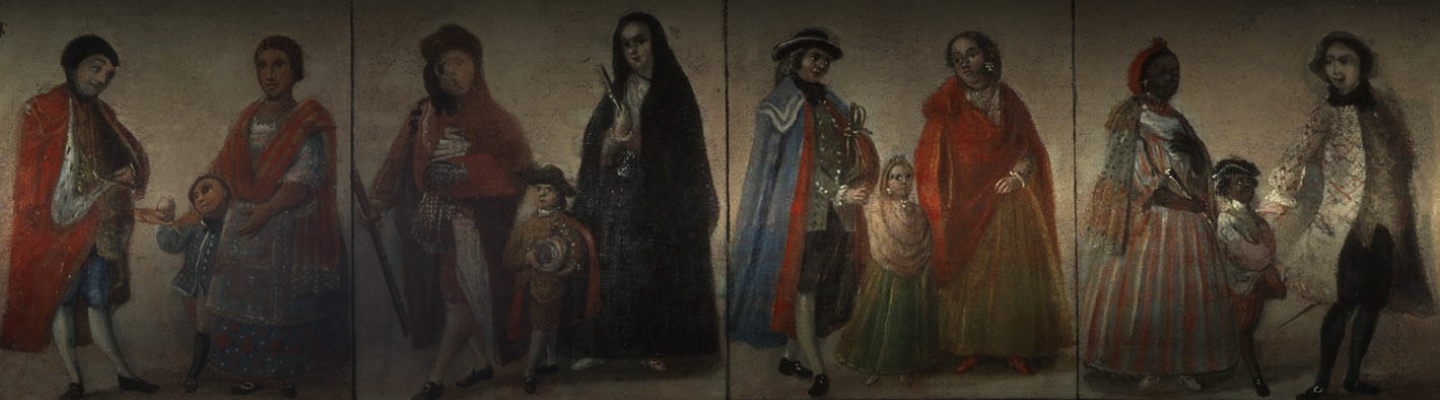
Lexicographic evidence confirms this cultural weight. The 1737 Diccionario de Autoridades defines castizo as “pure in lineage,” reinforcing its function as a term of racial and genealogical legitimacy. The classification also appears in casta paintings, where castizos are frequently depicted in family groupings that signal a return to Spanish purity—further entrenching the narrative of bloodlines as destiny.
Citations:
- Martínez, María Elena. Genealogical Fictions: Limpieza de Sangre, Religion, and Gender in Colonial Mexico. Stanford University Press, 2008.
- Real Academia Española. Diccionario de la lengua española. 22nd ed., 2001. Entry on “castizo.”
- Twinam, Ann. Purchasing Whiteness: Pardos, Mulattos, and the Quest for Social Mobility in the Spanish Indies. Stanford University Press, 2015.
Examples

CATECUMENO
The term catecúmeno refers to an individual undergoing instruction in the Christian faith in preparation for baptism. Derived from the Latin catechumenus and the Greek κατηχούμενος (katēchoumenos), meaning "one being instructed," it was commonly used within the territories of the Spanish empire to describe Indigenous individuals receiving religious education from missionaries.
In the context of Indigenous slavery, the status of catecúmeno held significant implications. Missionaries sought to convert Indigenous captives, viewing baptism and religious instruction as pathways to salvation. Once baptized, these individuals were considered neófitos (neophytes) and were granted some legal protections under Spanish colonial law. However, the transition from catecúmeno to neófito did not necessarily equate to freedom. Many baptized Indigenous people remained subject to systems of forced labor, particularly within reducciones and mission settlements, where their religious status justified continued control under the guise of spiritual guardianship (Burkholder and Johnson, 2018).
Spanish colonial authorities frequently framed religious conversion as an act of benevolence while maintaining structures that kept catecúmenos in exploitative labor arrangements. Within the reducción system, missionaries not only instructed Indigenous people in Christianity but also managed their labor for agricultural and economic purposes (Ricard, 1966). Furthermore, legal mechanisms allowed for Indigenous labor to continue under Christian masters, reinforcing colonial hierarchies (Gibson, 1964).
The role of catecúmenos in colonial society highlights the complex interplay between religious conversion and Indigenous servitude. While the Church aimed to integrate Indigenous peoples into Christian society, the realities of colonial exploitation often undermined these efforts, leading to a nuanced and often contradictory experience for Indigenous catechumens.
Citations:
- Burkholder, Mark A., and Lyman L. Johnson. Colonial Latin America. Oxford University Press, 2018.
- Gibson, Charles. The Aztecs Under Spanish Rule: A History of the Indians of the Valley of Mexico, 1519-1810. Stanford University Press, 1964.
- Ricard, Robert. The Spiritual Conquest of Mexico: An Essay on the Apostolate and the Evangelizing Methods of the Mendicant Orders in New Spain: 1523-1572. University of California Press, 1966.
CAUDILLO
The term caudillo, from the Latin capitellum (diminutive of caput, “head”), historically referred to a leader, chief, or warlord. In medieval Iberia, it described military commanders during the Reconquista, especially those wielding power through martial prowess and personal loyalty. As Spain expanded into the Americas, caudillo came to designate men who led armed expeditions, commanded frontier militias, or exerted local control over Indigenous territories. While not always formal enslavers, these figures often enforced systems of coercion, tribute, and territorial subjugation that directly facilitated Indigenous displacement and exploitation.
In the post-independence period of the 19th and early 20th centuries, caudillo became a defining term for charismatic strongmen who dominated political life across Latin America. These leaders operated through personalist authority rather than institutional governance, maintaining power through military force, patronage networks, and control over land and labor. Some caudillos were celebrated as defenders of local communities or national independence, but many perpetuated entrenched hierarchies and authoritarian rule, often relying on coerced labor or repression of marginalized groups.
Linguistically, caudillo encapsulates leadership rooted in personal dominance rather than legal legitimacy. The term often carried a dual resonance—suggesting both honor and violence—reflecting the ambivalent legacy of these figures within their communities. In both colonial and republican contexts, caudillos frequently served as instruments of territorial control, social discipline, and economic extraction, shaping long-term patterns of inequality across the region.
Citations:
- Hamill, Hugh M. Caudillos: Dictators in Spanish America. University of Oklahoma Press, 1992.
- Lynch, John. Caudillos in Spanish America, 1800–1850. Clarendon Press, 1992.
- Real Academia Española. Diccionario de la lengua española. 22nd ed., 2001. Entry on “caudillo.”
CAUTIVO/A
Variations: Cautibo, Captivo, Cativo
The term cautivo (feminine: cautiva) originates from the Latin captīvus, meaning "captive" or "prisoner." In the Spanish colonial world, cautivo was widely used to describe Indigenous individuals taken during warfare, raids, or punitive expeditions. While often translated as "captive," the term functioned as a euphemism for enslavement, legally distinguishing Indigenous captives from other enslaved populations while still subjecting them to forced labor.
Spanish colonial authorities justified Indigenous enslavement by classifying captives as cautivos, often framing their captivity as a consequence of rebellion or war. Under Spanish law, captives of "just wars" could be enslaved, and cautivos were frequently forced into agriculture, domestic service, and mining. This classification obscured the realities of enslavement, presenting Indigenous captivity as legal subjugation rather than outright chattel slavery.
The term cautivo appeared in baptismal and marriage records, marking captives as forcibly converted and assimilated into colonial society. However, conversion did not necessarily lead to freedom; many baptized cautivos remained in coercive labor arrangements. By the 16th and 17th centuries, cautivo was widely documented in colonial legal and administrative records, particularly in frontier regions where Indigenous resistance persisted.
The term cautivo encapsulates the colonial strategy of legitimizing enslavement under legal and religious frameworks. While it differentiated captives from other enslaved groups, the lived experiences of cautivos were marked by loss of freedom, coercion, and systemic exploitation.
Citations:
- Hanke, Lewis. The Spanish Struggle for Justice in the Conquest of America. University of Pennsylvania Press, 1949.
- Seed, Patricia. To Love, Honor, and Obey in Colonial Mexico: Conflicts Over Marriage Choice, 1574-1821. Stanford University Press, 1988.
- Weber, David J. Spanish Frontier in North America. Yale University Press, 1992.
CAUTIVERIO (Indio de)
Variations: Cautiveria, Cautiberio, Captiverio
The Spanish term cautiverio translates to "captivity," referring to a state of confinement or loss of freedom. When paired with Indio de, meaning "of the Indian," the phrase cautiverio (Indio de) described the condition of Indigenous people subjected to captivity and forced labor in the Spanish colonial world. This phrase frequently appeared in legal, ecclesiastical, and administrative records, signifying Indigenous captivity in contexts ranging from warfare to mission labor systems.
Etymologically, cautiverio derives from the Latin captīvus (captive) with the suffix -erio, indicating a state or condition. The term was codified in Spanish colonial law, notably in the Recopilación de Leyes de los Reynos de las Indias (1681), where it regulated the treatment of Indigenous captives. Laws provided legal justifications for captivity, particularly for those taken in "just wars" or deemed unbaptized "infidels" .
Beyond legal records, cautiverio (Indio de) appeared in baptismal and marriage registries, reinforcing the role of religious conversion in the assimilation of Indigenous captives. However, conversion did not necessarily grant freedom; many baptized cautivos remained subject to coerced labor . In Spanish America, captives were often transferred to encomiendas, missions, and military households, where they performed agricultural, domestic, and artisanal labor under restrictive conditions .
The application of cautiverio (Indio de) reflects the legal and religious mechanisms that sustained Indigenous captivity within Spanish colonial rule. While the term distinguished Indigenous captives from enslaved Africans or other forced laborers, in practice, those subjected to cautiverio faced conditions of coercion, displacement, and systemic exploitation.
Citations:
- Gibson, Charles. The Aztecs Under Spanish Rule: A History of the Indians of the Valley of Mexico, 1519-1810. Stanford University Press, 1964.
- Lockhart, James. Spanish Peru, 1532–1560: A Social History. University of Wisconsin Press, 1994.
- Seed, Patricia. To Love, Honor, and Obey in Colonial Mexico: Conflicts Over Marriage Choice, 1574-1821. Stanford University Press, 1988.
CHINO/A
The term chino (feminine: china), meaning “Chinese” in Spanish, was a racial classification used within the territories of the Spanish empire to categorize individuals of mixed ancestry—most commonly involving African and Indigenous descent. Despite its literal meaning, the term bore no consistent connection to East Asian heritage. Instead, chino/a served as a flexible and often unstable category within the sistema de castas, shaped by local conditions and perceptions rather than rigid biological lineage.
According to Ben Vinson III, chino lacked a fixed definition and varied across regions and contexts. In casta paintings, the term could refer to the offspring of a lobo and a negra, or a Spaniard and a morisca. This fluidity reflected the improvisational nature of caste naming, where phenotype, social performance, and discretion by clergy or notaries often played a greater role than strict genealogical logic.
The etymology of chino traces back to the Spanish word for “Chinese,” adapted from earlier encounters with Asia and recontextualized in the Americas as an exoticized label of racial otherness. Its appropriation into the caste system underscores how colonial societies employed foreign or animalistic terms to distance certain populations from Spanish identity and to reinforce hierarchies of difference.
María Elena Martínez situates this kind of classification within broader frameworks of limpieza de sangre (purity of blood), noting how colonial regimes used racial naming not just to describe ancestry but to regulate behavior, sexuality, and access to privilege. In this sense, chino/a operated not merely as a descriptor but as a social instrument used to police boundaries and uphold systems of control.
Archival records confirm the term’s circulation in practice. As Rafael Nieto Bayón has demonstrated through extensive study of parish registers in New Spain, terms like chino/a appear inconsistently in baptismal and marriage documents. This inconsistency reveals both the instability of caste terminology and the improvisational authority of local officials. While some individuals labeled Chino/a found ways to navigate colonial structures, the category generally signaled marginality and carried legal, social, and economic disadvantages.
The use of chino within the caste system reflects the colonial preoccupation with ordering human diversity. Though presented as taxonomic and rational, these classifications were deeply subjective, often serving as tools to reinforce inequality, deny rights, and justify coercive labor regimes.
Citations:
- Martínez, María Elena. Genealogical Fictions: Limpieza de Sangre, Religion, and Gender in Colonial Mexico. Stanford University Press, 2008.
- Nieto Bayón, Rafael. “El sistema de castas de la Nueva España: Una aproximación desde los registros parroquiales.” Revista de Indias , Vol.61, no. 223 (2001): 675–706.
- Vinson III, Ben. Before Mestizaje: The Frontiers of Race and Caste in Colonial Mexico. Cambridge University Press, 2018.
CHOLO/A
The term cholo (feminine: chola) has complex and regionally varied meanings, originating as a racial classification in colonial Spanish America and evolving into a modern expression of identity and resistance. Its etymology is often linked to the Nahuatl word xolotl, meaning “dog” or “mutt,” a term historically associated with low status and perceived impurity. Within the sistema de castas, cholo was used to describe individuals of mixed ancestry—typically mestizo and Indigenous—or, in some regions, the offspring of African and Indigenous parents.
In Peru, cholo appears as early as the early 17th century in Inca Garcilaso de la Vega’s Comentarios Reales de los Incas, where he refers to cholos as the children of Black and Indigenous parents. In this context, the term marked both racial mixture and colonial marginalization. In colonial Mexico, cholo was less common but sometimes used interchangeably with coyote in visual and textual sources to signal similar combinations of ancestry. As with many casta terms, its use varied by region and often reflected local anxieties about racial hierarchy, labor control, and social mobility.
The term rarely appeared in legal or ecclesiastical records in Mexico, suggesting it was more prevalent in visual culture and colonial discourse than in formal documentation—though it gained later prominence in vernacular and popular use. By the 19th century, cholo appeared in Anglophone literature, notably in Herman Melville’s Moby-Dick (1851), where it denoted a Spanish-speaking sailor of mixed heritage, reflecting early associations with cultural hybridity in the Americas.
In the 20th century, especially in the southwestern United States, cholo was repurposed as a derogatory term targeting working-class Mexican Americans. Yet during the Chicano Movement of the 1960s and 1970s, it was reclaimed by youth as a symbol of cultural pride, resistance, and rootedness in barrio identity. Today, cholo carries layered meanings—at once shaped by a legacy of colonial racialization and reframed by contemporary expressions of self-determination and resilience.
Citations:
- Garcilaso de la Vega, Inca. Comentarios Reales de los Incas. 1609–1616.
- Reyes III, Reynaldo. "Cholo to 'Me': From Peripherality to Practicing Student Success for a Chicano Former Gang Member." Multicultural Education, Vol. 14, no. 4, 2007, pp. 52-57.
- Vigil, James Diego. Barrio Gangs: Street Life and Identity in Southern California. University of Texas Press, 1991.
CIMARRÓN
The term cimarrón derives from the Spanish word cima (“summit” or “mountaintop”) and was initially used to describe domesticated animals that escaped into the wild. By the early colonial period, the term evolved to apply to human beings—particularly enslaved Africans—who fled captivity and sought refuge in remote or inaccessible terrain beyond colonial control.
In much of the Spanish and Portuguese Americas, cimarrón became a term closely associated with African fugitives from slavery, especially in regions such as the Caribbean, coastal Colombia, and Brazil. These escapees often established autonomous communities known as palenques (Spanish) or quilombos (Portuguese), which actively resisted colonial authority, defended their sovereignty, and, in some cases, negotiated with colonial officials.
While cimarrón appears most commonly in reference to Africans, colonial officials at times applied the concept—if not always the term itself—to Indigenous peoples who fled forced labor regimes, including encomiendas, repartimientos, and missions. As Cynthia Radding documents in her study of Sonora and Amazonia, many Indigenous communities evaded incorporation into colonial structures by retreating into forests, deserts, and mountainous regions. These acts of flight, concealment, and territorial reorganization reflect a form of Indigenous cimarronaje, even when other terms such as alzados or indios rebelados were used in the record.
The shared logics of flight, reterritorialization, and resistance among African and Indigenous fugitives underscore the term’s symbolic power. Though cimarrón was often deployed by colonizers with pejorative intent—to mark lawlessness or subversion—it also came to signify autonomy, defiance, and the will to survive outside the bounds of colonial control.
Citations:
- Davidson, David M. “Negros Cimarrones in the Mountains of Colonial Mexico.” The Hispanic American Historical Review, Vol. 49, no. 4, 1969, pp. 644–659.
- Ferrer, Ada. Freedom's Mirror: Cuba and Haiti in the Age of Revolution. Cambridge University Press, 2014.
- McKinley, Michelle. Fractional Freedoms: Slavery, Intimacy, and Legal Mobilization in Colonial Lima, 1600–1700. Cambridge University Press, 2016.
- Radding, Cynthia. Landscapes of Power and Identity: Comparative Histories in the Sonoran Desert and the Forests of Amazonia from Colony to Republic. Duke University Press, 2005.
COBRIZO
The term cobrizo, meaning “copper-colored” in Spanish, was used in colonial Latin America as a phenotypic descriptor rather than a formal casta category. Derived from cobre (copper), the word emphasized skin tone—typically a reddish-brown hue—commonly associated with Indigenous ancestry. The term first appeared in the 1780 edition of the Diccionario de la lengua castellana by the Real Academia Española, where it was defined in strictly physical terms, referring to the color of human skin without specific reference to ancestry or social status.
Although cobrizo was not codified within the caste system as an official category like mestizo or mulato, it occasionally appeared informally in correspondence, visual culture, or local descriptions, especially in late colonial and early republican contexts. Its usage underscores the colonial obsession with color-based differentiation, where skin tone alone could imply status, ancestry, and proximity to colonial ideals of whiteness.
The descriptor also reveals how racial classification in colonial Latin America was not solely genealogical but visually contingent and context-driven. As scholars such as Ramón Pagés note, terms like cobrizo functioned alongside other color-based adjectives—moreno, trigueño, prieto—in a shifting lexicon that allowed authorities and communities to adjust identity markers in response to changing social, economic, and political realities.
Understanding the use of cobrizo sheds light on how colonial societies employed language to reinforce hierarchies based on perceived physical difference. Even when not formalized in legal or ecclesiastical records, such descriptors contributed to the normalization of inequality and the persistence of colonial ideologies of racial gradation.
Citations:
- Fisher, Andrew B., and Matthew D. O’Hara, eds. Imperial Subjects: Race and Identity in Colonial Latin America. Duke University Press, 2009.
- Martínez, María Elena. Genealogical Fictions: Limpieza de Sangre, Religion, and Gender in Colonial Mexico. Stanford University Press, 2008.
- Quijada, Mónica. “From Spaniard to Creole: The Spanish Heritage in the Construction of Latin American Identities.” In The Collective and the Public in Latin America, edited by Roniger and Herzog.
- Real Academia Española. Diccionario de la lengua castellana, 1780.
COCI
The term coci referred to an Indigenous domestic servant assigned to kitchen and food preparation duties in colonial and republican Bolivia, particularly in Aymara-speaking regions. It functioned as one of several roles imposed through coercive systems of servidumbre indígena, whereby Indigenous individuals—often women or young people—were conscripted to serve in elite or ecclesiastical households. The labor was physically taxing, often extended over long hours, and typically unpaid. While coci may appear diminutive alongside more visible service roles such as pongo or postillón, it was fundamental to the maintenance of colonial domestic order and hierarchy.
The term likely derives from the Spanish cocina (kitchen) or cocinero/a (cook), adapted through Aymara pronunciation or localized usage. Unlike more formalized terms, coci does not appear in colonial dictionaries like the Diccionario de Autoridades, suggesting its usage was regional or informal—shaped by oral tradition and colonial power dynamics. Roberto Choque Canqui includes coci among a list of roles imposed by local Indigenous authorities on behalf of colonial systems, as documented in an official 1762 complaint in Tiwanaku. The invisibility of such roles in formal legal discourse reflects the broader strategy of euphemism and omission that allowed coercive domestic servitude to persist under the guise of tribute or custom.
Citations:
- Albó, Xavier. Raíces de América: el mundo Aymara. UNICEF/CIPCA, 1988.
- Archivo Nacional de Bolivia (ANB), EC. 1762, Nº 130. Francisco Miguel Quispe, indio principal del pueblo de Tiwanaku y capitán enterador de la mita de Potosí.
- Choque Canqui, Roberto. “La servidumbre indígena andina de Bolivia.” Política y economía en los Andes (siglos XVI–XX), editado por Tristan Platt et al., Institut Français d’Études Andines (IFEA), 2006.
COLOR QUEBRADO
The phrase color quebrado, meaning “broken color” in Spanish, was a pejorative term used within the territories of the Spanish empire to describe individuals of mixed ancestry whose appearance, lineage, or behavior deviated from the colonial ideal of racial purity. Unlike formal casta labels such as mestizo or mulato, color quebrado functioned as a moralized descriptor rather than a fixed legal category. It communicated not only physical mixture but also a perceived rupture in social and cultural legitimacy.
As Ben Vinson III explains, individuals referred to as color quebrado were often characterized as having malas costumbres (bad habits) and an innate inclination toward superstition or disorder. These traits were not framed as products of social conditions, but as evidence of an inherent defect attributed to racial mixture. The term thus reflected and reinforced colonial ideologies of limpieza de sangre (purity of blood), associating physical and cultural hybridity with moral degeneration.
To be labeled quebrado was to be marked by a perceived fracture—in lineage, civility, and worth. The phrase stood in direct contrast to the ideal of limpieza de sangre, which emphasized an unbroken, traceable lineage free of racial or religious impurity. Whereas español status conveyed good birth and noble origin, color quebrado implied contamination, degeneration, and disconnection from colonial norms of honor and Christian virtue.
The use of color quebrado reveals how colonial societies weaponized ambiguous, informal descriptors to uphold systems of inequality. These rhetorical tools enabled authorities to rationalize exclusion without recourse to formal caste law. By framing racial mixture as both a visible flaw and a moral failing, color quebrado reinforced colonial regimes of surveillance, labor exploitation, and social marginalization.
Citations:
- Martínez, María Elena. Genealogical Fictions: Limpieza de Sangre, Religion, and Gender in Colonial Mexico. Stanford University Press, 2008.
- O’Hara, Matthew D. A Flock Divided: Race, Religion, and Politics in Mexico, 1749–1857. Duke University Press, 2010.
- Twinam, Ann. Purchasing Whiteness: Pardos, Mulattos, and the Quest for Social Mobility in the Spanish Indies. Stanford University Press, 2015.
- Vinson III, Ben. Before Mestizaje: The Frontiers of Race and Caste in Colonial Mexico. Cambridge University Press, 2018.
COLOR REVUELTO
The phrase color revuelto, meaning “mixed color” in Spanish, was an informal but potent racial descriptor used within the territories of the Spanish empire to refer to individuals of mixed ancestry. While not part of the formal casta taxonomy, the term circulated in administrative, ecclesiastical, and social discourse—often with derogatory connotations. It emphasized disorder, confusion, or dilution, casting racial mixture as both a physical condition and a symbolic disruption of colonial norms.
The word revuelto, derived from the verb revolver (“to stir” or “to scramble”), invoked a sense of unstructured or uncontrolled mixture. In this sense, color revuelto signaled not simply biological hybridity but a perceived breakdown in the moral, genealogical, and social order. As María Elena Martínez has argued, colonial society’s obsession with limpieza de sangre (purity of blood) made mixed lineage an object of suspicion and anxiety. Terms like color revuelto served to label individuals who could not be easily categorized—and to warn against their integration.
Though it lacked formal legal weight, color revuelto was often used to justify marginalization in daily life, from labor assignments to marriage approvals. It functioned as a situational label, applied at the discretion of priests, notaries, or local elites when existing caste categories seemed inadequate or inconvenient. As Ben Vinson III notes, such descriptors reflected the limits of caste ideology and the improvisational quality of colonial racial classification.
The use of color revuelto underscores how language was deployed to naturalize inequality and reinforce systems of domination. By casting mixture as confusion or contamination, colonial authorities and elites reasserted racial boundaries and rationalized coercive hierarchies. The persistence of such terminology reveals the fragility of colonial order and the enduring power of racialized language.
Citations:
- Martínez, María Elena. Genealogical Fictions: Limpieza de Sangre, Religion, and Gender in Colonial Mexico. Stanford University Press, 2008.
- O’Hara, Matthew D. A Flock Divided: Race, Religion, and Politics in Mexico, 1749–1857. Duke University Press, 2010.
- Quijada, Mónica. “Limpieza de sangre y mestizaje en los discursos identitarios iberoamericanos.” In Identidades en construcción. Madrid: CSIC, 2000.
- Vinson III, Ben. Before Mestizaje: The Frontiers of Race and Caste in Colonial Mexico. Cambridge University Press, 2018.
COLOR SOSPECHOSO
The phrase color sospechoso, meaning “suspicious color” in Spanish, was a racialized descriptor used within the territories of the Spanish empire to cast doubt on an individual’s claimed identity—especially when asserting Spanish or European ancestry. It was not a formal casta category, but a situational marker of mistrust, often employed when phenotype appeared inconsistent with declared lineage. In contexts such as tribute registers, census rolls, and marriage records, individuals might be labeled español de color sospechoso—a Spaniard of suspicious color—indicating that their racial purity was questioned by colonial authorities.
The term derives from the Spanish verb sospechar (“to suspect”), rooted in the Latin suspicārī, meaning “to surmise” or “to mistrust.” In colonial society, where lineage was policed as both a legal and moral category, such suspicion carried serious consequences. As María Elena Martínez notes, limpieza de sangre (purity of blood) was central to colonial ideologies of honor, and any visual deviation from whiteness—darker skin, coarse hair, ambiguous features—could trigger administrative or social scrutiny.
Color sospechoso functioned as a rhetorical device to challenge claims to calidad (social quality), often with material effects: higher tribute rates, denial of marriage licenses, or barriers to officeholding. Ann Twinam documents cases where individuals with “suspicious color” had to petition the Crown for confirmation of their whiteness through gracias al sacar—a legal remedy used to correct or erase racial ambiguity. These records reveal the deep entanglement of appearance, identity, and power in the colonial order.
The use of color sospechoso reflects how language was weaponized to enforce racial hierarchies. More than a descriptor, it served as a mechanism of doubt, designed to police the boundaries of privilege and belonging. Its deployment underscores the visual and performative nature of race in colonial Latin America, where whiteness had to be both claimed and seen to be believed.
Citations:
- Martínez, María Elena. Genealogical Fictions: Limpieza de Sangre, Religion, and Gender in Colonial Mexico. Stanford University Press, 2008.
- O’Hara, Matthew D. A Flock Divided: Race, Religion, and Politics in Mexico, 1749–1857. Duke University Press, 2010.
- Quijada, Mónica. “Limpieza de sangre y mestizaje en los discursos identitarios iberoamericanos.” In Identidades en construcción. Madrid: CSIC, 2000.
- Twinam, Ann. Purchasing Whiteness: Pardos, Mulattos, and the Quest for Social Mobility in the Spanish Indies. Stanford University Press, 2015.
COMANCHERIA
The term Comanchería refers to the vast territorial domain historically controlled and inhabited by the Comanche people during the 18th and 19th centuries. Spanning parts of present-day Texas, New Mexico, Oklahoma, Kansas, and Colorado, Comanchería was not merely a geographic expanse but a dynamic Indigenous polity shaped by mobility, diplomacy, warfare, and trade.
Functioning as a flexible yet coherent geopolitical entity, Comanchería's boundaries shifted in response to seasonal migrations, intertribal alliances, and shifting colonial frontiers. The Comanche, having adopted the horse—introduced by the Spanish in the early 17th century—built a powerful equestrian culture that underpinned their military dominance and economic influence across the southern plains. Their expansive trade networks involved the exchange of horses, bison products, firearms, and enslaved captives. These captives included Indigenous peoples from neighboring groups as well as Spanish settlers and, later, Anglo-American migrants, revealing Comanchería’s complex role within broader systems of captivity and coerced labor.
Spanish and later Mexican and American authorities viewed Comanchería as a formidable threat to their territorial ambitions. Colonial records are replete with military dispatches, diplomatic negotiations, and accounts of captive exchanges that reflect both the Comanche’s strategic autonomy and their central role in shaping frontier dynamics.
As historian Pekka Hämäläinen has argued, Comanchería constituted a form of Indigenous empire—expansive, adaptive, and deeply embedded in the geopolitical currents of the Americas. The term itself marks not only a region but a sovereignty defined on Comanche terms, rooted in power, kinship, and resistance.
Citations:
- DeLay, Brian. War of a Thousand Deserts: Indian Raids and the U.S.-Mexican War. Yale University Press, 2008.
- Fowles, Severin. “Searching for the Comanche Empire.” Archaeology, May/June 2014.
- Gelo, Daniel J., and Zesch, Scott. “Comanche Land and Ever Has Been: A Native Geography of the Nineteenth-Century Comanchería.” Southwestern Historical Quarterly 103, no. 3 (2000): 273–308.
- Hämäläinen, Pekka. The Comanche Empire. Yale University Press, 2008.
COMMERÇANT
The French term commerçant, derived from commerce (trade), referred broadly to a merchant or trader, but in colonial contexts, it often denoted an individual engaged in the buying and selling of enslaved people, as well as other commodities produced by coerced labor. In French colonies across the Caribbean, West Africa, and North America, commerçants were key actors in both legal and illicit markets, participating directly in the economic machinery that sustained systems of racialized exploitation.
Unlike large plantation owners or state-appointed officials, many commerçants operated as mobile and flexible intermediaries—buying enslaved individuals from coastal African brokers, selling them in Caribbean ports like Saint-Domingue, Martinique, and Guadeloupe, or trading goods produced by enslaved labor, such as sugar, indigo, and coffee. In New France and Louisiana, some commerçants traded in enslaved Indigenous people captured through war or alliance, as well as African-descended individuals transported through French Atlantic routes.
The legal and social status of commerçants varied widely: some were affiliated with powerful trading companies such as the Compagnie des Indes, while others were independent agents navigating informal economies, smuggling networks, or hinterland trade. Despite this diversity, their common role in facilitating human commodification and profiting from systems of violence places them squarely within the structures of colonial domination.
In some contexts, commerçants also served as agents of cultural and political influence, shaping Indigenous alliances or mediating between European powers and Native nations. These activities further blurred the line between economic actor and colonial agent, particularly when trade in enslaved people overlapped with diplomacy or warfare.
The term commerçant, while superficially neutral, masks the extent to which commerce itself was built upon violence, especially in the French colonial world. Understanding the commerçant as a figure embedded in both capitalist expansion and coerced labor systems is essential to unpacking the economic foundations of empire.
Citations:
- Boulle, Pierre H. Race et esclavage dans la France de l’Ancien Régime. Perrin, 2007.
- Garrigus, John D. Before Haiti: Race and Citizenship in French Saint-Domingue. Palgrave Macmillan, 2006.
- White, Sophie. Voices of the Enslaved: Love, Labor, and Longing in French Louisiana. Omohundro Institute/UNC Press, 2019.
COMPRADO/A
The Spanish term comprado (feminine: comprada), derived from the verb comprar (“to buy” or “to purchase”), was used within the territories of the Spanish empire to describe individuals acquired through financial transactions, often in contexts of enslavement or coercive labor systems. The term underscored the commodification of human beings, framing them as property rather than persons within the colonial economy.
The term comprado frequently appeared in bills of sale, legal contracts, estate inventories, and official records, documenting the purchase of enslaved Indigenous and African individuals. These transactions were regulated under Spanish colonial law, particularly in the Recopilación de Leyes de Indias (1681), which outlined legal frameworks for enslavement, ownership, and manumission. Enslaved individuals were often listed in notarial records as “una pieza comprada” (a purchased piece), further reducing their legal identity to that of an economic asset.
Although comprado originally described chattel slavery, by the late colonial period, its meaning expanded to include individuals subjected to coercive labor contracts or exploitative conditions. Some individuals labeled as comprado were placed under forced service arrangements, particularly in frontier regions where labor shortages led to semi-permanent forms of servitude that blurred the lines between slavery and contractual labor.
The use of comprado reflects the deep entrenchment of human commodification in colonial economies, legitimized through legal, administrative, and commercial frameworks. Even as slavery was legally challenged in later centuries, the persistence of exploitative labor systems ensured that purchased laborers remained bound to hierarchical colonial structures.
Citations:
- Recopilación de Leyes de Indias (1681), Book VI, Title I.
- Restall, Matthew. The Black Middle: Africans, Mayas, and Spaniards in Colonial Yucatán. Stanford University Press, 2009.
- Vinson III, Ben. Before Mestizaje: The Frontiers of Race and Caste in Colonial Mexico. Cambridge University Press, 2018.
CONQUISTADOR
Translated: A conqueror
The term conquistador, derived from the Spanish verb conquistar (“to conquer”), historically referred to the soldiers, adventurers, and agents of empire who led the expansion of the Spanish Crown during the 15th and 16th centuries. Operating under royal charters or informal mandates, conquistadores spearheaded the violent subjugation of Indigenous peoples across the Americas and beyond. Their conquests resulted in the establishment of colonial systems grounded in the dispossession of land and the exploitation of labor, particularly through institutions like the encomienda.
Figures such as Hernán Cortés and Francisco Pizarro became emblematic of the conquest era, leading campaigns that toppled complex Indigenous polities like the Aztec and Inca empires. While these campaigns were justified through rhetoric of Christianization and civilizing missions, the motivations of most conquistadores centered on personal enrichment, political power, and access to Indigenous tribute and labor. Many received grants of land and control over Native peoples as rewards, institutionalizing systems of servitude under the guise of imperial service.
Linguistically, conquistador connoted military valor and divine purpose, reinforcing a worldview in which conquest was morally justified and spiritually ordained. In practice, the title masked a legacy of extraction, forced conversions, and widespread violence. Colonial chronicles—most notably Bernal Díaz del Castillo’s The True History of the Conquest of New Spain—helped enshrine this mythology, presenting conquistadores as noble warriors rather than as perpetrators of systemic subjugation.
The term remains symbolically potent, representing both the foundational violence of empire and the enduring legacy of historical distortion. It reflects a structure in which conquest, labor exploitation, and racial domination were intimately intertwined.
Citations:
- Cervantes, Fernando. Conquistadores: A New History of Spanish Discovery and Conquest. Viking, 2021.
- Real Academia Española. Diccionario de la lengua española. 22nd ed., 2001. Entry on “conquistador.”
- Restall, Matthew. Seven Myths of the Spanish Conquest. Oxford University Press, 2003.
- Todorov, Tzvetan. The Conquest of America: The Question of the Other. Harper & Row, 1984.
CONTRATADO/A
The Spanish term contratado (feminine: contratada) derives from the verb contratar, meaning "to contract" or "to hire." In the Spanish colonial period, contratado referred to individuals bound by labor agreements, often under conditions that blurred the line between voluntary employment and coercion. While contracts were framed as mutual agreements, in practice, many Indigenous laborers, debt peons, and other marginalized groups were compelled into exploitative labor arrangements.
Colonial labor laws regulated contratados through formal contracts, particularly in industries such as mining, agriculture, and domestic service. The 1680 Recopilación de Leyes de los Reynos de las Indias established guidelines for labor contracts, ostensibly to protect workers, yet these legal frameworks often served to justify coercive labor conditions. Spanish officials and landowners frequently leveraged debt peonage, false promises, or legal loopholes to bind Indigenous and mestizo workers to extended periods of servitude (Zavala, 1935).
By the 19th century, contratado expanded beyond Indigenous labor to describe indentured laborers from China, India, and Europe, who were brought to Latin America under exploitative labor contracts (Tutino, 2011). These contracts, while distinct from outright slavery, often subjected workers to restricted mobility, abusive conditions, and financial dependency, ensuring a continued supply of cheap labor to colonial and postcolonial economies.
The term contratado illustrates the systemic use of contracts as tools of labor exploitation, where the legal appearance of mutual agreement obscured underlying coercion. Although framed as employment, many contratados faced conditions indistinguishable from forced labor, reinforcing broader patterns of colonial and postcolonial economic subjugation.
Citations:
- Recopilación de Leyes de los Reynos de las Indias. Madrid, 1680.
- Tutino, John. Making a New World: Founding Capitalism in the Bajío and Spanish North America. Duke University Press, 2011.
- Zavala, Silvio. El Servicio Personal de los Indios en la Nueva España. El Colegio de México, 1935.
COYOTE
The term coyote was one of several animal-associated casta categories used in colonial Latin America to denote individuals of mixed ancestry. Its meaning and application varied regionally. In central Mexico, it was often used to describe individuals born to mestizo and Indigenous parents, while in frontier regions like New Mexico, coyote or coyota frequently referred to children born to enslaved Indigenous women—underscoring the violent realities of captivity and coerced reproduction in colonial borderlands.
Etymologically, coyote derives from the Nahuatl word cōyōtl, meaning “coyote,” an animal symbolizing adaptability and cunning in many Indigenous cultures. In the colonial context, however, the term was appropriated and racialized, transformed into a category of social difference rather than cultural reverence. Like other animal-based classifications such as lobo (“wolf”), coyote carried derogatory overtones, reinforcing notions of instability and impurity.
The earliest lexicographic appearance of coyote in a colonial-era dictionary comes from the 1786 Diccionario castellano con las voces de ciencias y artes, where it is defined simply as a species of dog found in Mexico and California. While not explicitly linked to racial classification in that text, archival evidence confirms that the term was widely used in New Spain and its northern provinces to categorize racialized individuals in baptismal, marriage, and census records.
Coyotes occupied a precarious and often marginalized position within colonial society. Subject to discrimination and often coerced into agricultural or domestic labor, their classification reinforced social hierarchies while also revealing their permeability. As with many casta terms, the label coyote exemplifies the fluid, situational, and deeply violent nature of colonial racial systems—where ancestry, appearance, and status intersected to shape lives under colonial rule.
Citations:
- Katzew, Ilona. Casta Painting: Images of Race in Eighteenth-Century Mexico. Yale University Press, 2004.
- Terreros y Pando, Esteban de. Diccionario castellano con las voces de ciencias y artes. Madrid, 1786.
- Vinson III, Ben. Before Mestizaje: The Frontiers of Race and Caste in Colonial Mexico. Cambridge University Press, 2018.
CRIADO/A
Variations: Creado/a
The Spanish term criado (feminine: criada) originates from the verb criar, meaning "to raise" or "to nurture." Initially, the word referred to individuals raised within a household, often serving as personal attendants or domestic workers. Over time, criado became a euphemism for forced servitude, particularly in colonial Latin America, where Indigenous and African individuals were placed in Spanish households under conditions of dependency and coercion.
Criados occupied an ambiguous status in colonial society. While some were nominally free, their reliance on the household often left them vulnerable to exploitation, mistreatment, and limited mobility. Criados performed a range of domestic tasks, including cooking, cleaning, child-rearing, and managing household affairs, reflecting the hierarchical and racialized structures of Spanish colonial society. Their status often mirrored forms of indentured servitude or perpetual dependency, despite lacking the explicit designation of slavery (Arrom, 1985).
Historical dictionaries consistently define criado in terms of servitude. Nebrija’s Gramática (1492) describes a criado as "que sirve" (one who serves). Percivale’s Spanish Grammar (1591) refers to criado as both "servant" and "famulus," reinforcing its association with domestic service. A 1679 Spanish dictionary emphasizes the subordination of criados, illustrating their assigned duties such as cleaning, making beds, and tending to their master’s needs.
Criados were deeply embedded in colonial labor hierarchies, often tied to elite Spanish and mestizo households (Lockhart, 1994). The legal and social frameworks surrounding their servitude reinforced power dynamics that blurred the boundaries between labor, dependency, and coercion. While some criados gained social mobility, many remained trapped in exploitative conditions that persisted into the postcolonial era (Johnson & Lipsett-Rivera, 1998). In some Latin American countries today, "criado" may retain colloquial or derogatory connotations, depending on the context, reflecting lingering class and racial divisions rooted in colonial history.
Citations:
- Arrom, Silvia Marina. The Women of Mexico City, 1790–1857. Stanford University Press, 1985.
- Johnson, Lyman, and Sonya Lipsett-Rivera, eds. The Faces of Honor: Sex, Shame, and Violence in Colonial Latin America. University of New Mexico Press, 1998.
- Lockhart, James. Spanish Peru, 1532–1560: A Social History. University of Wisconsin Press, 1994.
Examples
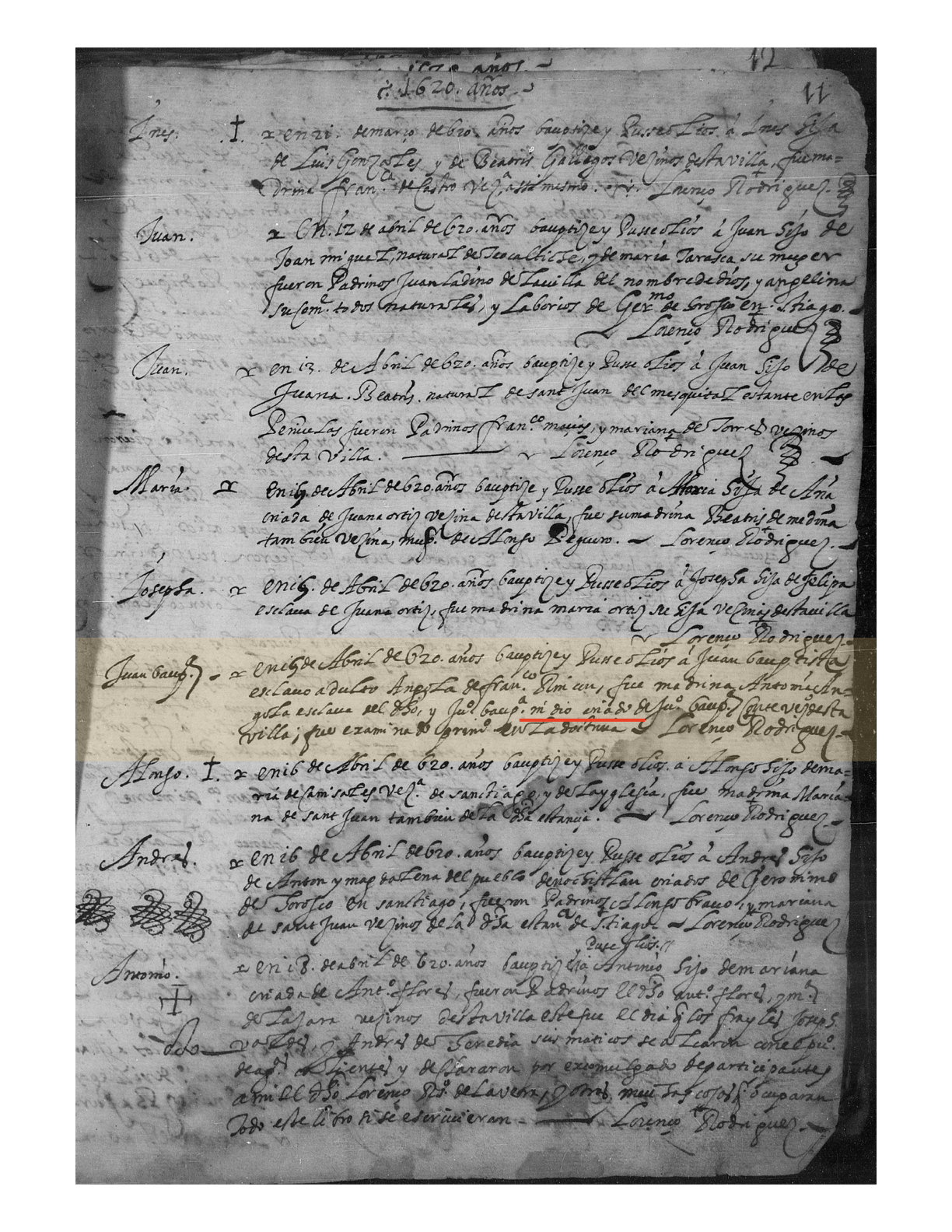
DE LA LABOR DE
The phrase de la labor de, translating to “from the labor of” in English, frequently appeared in colonial Spanish records, particularly in land, agricultural, and tribute documentation. In this context, labor referred to agricultural work or a cultivated plot of land, often maintained through the coerced or forced labor of Indigenous or enslaved individuals. The phrase served as a linguistic marker to connect individuals or resources to a specific labor force, estate, or system of production.
First documented in the 16th century, de la labor de was commonly used in baptismal, tribute, and legal records to denote people whose identity and status were tied to the labor they provided. For example, an individual might be described as “de la labor de [hacienda or encomienda name],” signaling their connection to a specific colonial enterprise. Such usage reflected the central role of Indigenous labor in sustaining colonial agricultural systems and economies.
The phrase highlights the depersonalizing and commodifying nature of colonial language, which reduced individuals to their economic function. It also illustrates how colonial authorities documented and legitimized the systemic exploitation of Indigenous peoples, integrating their forced labor into broader economic and social frameworks. Additionally, it underscores the displacement and subjugation of Indigenous communities, who were often uprooted from their homelands to labor on haciendas, missions, or other colonial estates.
Citations:
- Real Academia Española. Diccionario de la lengua española. 22nd ed., 2001. Entry on “labor.”
- Taylor, William B. Landlord and Peasant in Colonial Oaxaca. Stanford University Press, 1972.
- Zavala, Silvio. El servicio personal de los Indios en la Nueva España. El Colegio de México, 1984.
Examples
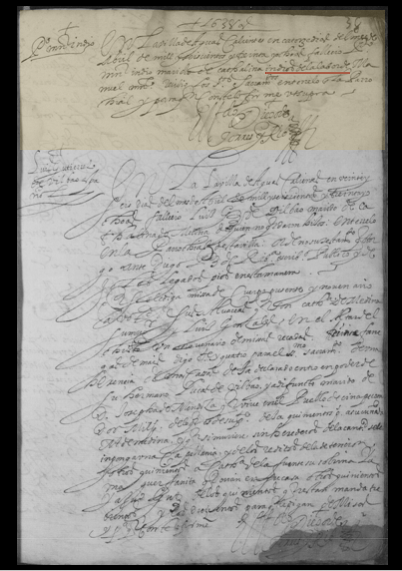
DE NACIÓN ...
The phrase de nación (“of nation”) was widely used in colonial Spanish records to indicate an individual’s ethnic or tribal affiliation. In this context, nación did not signify a political state but rather an Indigenous group, such as de nación Tlaxcalteca or de nación Apache. This designation functioned as a marker of foreignness and displacement, often applied to individuals removed from their original communities through war, enslavement, or forced labor systems.
The use of de nación in baptismal registers, marriage records, and labor contracts frequently indicated an Indigenous person’s subordinate status within colonial society. It often signaled that the individual had been integrated into missions, encomiendas, or haciendas, where forced assimilation and coerced labor were common. The phrase served both as a legal identifier and a mechanism of colonial control, reinforcing racial hierarchies by categorizing Indigenous individuals as outsiders within Spanish settlements.
While primarily used to classify Indigenous peoples, de nación could also appear in relation to Spaniards born outside of the Iberian Peninsula or other non-local populations, emphasizing distinctions between origin and social standing. The phrase highlights how colonial authorities used ethnic labels to manage and regulate populations, particularly in systems of labor extraction and religious conversion.
Citations:
- Gibson, Charles. The Aztecs Under Spanish Rule: A History of the Indians of the Valley of Mexico, 1519-1810. Stanford University Press, 1964.
- Real Academia Española. Diccionario de la lengua española. 22nd ed., 2001. Entry on “nación.”
- Seed, Patricia. To Love, Honor, and Obey in Colonial Mexico: Conflicts Over Marriage Choice, 1574-1821. Stanford University Press, 1988.
DE SERVICIO
Variations: del servicio de; Indio de servicio; See also Portuguese variation: do serviço
The Spanish phrase de servicio, meaning "in service" or "of service," was widely used in colonial Latin America to classify individuals engaged in labor, often under coercive conditions. Derived from the Latin servitium (servitude or slavery), de servicio carried connotations of subordination, frequently obscuring the realities of forced labor. The phrase appeared in baptismal records, censuses, legal petitions, and estate inventories, identifying Indigenous, African-descended, and mixed-race individuals who performed domestic, agricultural, and artisanal work within colonial households and estates.
Historical definitions reinforce these associations. The Real Academia Española consistently defines servicio as labor performed for another, emphasizing menial and subordinate tasks. The Diccionario de Autoridades (1737) specifies that de servicio refers to labor rendered under obligation, often in exchange for sustenance rather than wages.
By the 16th century, de servicio had become a euphemism for compulsory labor, particularly within the encomienda, debt peonage, and Indigenous slavery systems. While the phrase occasionally denoted wage labor, it was more commonly used to justify and normalize exploitative labor arrangements. Indigenous neophytes working in missions were frequently labeled de servicio, ostensibly contributing to their "conversion" while being subjected to intensive and often unpaid labor (Arrom, 1985).
In practice, de servicio functioned as a linguistic tool to maintain colonial hierarchies, reinforcing a system where laborers were essential to economic production but relegated to the lowest social ranks. The phrase signified the blurred boundaries between coerced labor and formal employment, allowing colonial authorities to classify and control workers without explicitly acknowledging their exploitation (Bristol, 2007; Seed, 1988).
Citations:
- Arrom, Silvia Marina. The Women of Mexico City, 1790–1857. Stanford University Press, 1985.
- Bristol, Joan. Christians, Blasphemers, and Witches: Afro-Mexican Ritual Practice in the Seventeenth Century. University of New Mexico Press, 2007.
- Seed, Patricia. To Love, Honor, and Obey in Colonial Mexico: Conflicts Over Marriage Choice, 1574-1821. Stanford University Press, 1988.
DEMEURANT CHEZ...
The French phrase demeurant chez..., meaning “residing at” or “living with,” frequently appears in colonial records such as baptismal entries, censuses, and legal documents. While seemingly neutral, it often signified dependency and subordination. Derived from demeurer (to reside, remain) and chez (at the house of), the phrase described individuals under another’s authority—whether tenants, laborers, or enslaved persons.
In French colonies like Louisiana, Saint-Domingue, and Martinique, demeurant chez... was commonly used to record Indigenous or African-descended individuals forcibly integrated into French households as domestic workers, laborers, or enslaved persons. Though it could denote voluntary residence, colonial legal and social structures often framed residency as a form of coerced servitude. French colonial law generally distinguished enslaved persons (esclaves) from free dependents, but demeurant chez... was used ambiguously, obscuring power imbalances and reinforcing hierarchical control. In some cases, it applied to engagés (indentured servants) or other laborers whose legal status remained precarious.
The Dictionnaire de l’Académie française (1694) defines demeurer as “to reside, to live” but also notes its use to indicate remaining in a place due to external control. This secondary nuance reflected the constrained mobility of those labeled as such, particularly in colonial contexts. By the 18th century, demeurant chez... had become a linguistic marker of social inequality, reinforcing the entrenched hierarchies of race, class, and power, where residency often equated to enforced labor, displacement, and limited agency.
Citations:
- Académie française. Dictionnaire de l’Académie française, 1st ed. Paris: Jean-Baptiste Coignard, 1694. https://artfl-project.uchicago.edu/content/dictionnaire-de-lacademie-francaise-1694
- Dubois, Laurent. A Colony of Citizens: Revolution and Slave Emancipation in the French Caribbean, 1787–1804. Chapel Hill: University of North Carolina Press, 2004.
- Hall, Gwendolyn Midlo. Africans in Colonial Louisiana: The Development of Afro-Creole Culture in the Eighteenth Century. Baton Rouge: Louisiana State University Press, 1992.
DEPOSITADO/A (su)
Within the territories of the Spanish empire, the term depositado (feminine: despositada) (from depositar, meaning “to deposit” or “to place”) referred to an individual—often Indigenous—placed under the guardianship or custody of a colonial authority, settler, or institution. While framed as a protective measure, this system functioned as a means of controlling and exploiting Indigenous labor, reinforcing colonial hierarchies of power.
The depositado system coexisted with other colonial labor institutions, including the encomienda and repartimiento. It was often justified as a mechanism to Christianize and “civilize” Indigenous peoples while integrating them into the colonial economy. In practice, however, those labeled depositados were frequently subjected to forced labor, relocation, and cultural assimilation pressures. Colonial legal frameworks provided Spanish authorities broad discretion in determining custody, further restricting Indigenous agency and reinforcing dependency.
The Dictionnaire de la langue espagnole (1726) defines depositar as “to entrust” or “to consign to another’s care,” reflecting the colonial rationale for the practice. However, the system played a key role in the disintegration of Indigenous social structures, eroding traditional networks of kinship, governance, and autonomy. It exemplifies the broader use of legal mechanisms to obscure coercive labor practices in colonial Spanish America.
Citations:
- Borah, Woodrow. Justice by Insurance: The General Indian Court of Colonial Mexico and the Legal Aids of the Half-Real. University of California Press, 1983.
- Gibson, Charles. The Aztecs Under Spanish Rule: A History of the Indians of the Valley of Mexico, 1519–1810. Stanford University Press, 1964.
- Lockhart, James. Spanish Peru, 1532–1560: A Social History. University of Wisconsin Press, 1994.
DEPÓSITO
The term depósito, meaning “deposit” or “custody” in Spanish, was a legal and administrative term in colonial Latin America that described the forced placement of individuals—often Indigenous or African-descended peoples—into the custody of a specific institution, household, or authority. Rooted in the Latin word depositum (something entrusted), depósito was used in colonial contexts to denote both the physical custody of goods and, more disturbingly, the control or assignment of human beings.
First appearing in 16th-century legal documents, depósito referred to the temporary or permanent placement of individuals deemed "in need of protection" or "under correction" into the custody of colonial officials, religious institutions, or private households. This mechanism was frequently applied to Indigenous captives, runaway slaves, or individuals accused of crimes or moral transgressions. The depósito system allowed colonial authorities to reassert control over these individuals by placing them in environments where they could be closely monitored and forced into labor or religious instruction.
While the term carried an official veneer of care or rehabilitation, depósito often masked exploitative practices. Those placed in depósito were subjected to coercive labor, denied personal agency, and forced into roles that benefitted their custodians. Over time, the term became synonymous with the institutionalized systems of control and exploitation that defined colonial life, especially for marginalized populations.
Definitions from colonial dictionaries further highlight this duality. The Diccionario de Autoridades (1737) defines depósito as “the act of entrusting something to another,” with a secondary application to human beings, emphasizing the legal framework of custody and control. This underscores how depósito served as both a legal and rhetorical tool to institutionalize the subjugation of individuals under the guise of colonial order.
Citations:
- Borah, Woodrow. Justice by Insurance: The General Indian Court of Colonial Mexico and the Legal Aids of the Half-Real. University of California Press, 1983.
- Lockhart, James. Spanish Peru, 1532–1560: A Social History. University of Wisconsin Press, 1994.
- Real Academia Española. Diccionario de Autoridades. 1726–1739. https://webfrl.rae.es/DA.html
DO SERVIÇO
Variations: See prior entry: De Servicio
The Portuguese term do serviço, meaning "of the service," was used during the colonial period to describe labor relations between Indigenous workers and Portuguese settlers. This designation reflected the assignment of Indigenous individuals to specific settlers, households, or institutions for labor. The phrase often followed the name of the settler or entity to which the worker was tied, as in “do serviço de [name]” (in the service of [name]).
In Maranhão and other Portuguese colonial territories, do serviço frequently appeared in parish records, where it identified Indigenous individuals, including children, who were baptized, married, or buried. These labor relations were typically coercive, often involving long-term arrangements that blurred the lines between servitude and slavery. Although framed as a form of employment or mutual agreement, do serviço often deprived Indigenous people of autonomy, subjecting them to harsh working conditions and social marginalization.
The term gained prominence after the Portuguese abolition law of 1755, which officially prohibited Indigenous slavery. Despite this legal change, many colonial practices continued under new terms like do serviço, which served to obscure the persistence of forced labor. Indigenous individuals labeled as do serviço were often treated as dependents or subordinates, their labor extracted under the guise of contractual or social obligation.
The use of do serviço highlights the colonial strategy of masking exploitation through legal and linguistic mechanisms, enabling the continued subjugation of Indigenous populations in the guise of service rather than outright enslavement.
Citations:
- Chambouleyron, Rafael. "From Slaves to Índios: Empire, Slavery, and Race in Maranhão, Brazil (c.1740–90)." Law and History Review, Vol. 38, no. 2, 2020, pp. 409–432.
- Guzmán, Décio de Alencar. "Colonization in the Amazon: Wars, Trade, and Slavery in the 17th and 18th Centuries." Revista Estudos Amazônicos, vol. 3, no. 2, 2008, pp. 103–139.
- Perrone-Moisés, Beatriz. "Índios livres e índios escravos: os princípios da legislação indigenista do período colonial (16th–18th centuries)." In História dos índios no Brasil, 2nd ed., Companhia das Letras, 1992, pp. 115–132.
DOCTRINERO
The term doctrinero, derived from the Spanish doctrina (“doctrine” or “teaching”), historically referred to clergy tasked with the religious instruction and conversion of Indigenous peoples in the Spanish Americas. Unlike parish priests (curas) assigned to Spanish towns, doctrineros served in doctrinas—mission settlements established specifically for evangelizing Indigenous communities. Within these settlements, they administered sacraments, taught Catholic doctrine, and oversaw daily life, making them central figures in the Spanish Crown’s efforts to Christianize and culturally assimilate Native populations.
In practice, the doctrinero’s authority extended far beyond spiritual matters. As the sole permanent representatives of colonial authority in many remote areas, doctrineros regulated labor, enforced moral and social norms, and supervised agricultural or artisanal production. Doctrinas often functioned as enclosed and controlled spaces of economic extraction, relying on Indigenous labor while simultaneously claiming to protect and uplift Native peoples. Though doctrineros were theoretically prohibited from profiting from Indigenous labor, many colluded with local elites or exploited loopholes to extract tribute or unpaid service.
The term appears frequently in ecclesiastical records, missionary reports, and legal disputes, particularly in conflicts between regular clergy (missionaries from religious orders) and secular authorities over jurisdiction and control of resources. These documents reveal how doctrineros operated as intermediaries between empire and Indigenous communities, often reinforcing systems of dependency, coercion, and cultural erasure.
Linguistically and ideologically, doctrinero encapsulates the paternalistic framework of Spanish colonial rule: a figure ostensibly committed to salvation and moral instruction but frequently complicit in the everyday mechanics of colonial domination.
Citations:
- Lavrin, Asunción. Brides of Christ: Conventual Life in Colonial Mexico. Stanford University Press, 2008.
- Real Academia Española. Diccionario de la lengua española. 22nd ed., 2001. Entry on “doctrinero.”
- Weber, David J. The Spanish Frontier in North America. Yale University Press, 1992.
DOMESTIQUE
Variations: doméstico
The French term domestique originally referred to something or someone associated with the home. Its roots lie in the Latin word domesticus, meaning "of the household" or "belonging to the home." By the early 17th century, the term took on more layered meanings, as defined in Sebastián de Covarrubias’ Tesoro de la lengua castellana o española (1611): "everything that is raised at home, and for this reason is meek and peaceful, more than what is raised in the field... not only the animal we call domestic, but even the one that is obedient to the father, or to the lord." This definition reflects its dual application to animals and people within a household, emphasizing obedience and subservience.
In colonial contexts, domestique was used to describe individuals—often Indigenous captives or enslaved persons—integrated into European households as laborers or dependents. In New France, the term frequently appeared in parish records, such as baptisms, marriages, or burials, where Indigenous servants or enslaved individuals were listed as domestiques. These individuals were often identified by their ethnic origins, such as Panis (enslaved individuals from Plains tribes), underscoring the intersection of race, servitude, and household labor in colonial societies.
While the term domestique suggested a degree of assimilation into a household, it often masked the coercive and exploitative realities of their labor. Indigenous domestiques in colonial households were rarely afforded the rights or protections of family members, despite the implication of closeness suggested by the term. They played an essential role in the colonial domestic economy, yet their autonomy remained severely restricted.
Citations:
- Eccles, W.J. The French in North America, 1500-1783. Michigan State University Press, 1998.
- Rushforth, Brett. Bonds of Alliance: Indigenous and Atlantic Slaveries in New France. University of North Carolina Press, 2012.
- Trudel, Marcel. Canada’s Forgotten Slaves: Two Centuries of Bondage. Véhicule Press, 2013.
DOMICILIARIA
The term domiciliaria, derived from the Latin domicilium (home or dwelling), historically pertains to matters associated with the household or residence. In colonial Spanish America, domiciliaria often appeared in legal and administrative documents to denote obligations, services, or restrictions tied to a specific domicile. While seemingly neutral, its usage frequently signaled underlying dynamics of control, labor exploitation, and social hierarchy, particularly affecting Indigenous and marginalized populations.
Phrases such as asistencia domiciliaria (home assistance) could imply coerced labor framed as household service, where Indigenous individuals were compelled to work in colonial households under the pretense of mutual aid. Similarly, arresto domiciliario (house arrest) was a legal measure confining individuals to their homes, often used to control dissent or punish those challenging colonial authority. These terms reflect how colonial authorities utilized the concept of the domicile as a locus of surveillance and regulation, enforcing social order and labor structures that benefited colonial settlers.
The application of domiciliaria in these contexts underscores the colonial strategy of embedding systems of exploitation and control within the fabric of daily life. By framing coercive practices as domestic or household-related, colonial powers obscured the oppressive realities faced by Indigenous and enslaved peoples, perpetuating a social order rooted in inequality and subjugation.
Citations:
- Boyer, Richard, and Geoffrey Spurling. Colonial Lives: Documents on Latin American History, 1550-1850. Oxford University Press, 2000.
- Gibson, Charles. The Aztecs Under Spanish Rule: A History of the Indians of the Valley of Mexico, 1519-1810. Stanford University Press, 1964.
- Seed, Patricia. To Love, Honor, and Obey in Colonial Mexico: Conflicts Over Marriage Choice, 1574-1821. Stanford University Press, 1988.
DON/ñA
The term Don (and its feminine form Doña), derived from the Latin dominus (“lord” or “master”), historically functioned as an honorific title signifying nobility, respect, or elevated social standing in Spanish-speaking societies. By the time of the Spanish Empire’s expansion into the Americas, Don had become a powerful symbol of colonial hierarchy, used primarily to distinguish Spanish and creole elites from Indigenous and African populations. As a linguistic marker, it affirmed the caste system’s rigid stratification, signaling privilege in both legal and cultural terms.
In colonial contexts, the title Don was commonly attached to men of European descent who held significant authority—such as encomenderos, landowners, military officers, or high-ranking clergy. It appears regularly in legal, ecclesiastical, and administrative records, lending formal legitimacy to the bearers’ claims over land, labor, and jurisdiction. Although ostensibly a sign of honor, Don functioned as a performative instrument of dominance, reinforcing systems of racial and class exclusion. By elevating its recipients, it helped institutionalize inequality within the colonial social order.
While rare, some Indigenous leaders—particularly in the early colonial period—were granted the title Don as part of Spanish strategies to co-opt local authority. These cases, however, remained exceptional and often served to underscore, rather than disrupt, the broader racialized hierarchy.
The cultural weight of Don extended beyond politeness or formality; it signaled legitimacy, power, and entitlement within a system built on conquest, forced labor, and exclusion. Its continued presence in colonial documentation embeds it deeply in the bureaucratic language of empire.
Citations:
- Chance, John K. Native Nobility and the Spanish Empire: The Role of Don Juan de Guzmán Itztolinqui. University of Texas Press, 2000.
- Martínez, María Elena. Genealogical Fictions: Limpieza de Sangre, Religion, and Gender in Colonial Mexico. Stanford University Press, 2008.
- Real Academia Española. Diccionario de la lengua española. 22nd ed., 2001. Entry on “Don.”
DONATÁRIO
The term donatário (plural: donatários), derived from the Portuguese donatar (“to donate or grant”), referred to an individual who received a royal land grant under the hereditary captaincy system (capitanias hereditárias) established by the Portuguese Crown in the 15th and 16th centuries. This system was especially prominent in early colonization efforts in Brazil, the Azores, Cape Verde, and parts of West Africa, where the monarchy delegated vast tracts of land to private individuals in exchange for their promise to develop, defend, and Christianize the territory.
A donatário was vested with extensive powers, including the right to collect taxes, administer justice, distribute land, and—crucially—control and mobilize labor. Though not always formally titled as enslavers, many donatários engaged in or sanctioned the enslavement of Indigenous peoples, especially during the early phases of Portuguese expansion in Brazil. Some also played a role in establishing or profiting from the transatlantic slave trade, eventually incorporating enslaved Africans into their economic enterprises.
The role of the donatário blurred the line between private landowner and colonial governor. In theory, they operated as agents of the Crown; in practice, they often ruled their captaincies as semi-autonomous lords, implementing systems of extraction that mirrored feudal or seigneurial models. Their authority frequently included control over missions, settlements, and Indigenous tribute labor, and they sometimes clashed with Jesuits or other religious orders over competing claims to Native labor and territory.
Though the hereditary captaincy system ultimately declined—particularly after the Crown centralized authority in the 17th century—the legacy of the donatário persisted in the structure of land ownership, the legal framework of slavery, and the logic of delegated colonial power. Their influence marked an early phase in the institutionalization of forced labor, including systems that later relied more heavily on enslaved Africans.
The donatário exemplifies how land, sovereignty, and labor exploitation were entwined from the outset of Portuguese colonization. Their privileges, cloaked in language of Christian duty and royal loyalty, facilitated the entrenchment of hierarchical and racialized systems of control across the Atlantic world.
Citations:
- Boxer, Charles R. The Portuguese Seaborne Empire, 1415–1825. Alfred A. Knopf, 1969.
- Monteiro, John Manuel. Negros da Terra: Índios e Bandeirantes nas Origens de São Paulo. Companhia das Letras, 1994.
- Russell-Wood, A.J.R. The Portuguese Empire, 1415–1808: A World on the Move. Johns Hopkins University Press, 1998.
DONCELLA
The Spanish term doncella traditionally refers to an unmarried woman or maiden. Its etymology traces back to the Latin domnicella, meaning "young lady" or "little mistress of the house," emphasizing youth and chastity. In historical contexts, doncella was a neutral descriptor for single women across various social strata, from Indigenous individuals to Spanish nobility.
Within the territories of the Spanish empire, doncella frequently appeared in parish records and legal documents, primarily indicating a woman's unmarried status. However, its usage could carry additional implications. For instance, the Diccionario de la lengua española (1780) defines doncella as "la criada de una casa, que sirve cerca de la señora, y de hacer labor" (the servant of a household who serves closely to her mistress and does handiwork). This suggests that, in certain contexts, doncella functioned as a euphemism for domestic servants, often involving Indigenous or African women in colonial households.
Additionally, historical accounts, such as those by Felipe Guaman Poma de Ayala in his Nueva corónica y buen gobierno (1615–1616), depict Indigenous women labeled as doncellas being presented as tribute to conquistadors. This practice underscores how the term was utilized within colonial systems to facilitate the exploitation and subjugation of Indigenous populations.
While doncella does not inherently imply servitude or captivity, its application in these contexts illustrates the complexities of colonial language, where terms often obscured coercive practices and reinforced social hierarchies.
Citations:
- Guaman Poma de Ayala, Felipe. Nueva corónica y buen gobierno. 1615–1616.
- Real Academia Española. Diccionario de la lengua española. 1st ed., 1780.
- Twinam, Ann. Public Lives, Private Secrets: Gender, Honor, Sexuality, and Illegitimacy in Colonial Spanish America. Stanford University Press, 1999.
DRUDGE
The term drudge originates from Middle English druggen (“to labor”), possibly related to Old English drēogan (“to work, suffer, endure”). By the 14th century, drudge was commonly used to describe individuals burdened with hard, menial, or degrading labor. Over time, it became associated with those relegated to physically demanding tasks, often under exploitative conditions.
In early modern English society, drudge referred to individuals engaged in the lowest forms of labor, including agricultural workers, domestic servants, and factory laborers. Samuel Johnson’s A Dictionary of the English Language (1755) defined a drudge as “one who works hard in mean employments; a slave; a servant.” This definition underscores how the term was used to denote individuals subjected to relentless toil, with connotations of subjugation.
Although drudge does not frequently appear in colonial legal records, its usage in literary and popular discourse suggests it was an informal but widely understood term for those in exploitative labor conditions. In colonial America, it could describe indentured servants, enslaved Africans, and marginalized laborers forced into grueling labor, though it was not a formal legal designation. While historical sources do not consistently apply drudge to Indigenous people, the term captures the grueling conditions endured by Indigenous laborers forced into servitude through systems such as encomiendas and coerced domestic service.
The evolution of drudge reflects broader colonial hierarchies, where economic and racialized labor structures determined who performed the most arduous tasks. Though not a legal classification, its meaning in English colonial contexts aligns with how servitude and forced labor were normalized through language.
Citations:
- "Drudge." Merriam-Webster Dictionary.
- "Drudge." Online Etymology Dictionary.
- Johnson, Samuel. A Dictionary of the English Language. 1755.
DUEÑO/A
The Spanish term dueño, derived from the Latin dominus (“master” or “lord”), denotes legal ownership and control over property, land, or persons. In colonial contexts, dueño was a key term used to establish and affirm dominion over enslaved individuals, both Indigenous and African. Unlike related terms such as amo (master) or patrón (employer or overseer), dueño conveyed unambiguous legal possession, making it central to the language of slavery and property in the Spanish Empire.
Across the early modern Spanish world, dueño appeared frequently in legal, notarial, and ecclesiastical records to codify the ownership of enslaved people. In baptismal entries, enslaved children were often recorded with the name of their dueño rather than their parents. Wills, dowries, and estate inventories routinely listed enslaved individuals as assets belonging to a dueño, reinforcing their classification as movable property within colonial economies.
The precision of the term underscored the denial of legal personhood to the enslaved. While titles such as señor or caballero might reflect honorific status or social standing, dueño was a juridical term rooted in economic valuation and control. It defined relationships of ownership within the larger framework of slavery, reflecting a system in which human beings could be bought, sold, transferred, or inherited under law.
The term’s widespread use across colonial legal systems reveals how deeply the concept of ownership—of both land and people—was embedded in the structure of empire. Dueño functioned as a cornerstone in the administrative, economic, and spiritual mechanisms that sustained racialized systems of forced labor and social domination.
Citations:
- Diccionario de Autoridades. 1734. Entry on “dueño.”
- Martínez, María Elena. Genealogical Fictions: Limpieza de Sangre, Religion, and Gender in Colonial Mexico. Stanford University Press, 2008.
- Real Academia Española. Diccionario de la lengua española. 22nd ed., 2001. Entry on “dueño.”
EN-NA-K'IÉ
The term en-na-k’ié is identified in some sources as a Loucheux (Gwich'in) word that translates to "steppes-ennemis," reflecting a social distinction between the Loucheux and neighboring groups perceived as adversaries or captives. The Loucheux, also known as Gwich'in, traditionally inhabit regions in northwestern Canada, including the Yukon and Northwest Territories, as well as parts of northeastern Alaska. Linguistically and culturally, en-na-k’ié embodies the Loucheux practice of defining social relationships through terms that highlighted conflict and subjugation. While the term may not directly equate to "slave" in the European sense, it reveals how Indigenous languages captured the dynamics of intergroup power and hierarchy.
In pre-contact Loucheux society, captives were often taken during periods of intergroup conflict and were incorporated into the community under varying conditions. Some captives were adopted into families and integrated as full members of the society, while others remained in subordinate roles, providing labor or serving other community functions. The designation en-na-k’ié likely reflected a nuanced understanding of these relationships, distinguishing between allies, neutral parties, and those perceived as outsiders or subjugated individuals.
The advent of European contact introduced new pressures on Indigenous systems of captivity, including the increasing commodification of labor and the imposition of colonial hierarchies. Terms like en-na-k’ié help illuminate the pre-existing frameworks through which Indigenous societies navigated power and subordination, frameworks that were often reshaped or intensified by colonial influence.
Citations:
- Helm, June. The People of Denendeh: Ethnohistory of the Indians of Canada's Northwest Territories. University of Iowa Press, 2000.
- Krauss, Michael E. Gwich'in Athabaskan Dictionary. Alaska Native Language Center, 1985.
- Slobodin, Richard. Gwich'in and Their Neighbors in Prehistoric and Historic Times. Canadian Museum of Civilization, 1981.
ENCOMENDADO
Variations: Commended
The Spanish term encomendado refers to an Indigenous person assigned to a Spanish colonizer, official, or religious authority under the colonial encomienda system. Derived from the verb encomendar ("to entrust") and ultimately from the Latin commendare, the term signified individuals "entrusted" to a settler (encomendero) who was supposed to provide protection and Christian instruction. In practice, however, this system served as a mechanism for coerced labor and exploitation.
The encomienda system, established in the early 16th century, was a cornerstone of Spanish colonial governance, particularly in newly conquered territories. Indigenous individuals labeled as encomendados were required to work in agriculture, mining, or domestic service while paying tributes in goods or labor. Although the system was framed as a reciprocal relationship, in reality, encomendados were subjected to harsh conditions, abuse, and excessive tribute demands.
As abuses escalated, criticism from figures like Bartolomé de Las Casas and debates at the Valladolid Debate (1550–1551) pressured the Spanish Crown to implement reforms. The New Laws of 1542 sought to limit encomendero power and prohibit the inheritance of encomiendas, aiming to phase out the system. However, resistance from colonial elites led to weak enforcement, and the system persisted in various forms for centuries.
The designation encomendado exemplifies the linguistic strategies used by the Spanish to justify colonial systems of forced labor. By portraying coercion as an entrusted responsibility, the Spanish Crown legitimized systemic oppression and the economic exploitation of Indigenous populations. Even after the formal abolition of the encomienda system, similar coercive labor structures continued to shape colonial labor policies, ensuring the continued subjugation of Indigenous peoples.
Citations:
- "Bartolomé de Las Casas Debates the Subjugation of the Indians, 1550." Gilder Lehrman Institute of American History.
- "Encomienda or Slavery? The Spanish Crown's Choice of Labor Organization in Sixteenth-Century Spanish America." The Journal of Economic History, 1984.
- "Ferdinand and Isabella, Instructions for Hispaniola, 1501, to Nicolas de Ovando." National Humanities Center.
ENCOMIENDA
The term encomienda derives from the Spanish verb encomendar (“to entrust”), itself from the Latin in commendare. Institutionalized by the Spanish Crown in the early 1500s, the encomienda was a system of forced tribute and labor foundational to colonial domination in the Americas. It was codified under the Laws of Burgos (1512–1513), which nominally regulated the responsibilities of encomenderos toward Indigenous communities, including mandates for religious instruction and protection. In reality, enforcement was weak, and the system facilitated widespread abuse.
Through the encomienda, Indigenous communities were “entrusted” to Spanish colonists who received the right to extract tribute and labor—often violently and without limit. Although cast as a reciprocal arrangement, the system functioned as a mechanism of coercion, rooted in conquest and sustained by imperial bureaucracy. Encomenderos amassed wealth and power, while Indigenous people endured displacement, forced labor, and cultural suppression.
The model was adapted from medieval practices during the Reconquista, in which land and vassals were granted to Christian knights. In the Americas, the encomienda underwrote mining, agriculture, and the early colonial economy, embedding racialized hierarchies and legal fictions that masked exploitation. While it was gradually replaced by other labor systems in the late 16th and early 17th centuries, its legacy endured in successor institutions that continued to exploit Indigenous labor and sovereignty.
Citations:
- Elliott, J. H. Empires of the Atlantic World: Britain and Spain in America, 1492–1830. Yale University Press, 2006.
- Reséndez, Andrés. The Other Slavery: The Uncovered Story of Indian Enslavement in America. Houghton Mifflin Harcourt, 2016.
- Spalding, Karen. Huarochirí: An Andean Society Under Inca and Spanish Rule. Stanford University Press, 1984.
ENCOMENDERO
Variations: Encomenderos
The term encomendero, derived from the Spanish verb encomendar (“to entrust”), refers to an individual granted an encomienda—a royal concession that assigned control over an Indigenous community to a Spaniard under the guise of protection and religious instruction. First institutionalized in the early 16th century, the encomienda system allowed encomenderos to extract labor, tribute, or both from Indigenous people in return for promises of Christianization and care. While framed as a mechanism for social and spiritual integration, the system was inherently coercive and functioned as a cornerstone of colonial exploitation.
Encomenderos were typically drawn from the colonial elite—conquistadors, military leaders, or their descendants—and operated as intermediaries between the Crown and Indigenous populations. They wielded substantial local authority, often serving as de facto governors of rural territories. Although some legal distinctions existed between the encomienda (grant of people and tribute) and the repartimiento (rotating labor draft), in practice both systems facilitated the extraction of Indigenous labor. Many encomenderos prioritized private gain over their ostensible spiritual and protective duties, prompting frequent complaints from missionaries and Indigenous leaders alike.
The role of the encomendero was marked by violent contradiction. While authorized as a paternal figure, the encomendero was primarily a beneficiary of unpaid or underpaid labor. The conditions imposed on Indigenous communities—including overwork, displacement, and exposure to disease—contributed directly to demographic collapse and cultural disintegration. The system persisted despite reform efforts, such as the New Laws of 1542, which sought (often unsuccessfully) to curtail abuses and limit inheritance of encomiendas.
The term encapsulates the structural hypocrisy of Spanish colonial rule: the encomendero was both “protector” and exploiter, a title that codified dominance under the pretense of moral duty. Encomenderos appear frequently in royal decrees, ecclesiastical visitations, and legal proceedings, often in connection with contested labor practices, resistance, and reform.
Citations:
- Diccionario de Autoridades. 1737. Entry on “encomendero.”
- Pagden, Anthony. The Fall of Natural Man: The American Indian and the Origins of Comparative Ethnology. Cambridge University Press, 1986.
- Real Academia Española. Diccionario de la lengua española. 22nd ed., 2001. Entry on “encomendero.”
- Spalding, Karen. Huarochirí: An Andean Society under Inca and Spanish Rule. Stanford University Press, 1984.
ENGARGADO/A
The Spanish term encargado (masculine) or encargada (feminine), derived from the verb encargar (“to entrust” or “to assign responsibility”), historically referred to individuals charged with overseeing specific tasks or domains. In colonial contexts, encargados played pivotal intermediary roles in the management of property, labor, and production—particularly within coercive systems that governed Indigenous and African workers.
On haciendas, missions, and rural estates, encargados were often responsible for enforcing work routines, maintaining discipline, and reporting to landowners, clergy, or state officials. Although not always titled administrators (administradores), overseers (capataces), or stewards (mayordomos), encargados performed many of the same supervisory functions—especially in smaller or mission-run enterprises. In religious institutions, including convents and mission settlements, encargados frequently managed Indigenous labor involved in agriculture, domestic service, and artisanal production under spiritual pretexts.
The term appears in legal, ecclesiastical, and notarial records, typically denoting someone entrusted with authority yet operating under a higher power. This dual positioning—as both subordinate to elites and dominant over laborers—made encargados critical agents in enforcing racialized labor hierarchies. Whether supervising enslaved Africans, Indigenous tribute laborers, or debt-bound peons, they helped implement systems of extraction and control.
Linguistically, encargado/a implies delegated responsibility, but in practice, the term masked the coercive nature of colonial labor regimes. As local enforcers of broader structures of inequality, encargados embodied the layered authority that sustained everyday exploitation across the Spanish Empire.
Citations:
- Lavrin, Asunción. Brides of Christ: Conventual Life in Colonial Mexico. Stanford University Press, 2008.
- Lockhart, James. Spanish Peru, 1532–1560: A Colonial Society. University of Wisconsin Press, 1994.
- Real Academia Española. Diccionario de la lengua española. 22nd ed., 2001. Entry on “encargado.”
ENTACHITA
The term entachita appears in the Gravier-Langillier Illinois Dictionary (c. 1690s), where it is glossed in French as luy qui ma pour esclave—“he/she who has me as a slave”—as translated by historian Brett Rushforth. Originating in the Illinois language, a dialect of Miami-Illinois within the Algonquian family, entachita reflects the possessive relationship at the core of enslavement, articulated from the perspective of the captive.
Rushforth further notes that entachita literally translates as “I stay at his place for a long time,” emphasizing the captive’s attachment to a household or domain rather than to kin. Unlike terms that might suggest adoption or incorporation, entachita conveys the enduring spatial and hierarchical relationship between enslaved individuals and those who held them. The captive remains bound not through familial ties but through continued subordination within the enslaver’s sphere of control.
The Illinois people, like many Indigenous nations in the Great Lakes and Mississippi Valley regions, experienced widespread displacement and enslavement through intertribal warfare and the expanding French colonial slave trade. Terms like entachita offer insight into how Indigenous languages encoded the lived experience of bondage, revealing conceptions of captivity rooted in residence, control, and exclusion. Its inclusion in a colonial dictionary signals both its everyday usage and the way Native speakers described systems of domination under both Indigenous and French frameworks.
Citations:
- Gravier-Langillier Illinois Dictionary, c. 1690s. Manuscript held at Watkinson Library, Special Collections, Trinity College, Hartford, Conn.
- Rushforth, Brett. Bonds of Alliance: Indigenous and Atlantic Slaveries in New France. University of North Carolina Press, 2012.
ENTENADO/A
Variations: Ente
The Spanish term entenado (feminine: entenada) traditionally refers to a stepchild or foster child, originating from the Latin antenatus (“born before”). While primarily a familial designation, its historical usage in colonial Spanish America suggests broader social and economic connotations, particularly in contexts of dependency and subordination.
In early Spanish lexicons, entenado appears in Cristóbal de las Casas’s Vocabulario de las dos lenguas toscana y castellana (1570), where it is defined as figliastro ("stepchild"). Although dictionaries primarily recorded its familial meaning, colonial records suggest broader applications, particularly for Indigenous captives, wards, or servants integrated into Spanish households. While not an official designation of servitude, entenado functioned as a linguistic mechanism to obscure coerced labor, allowing settlers to present dependent Indigenous individuals as assimilated household members rather than forced laborers.
This strategic use of kinship terminology to mask exploitative labor arrangements was common in colonial Spanish America. Terms such as criado ("servant") and encomendado ("entrusted laborer") similarly framed coerced relationships as paternalistic or benevolent. By positioning Indigenous individuals as entenados, Spanish colonizers legitimized their continued subjugation within domestic spaces, reinforcing social hierarchies that blurred the lines between familial belonging and forced dependency.
Citations:
- Alcalá, Pedro de. Vocabulista en lengua castellana y árabe. 1505.
- González, María Elena. Kinship, Tribute, and Power: Indigenous Relations in Colonial Spanish America. University of New Mexico Press, 2015.
- Las Casas, Cristóbal de. Vocabulario de las dos lenguas toscana y castellana. 1570.
ESCLAVIZADOR
The term esclavizador, derived from the Spanish esclavo (slave) and the agentive suffix -izador (denoting one who acts), explicitly refers to a person who enslaves others. Unlike more common colonial-era terms such as dueño (owner), amo (master), or patrón (boss), esclavizador centers the act and agency of enslavement—naming the individual as an active participant in systems of human bondage. It emphasizes the violence, domination, and commodification that defined slavery across the Spanish Empire.
Throughout the early modern period, esclavizador appeared most often in polemical writings, legal cases, and ecclesiastical condemnations rather than in routine administrative records. It was particularly used when calling attention to abuses—such as in the works of Bartolomé de las Casas, who denounced esclavizadores for the capture, trafficking, and forced labor of Indigenous peoples during unauthorized expeditions. The term also surfaced in judicial proceedings related to illegal slaving, where clarity about the actor’s role was necessary.
Enslavers in the Spanish colonial world included encomenderos, hacendados, soldiers, traders, and other intermediaries who captured or purchased enslaved people, whether through warfare, raiding, or commerce. Esclavizador encompasses the full range of individuals complicit in sustaining these practices.
Its use today in historical analysis serves as a corrective to terms that obscure or sanitize the realities of enslavement. By explicitly naming the perpetrators, esclavizador clarifies the asymmetrical power dynamics at the core of slavery and resists the depersonalization often found in colonial bureaucratic language.
Citations:
- De la Fuente, Alejandro. Slave Law and the Politics of Resistance in the Atlantic World. Cambridge University Press, 2005.
- Real Academia Española. Diccionario de la lengua española. 22nd ed., 2001. Entry on “esclavizador.”
- Yun-Casalilla, Bartolomé. Iberian World Empires and the Globalization of Europe, 1415–1668. Palgrave Macmillan, 2019.
ESPAÑOLADO/A
The term españolada (feminine: españolada), derived from español ("Spanish"), has historically conveyed two distinct meanings. In modern usage, españolada refers to exaggerated or stereotypical depictions of Spanish identity—especially in art, theater, and popular culture. These representations often romanticize or caricature Spanish customs, evoking flamenco dancers, bullfighters, or gallant soldiers as icons of national character.
In colonial contexts, however, variants of the term—particularly españolado—may have been used to describe Indigenous or African-descended individuals who had adopted Spanish language, dress, or customs. While rarely formalized in caste records, españolado likely functioned as a descriptor of acculturation or assimilation, similar in use to ladino/a. It signified the degree to which a person was perceived to have been integrated into Spanish colonial norms, often through processes of religious instruction, linguistic conversion, domestic labor, or reeducation.
To be españolado was to be marked by cultural transformation. It reflected colonial efforts to reshape identity not only through racial categories but through language, religion, kinship dislocation, and bodily comportment. Individuals labeled this way may have been raised in Spanish households, subjected to missionary discipline, or separated from their communities as part of a broader strategy of social control.
The term highlights the ways colonial societies exercised power not just through classification, but through cultural imposition and behavioral regulation. In this sense, points to the subtle but pervasive mechanisms of domination that underpinned colonial hierarchies, where the adoption of Spanish norms functioned simultaneously as a path to conditional privilege and a marker of subjugation.
Citations:
- Martínez, María Elena. Genealogical Fictions: Limpieza de Sangre, Religion, and Gender in Colonial Mexico. Stanford University Press, 2008.
- Radding, Cynthia. Landscapes of Power and Identity: Comparative Histories in the Sonoran Desert and the Forests of Amazonia from Colony to Republic. Duke University Press, 2005.
- Restall, Matthew. The Black Middle: Africans, Mayas, and Spaniards in Colonial Yucatán. Stanford University Press, 2009.
- Seed, Patricia. To Love, Honor, and Obey in Colonial Mexico: Conflicts over Marriage Choice, 1574–1821. Stanford University Press, 1988.
EXPÓSITO
Variations: EXPUESTO
The term expósito, along with its variant expuesto, refers to an abandoned child—typically left anonymously at the threshold of a church, convent, or other public institution. Rooted in the Latin exponere (“to expose” or “to set forth”), the term acquired particular weight in colonial Spanish America, where it was commonly used to describe infants relinquished at foundling homes or religious institutions. While ostensibly denoting orphanhood, the term could also mask deeper structures of dispossession, including the forced separation of Indigenous children from their families.
Colonial institutions routinely took in such children under the guise of Christian charity, yet often imposed strict regimens of labor, cultural assimilation, and religious instruction. In some cases, Indigenous or mixed-heritage children labeled as expósitos were not simply orphaned but forcibly removed from their communities. Their status facilitated their incorporation into systems of servitude and marginalization, aligning with broader colonial strategies of population control and racial reordering.
The term appears in the 1705 Diccionario nuevo de las lenguas española y francesa, where it is defined as “criatura abandonada de padres y madre” (child abandoned by father and mother). By 1853, the Diccionario Nacional o Gran Diccionario Clásico de la Lengua Española provides a more detailed explanation: “Dícese del niño o niña que ha sido echado o expuesto a las puertas de alguna iglesia, casa u otro paraje público, por no tener sus padres con qué criarlo, por ocultar su procedencia, o por otro motivo” (It is said of the boy or girl who has been deposited or placed at the doors of some church, house or other public place, for not having his parents with whom to raise him, for hiding his origin, or for another reason).
Citations:
- Diccionario nuevo de las lenguas española y francesa. París: Juan Jacobo Fievet, 1705.
- Domínguez, Ramón Joaquín. Diccionario Nacional o Gran Diccionario Clásico de la Lengua Española, vol. 3. Madrid: Rivadeneira, 1853.
- Premo, Bianca. Children of the Father King: Youth, Authority, and Legal Minority in Colonial Lima. University of North Carolina Press, 2005.
EXTRAIDO DE
Variations: estraido
The phrase extraído de, meaning “extracted from,” appears in colonial sacramental records—particularly in baptismal and marriage registers—to signal the removal or separation of an individual, often an Indigenous person, from their community or place of origin. Derived from the Spanish verb extraer (“to extract”), which in turn stems from the Latin extrahere (“to draw out, remove”), the phrase in colonial usage obscured the violence of forced relocations under the language of administrative detachment.
In many records, extraído de is followed by the name of an Indigenous pueblo or region, marking the displacement of individuals into missions, haciendas, or Spanish urban households. According to the Diccionario de la lengua española (RAE 2001), extraído denotes something “que ha sido sacado de otra cosa” (“that has been taken out of something else”), a definition that, while neutral, belies the coercion embedded in colonial contexts. Framing these dislocations as logistical transfers or pastoral acts masked the rupture of kinship networks and communal life.
Functioning as part of a broader colonial lexicon of control, extraído de served to legitimize the absorption of Indigenous persons into tribute systems, religious institutions, and coerced labor. Its appearance in ecclesiastical registers exemplifies how bureaucratic language helped normalize structural violence and imperial expansion.
Citations:
- Lockhart, James. The Nahuas After the Conquest: A Social and Cultural History of the Indians of Central Mexico, Sixteenth Through Eighteenth Centuries. Stanford University Press, 1992.
- Real Academia Española. Diccionario de la lengua española. 22nd ed., 2001. Entry on “extraído.”
- Taylor, William B. Magistrates of the Sacred: Priests and Parishioners in Eighteenth-Century Mexico. Stanford University Press, 1996.
FAMILIAR
The term familiar in colonial Spanish America referred to domestic servants or aides, particularly within ecclesiastical households. According to the Diccionario de Autoridades (1726), a familiar was "Criado que sirve en la casa de un Eclesiástico" (“a servant who serves in the house of a clergyman”). This term was commonly used to describe individuals—often Indigenous or enslaved—who worked in clergy residences, assisting with household operations and maintaining daily affairs.
Beyond its domestic meaning, familiar also had a distinct institutional role in the Spanish Inquisition. Familiares del Santo Oficio were lay collaborators who assisted inquisitors by identifying, detaining, and escorting accused individuals. Unlike domestic servants, these familiares were often community members granted privileges such as tax exemptions in exchange for their service.
In colonial households, the term familiar was frequently applied to Indigenous and enslaved individuals, reflecting their integration into elite domestic spaces under exploitative conditions. Although proximity to power sometimes granted trusted status, it more often reinforced dependency and coercion within the colonial labor system.
The dual meaning of familiar—as both a domestic worker and an official attached to the Inquisition—illustrates the multifaceted nature of servitude and authority in colonial Spanish America.
Citations:
- "Domestic Service in Colonial Latin America" in The Cambridge History of Latin America, edited by Leslie Bethell, Cambridge University Press.
- Kamen, Henry. The Spanish Inquisition: A Historical Revision. Yale University Press, 1997.
- Real Academia Española. Diccionario de autoridades .1726-1739.
FÁMULO/A
The term fámulo (feminine: fámula) originates from the Latin famulus, meaning “household slave” or "servant." In early modern Spanish, fámulo referred to domestic workers, particularly in ecclesiastical and educational institutions. According to the Diccionario de Autoridades (1732), fámulo was defined as "sirviente de la comunidad de algún colegio" (“servant of a college community”), while fámula was synonymous with criada ("maid" or "female servant").
Within the territories of the Spanish empire, fámulo often functioned as a euphemism for slavery, particularly when applied to Indigenous and African individuals assigned to domestic service. While the term did not explicitly denote enslaved status, it frequently obscured the forced labor and dependency imposed on those classified as fámulos. Spanish households, religious institutions, and schools absorbed these individuals under coercive labor systems that denied them personal agency while presenting their service as voluntary or customary.
Beyond its practical meaning, fámulo also reflected the deep entanglement of servitude, household labor, and colonial power structures. Friedrich Engels noted that famulus and its derivatives illustrate how historical notions of “family” were originally tied to labor and subjugation rather than kinship. Among the Romans, famulus referred to household slaves, and familia denoted the entire body of enslaved persons belonging to a household.
While the term declined in usage over time, its appearance in colonial records, ecclesiastical documents, and dictionaries underscores how fámulo functioned as a designation of labor and a rhetorical tool to disguise slavery and forced servitude in Spanish and colonial society.
Citations:
- Diccionario de la lengua española (Current Edition), Real Academia Española.
- "Domestic Service in Colonial Latin America" in The Cambridge History of Latin America, edited by Leslie Bethell, Cambridge University Press.
- Engels, Friedrich. The Origin of the Family, Private Property, and the State. Yale University Press, 1884.
- Lockhart, James, and Stuart B. Schwartz. Early Latin America: A History of Colonial Spanish America and Brazil. Cambridge University Press.
- Real Academia Española. Diccionario de autoridades. 1732.
FEITOR
The term feitor, derived from the Portuguese verb fazer (“to do” or “to make”), historically referred to an agent, overseer, or steward charged with supervising labor and managing economic operations in service of the Portuguese Crown or private enterprise. In the colonial context, feitores became key figures in the enforcement of slavery, particularly across West Africa, the Atlantic islands, and Brazil. Their role evolved from commercial representative to plantation overseer, often combining logistical coordination with the exercise of coercive power.
In West African trading posts, known as feitorias, feitores managed the purchase, confinement, and shipment of enslaved Africans, serving as agents of the Atlantic slave trade. In colonial Brazil, the term came to designate overseers on sugar plantations, cattle ranches, and rural estates. These feitores directed enslaved workers, maintained inventories, distributed rations, and enforced daily discipline—frequently through physical punishment. While subordinate to the landowning class, they wielded considerable authority over laborers and were central to the day-to-day operation of plantation economies.
Most feitores were of Portuguese descent, but in some regions—particularly in Bahia and along the African coast—feitores could also be Luso-African, mixed-race, or Brazilian-born men positioned ambiguously within the racial and social hierarchy. Their intermediary status reflects a broader colonial strategy of delegating control through fragmented authority, often pitting racialized workers against one another within a rigid labor regime.
Although most documentation of feitores pertains to their role in African enslavement, the position may also have intersected with Indigenous slavery, particularly in early colonial Brazil, where Native peoples were forced into labor on plantations and in settlements. As more records are uncovered, these connections may yield further insight into how the figure of the feitor operated across racial and ethnic lines.
Linguistically and institutionally, the feitor embodies the intersection of commerce and coercion. Whether as an imperial factor or plantation enforcer, the term signifies a system in which labor was extracted through violence and supervision. Its persistence across centuries and geographies underscores the adaptability—and brutality—of Portuguese colonial rule.
Citations:
- Michaelis Dicionário Brasileiro da Língua Portuguesa. Entry on “feitor.”
- Rodrigues, Jaime. Slave Society in Brazil. University of Illinois Press, 2006.
- Sweet, James H. Recreating Africa: Culture, Kinship, and Religion in the African-Portuguese World, 1441–1770. University of North Carolina Press, 2003.
FORÇAT
The term forçat originates from the French word meaning forced laborer and historically referred to individuals sentenced to penal servitude as punishment. Derived from force, it reflects the coercive nature of their labor. Under the French Penal Code of 1810, forced labor (travaux forcés) was codified as a state-imposed penalty, with convicts sent to penal colonies such as French Guiana and New Caledonia to work on colonial infrastructure. The law of May 30, 1854, formalized this system, removing criminals from France while exploiting their labor. Many forçats were subjected to “doubling”, requiring them to serve additional time beyond their original sentence.
Although French Guiana is the most infamous penal colony, forçats were also transported to Saint-Domingue, Louisiana, and Martinique in earlier periods. Penal labor was used to construct fortifications, clear land, and build roads, reinforcing the colonial reliance on coerced labor. The brutal conditions endured by forçats often mirrored those of enslaved individuals, with high mortality rates due to disease, violence, and forced labor.
While legally distinct from enslaved people, forçats occupied a similar role within colonial labor systems. Authorities often used penal labor to supplement or replace enslaved workers, and free Black individuals and Indigenous people were sometimes sentenced as forçats, demonstrating how penal systems reinforced racial and colonial control. Penal servitude became a key tool in sustaining colonial economies, ensuring forçats remained a disposable labor force under state-sanctioned forced labor policies.
Citations:
- Daget, Serge. Répression et prison sous le Second Empire: les forçats et les bagnes de Guyane. Karthala, 1980.
- "Forced Migrations and Labor in European Colonies." Encyclopedia of European History, ehne.fr/en/encyclopedia/themes/europe-europeans-and-world/forced-migration-and-work-european-colonies/forced-migrations-and-labor-in-european-colonies.
- Gibbs, Christopher C. The French Penal Colony in Guiana: From Bagne to Freedom, 1792-1953. Texas A&M University Press, 1999.
FORRO/A
The term forro (feminine: forra) in Portuguese means “freed” or “free” and historically referred to individuals manumitted from slavery. Derived from the Latin foris (outside), it signified a legal and social status that placed freed individuals outside enslavement while often maintaining certain dependencies. Under the Portuguese Empire, forro applied to formerly enslaved Indigenous and African-descended people who gained freedom through manumission, inheritance, military service, or royal decrees.
The Portuguese abolition law of 1755 abolished Indigenous slavery, granting them the status of forro, while African-descended individuals typically had to secure manumission individually. Despite legal freedom, many forros remained economically dependent on former enslavers, continuing labor under contracts (soldo or soldada). They could own property, testify in court, and work for wages, but social and economic barriers often left them in precarious conditions.
The status of forro varied by region and labor system. In cities like Salvador, Rio de Janeiro, and Recife, forros worked as artisans, porters, or vendors, while in rural areas, they became sharecroppers or wage laborers. In São Tomé and Príncipe, forro evolved into an ethnic identity, referring to freed descendants who developed a Portuguese-based creole culture.
Although forro denoted legal emancipation, it did not always equate to full autonomy or social equality. Many forros faced systemic discrimination, demonstrating how manumission often functioned as a partial rather than absolute release from servitude.
Citations:
- "Forced Migrations and Labor in European Colonies." Encyclopedia of European History, ehne.fr/en/encyclopedia/themes/europe-europeans-and-world/forced-migration-and-work-european-colonies/forced-migrations-and-labor-in-european-colonies.
- Higgins, Kathleen J. Licentious Liberty in a Brazilian Gold-Mining Region: Slavery, Manumission, and Social Mobility in Gold Rush Brazil. Pennsylvania State University Press, 1999.
- "Portuguese Manumission Laws and Forros in Brazil." Oxford Research Encyclopedia of Latin American History, oxfordre.com/latinamericanhistory.
- Schwartz, Stuart B. Slaves, Peasants, and Rebels: Reconsidering Brazilian Slavery. University of Illinois Press, 1996.
FORRO/A DA LEI
Variations: Forro da lei das liberdades; Forro da lei novíssima
The term forro/a da lei, meaning “freed by the law,” specifically refers to Indigenous individuals emancipated under the Portuguese abolition law of June 6, 1755. While forro broadly denotes freedom from enslavement, forro da lei applied to Indigenous people and their maternal descendants, as dictated by the 1755 decree. This law did not extend to African or African-descended enslaved individuals, reinforcing the racialized legal distinctions in Portuguese colonial society.
Despite granting legal freedom, forros da lei often remained subject to exploitative labor arrangements, with many forced into contractual servitude under terms such as soldo or soldada. The Portuguese Crown permitted these contracts under the pretense of voluntary employment, allowing former enslavers to maintain control over Indigenous labor. Colonial officials frequently classified forros da lei as dependents, limiting their autonomy while upholding labor obligations.
The term appears in sacramental records, legal petitions, and estate inventories, often specifying whether an individual remained in service (forro da lei do serviço de…) or had fully severed ties with an enslaver (forro da lei que foi do serviço de…). While forro da lei did not always explicitly state Indigenous identity, its use generally implied legal and social status tied to Indigeneity.
Although framed as abolition, the 1755 decree did not eliminate colonial control over Indigenous labor. The persistence of coerced work contracts and ambiguous legal classifications reveals the limits of manumission within Portuguese imperial governance.
Citations:
- Anderson, Robert Nelson. "Why Joanna Baptista Sold Herself into Slavery: Indian Women in Portuguese Amazonia, 1755–1798." Slavery & Abolition, Vol. 20, no. 1, 1999, pp. 109–128.
- Monteiro, John Manuel. Negros da Terra: Índios e bandeirantes nas origens de São Paulo. Companhia das Letras, 1994.
- "Portuguese Manumission Laws and Forros in Brazil." Oxford Research Encyclopedia of Latin American History, oxfordre.com/latinamericanhistory.
GAÑANES
Variations: Gañanía; gañán
The term gañanes refers to agricultural laborers or farmhands, often employed seasonally or on a daily basis in rural estates such as haciendas or estancias across Spain and its colonies. Within the territories of the Spanish empire, the term commonly denoted non-elite rural workers—typically Indigenous, African-descended, or mixed-heritage men—who performed low-status agricultural labor. While gañán was not a legal status, its usage often obscured exploitative labor arrangements ranging from debt peonage to coerced service within broader colonial systems of control.
According to the Diccionario de la lengua española (RAE, 22nd ed., 2001), gañán is defined as “mozo de labranza” (farmhand) and “hombre fuerte y rudo” (a strong, coarse man), reflecting both occupational and classist connotations. The term derives from Old Spanish and may ultimately trace to the Arabic gannám, meaning “shepherd,” underscoring its rural and pastoral origins. In colonial Peru and other Andean regions, gañán could also refer specifically to a boyero—a laborer who guided a yoke of oxen—indicating a further specialization within agrarian hierarchies.
Though nominally distinct from enslaved persons, gañanes often worked under coercive systems that restricted mobility, choice, or compensation. Their inclusion in estate records and labor rosters reflects how colonial regimes normalized unpaid or underpaid labor through caste- and class-inflected terminology. As such, gañán belongs to a broader lexicon that helped disguise structural unfreedom within the language of agrarian work.
Citations:
- Florescano, Enrique. Memory, Myth, and Time in Mexico: From the Aztecs to Independence. University of Texas Press, 1994.
- Real Academia Española. Diccionario de la lengua española. 22nd ed., 2001. Entry on “gañán.”
Corominas, Joan, and José A. Pascual. Diccionario crítico etimológico castellano e hispánico. Gredos, 1980. - Salomon, Frank, and Stuart B. Schwartz, eds. The Cambridge History of the Native Peoples of the Americas: South America, Vol. 3. Cambridge University Press, 1999.
GATSENNEN
The Mohawk term gatsennen has been documented to mean "domestic animal, butler, slave," reflecting the ways in which the Mohawk and broader Haudenosaunee (Iroquois) societies categorized individuals within their social hierarchy. Gatsennen appears in Jacques Bruyas’ Radical Words of the Mohawk Language with Their Derivatives, where it is recorded as a term encompassing both servitude and domestication. This dual meaning aligns with Mohawk captivity practices, in which captives were either ritually adopted and granted full kinship or relegated to subordinate labor roles.
Captivity was central to Mohawk social organization, particularly through mourning wars, in which captives replaced deceased community members or were assigned roles based on the needs of the community. Some captives, particularly children and women, were adopted and integrated into Mohawk families, while others performed agricultural, household, or menial labor under conditions of servitude. Although the term gatsennen does not equate to European notions of racialized chattel slavery, it reflects an Indigenous framework of social hierarchy, subjugation, and labor extraction.
European colonization and the expansion of colonial economies influenced these Indigenous systems of captivity. The arrival of European trade networks, particularly those involving the Dutch and later the British, introduced new pressures that commodified captives in ways distinct from traditional Mohawk practices. However, the Mohawk maintained distinct terminology and social classifications, including gatsennen, to define the status of those within their communities.
Citations:
- Bruyas, Jacques. Radical Words of the Mohawk Language with Their Derivatives. [Albany, New York? : s.n.].
- Richter, Daniel K. The Ordeal of the Longhouse: The Peoples of the Iroquois League in the Era of European Colonization. University of North Carolina Press, 1992.
- Snow, Dean R. The Iroquois. Cambridge University Press, 1996.
GENÍZARO/A
Variations: Jenízaro/a; Xenízaro/a
The term genízaro (feminine: genízara) has complex origins and layered meanings shaped by imperial, regional, and historiographical contexts. Etymologically, it derives from the Turkish yeniçeri (“new soldier” or "Janissary"), referencing enslaved boys taken from Christian families and trained as elite troops in the Ottoman Empire. The word was later adapted into Spanish and appeared in early modern dictionaries to describe individuals of mixed or uncertain ancestry. By the colonial period, it acquired additional meanings across the Spanish Empire.
In New Mexico, genízaro took on a distinct and localized meaning. From the late 17th to the early 19th centuries, the term primarily designated Indigenous people—often children—who had been captured during intertribal warfare, purchased or “rescued” by Spanish settlers, and integrated into Hispano or Pueblo households. These individuals were typically baptized, renamed, and brought into Catholic life, though they remained socially and economically subordinate. Over time, genízaro became both a caste classification and a form of collective identity. Some second- and third-generation descendants came to self-identify as genízaros, forming communities such as Abiquiú, Belen, and Tomé.
While many scholars have defined genízaros as “detribalized, Hispanicized Indians,” recent work has deepened this interpretation by emphasizing captivity, forced relocation, and the persistence of cultural loss. Others, such as historian Joaquín Rivaya-Martínez, caution against definitions rooted solely in captivity, arguing that the term also described individuals of mixed or ambiguous ancestry. These perspectives reflect the term’s shifting and contested meanings.
The earliest documented use of genízaro in New Mexico appears in 1664. Though long thought to have fallen out of use after Mexican independence in 1821, documented examples have now been identified as late as 1845. In the present day, genízaro identity has been increasingly reclaimed by descendants seeking to honor histories of survival and assert cultural continuity. This contemporary usage emphasizes ancestral displacement, intergenerational resilience, and ties to place, particularly in historic communities like Abiquiú and San Miguel del Vado. While some scholars caution against flattening the term’s meanings or retroactively applying it as a legal identity, its reemergence reflects broader movements to recognize the enduring legacies of colonial bondage and forced assimilation in shaping New Mexican society.
Citations:
- Brooks, James F. Captives and Cousins: Slavery, Kinship, and Community in the Southwest Borderlands. University of North Carolina Press, 2002.
- Chávez, Fray Angélico. “Genízaros.” In Handbook of North American Indians, Vol. 9: Southwest, edited by Alfonso Ortiz, 198–200. Smithsonian Institution, 1979.
- Gonzales, Moises, and Enrique R. Lamadrid, eds. Nación Genízara: Ethnogenesis, Place, and Identity in New Mexico. University of New Mexico Press, 2019.
- Rael-Gálvez, Estevan. Identifying Captivity and Capturing Identity: Narratives of American Indian Slavery in New Mexico and Southern Colorado, 1700–1880. Ph.D. dissertation, University of Michigan, 2002.
- Rivaya-Martínez, Joaquín. “Reflexión historiográfica sobre los genízaros de Nuevo México, una comunidad pluriétnica del septentrión novohispano.” In Familias Plurietnicas y Mestizaje en la Nueva España y el Río de la Plata, edited by Sandra Olivero Guidobono, 270–303. Universidad de Sevilla, 2023.
GENTIL
Variations: Jentil; Gentilidad; Gentilismo
The term gentil, derived from the Latin gentilis—originally meaning “of the same clan or people,” and later “non-Jew” or “non-Christian”—entered Christian theological vocabulary to refer to pagans or unbelievers. In the context of colonial Spanish America, gentil was used by missionaries, ecclesiastics, and civil authorities to describe Indigenous individuals or communities who had not yet been baptized or incorporated into Christian society.
Unlike infiel, which carried a tone of obstinacy or resistance, gentil often suggested a state of spiritual ignorance or liminality. It appears frequently in sacramental records, particularly baptismal registers, to identify Indigenous captives, refugees, or individuals taken from non-Christian communities. As such, gentil marked both religious status and political otherness: those outside the Church and outside the reach of formal colonial authority. The designation justified missionary intervention, forced relocation to reducciones, and often accompanied practices of coerced conversion and labor.
Once baptized, a person previously labeled gentil was often reclassified in ecclesiastical records as cristiano nuevo (new Christian) or simply indio, reflecting a nominal incorporation into colonial religious structures. However, the label gentil persisted in shaping perceptions of cultural inferiority, even after conversion.
The term exemplifies how religious taxonomy functioned as an instrument of imperial control—categorizing Indigenous people not only by belief, but by their accessibility to colonial domination.
Citations:
- Burkhart, Louise M. The Slippery Earth: Nahua-Christian Moral Dialogue in Sixteenth-Century Mexico. University of Arizona Press, 1989.
- Mills, Kenneth. Idolatry and Its Enemies: Colonial Andean Religion and Extirpation, 1640–1750. Princeton University Press, 1997.
- Poole, Stafford. Our Lady of Guadalupe: The Origins and Sources of a Mexican National Symbol, 1531–1797. University of Arizona Press, 1995.
- Van Deusen, Nancy E. Between the Sacred and the Worldly: The Institutionalization of Female Religious Life in Colonial Lima. Stanford University Press, 2001.
GUARDIAN
Variations: Guardianes
The term guardian refers to an individual legally appointed to oversee the person, property, or affairs of another—typically a minor or someone deemed incapable of self-management. Rooted in English common law, as codified in Blackstone’s Commentaries on the Laws of England (1765–1769), the institution of guardianship was imported into British colonial contexts, where it became a key tool for structuring relationships of dependency and authority.
In practice, guardianship frequently functioned as a mechanism of control over Indigenous and marginalized populations, particularly in early America and U.S. Indian policy. Although framed as protective, the system allowed state-appointed or court-sanctioned guardians to manage Native people's land, labor, and children—often without consent. In colonial New England, guardians were assigned to Indigenous minors, orphans, and adults deemed legally incompetent, enabling the extraction of wages, sale of land, or forced apprenticeships. These legal relationships often blurred with conditions of servitude, embedding Indigenous people in systems of economic exploitation under the guise of legal care.
During the 19th century, U.S. guardianship systems extended into federal Indian policy, where Native individuals were declared “wards of the state” and subjected to guardianship structures that limited autonomy. Guardianship, in these contexts, reinforced racialized hierarchies and denied Indigenous sovereignty through legal paternalism.
While guardianship was formally intended to protect vulnerable individuals, it served as a cornerstone of colonial and postcolonial systems of dispossession. The term encapsulates a legal framework that—under the pretense of care—enabled the control and exploitation of Indigenous people across centuries.
Citations:
- Blackstone, William. Commentaries on the Laws of England. Clarendon Press, 1765–1769.
- Campisi, Jack. “The Emergence of the American Indian as a Ward of the Government.” Annals of the American Academy of Political and Social Science, vol. 436, 1978, pp. 43–55.
- Hendrickson, Brett. The Healing Power of the Santuario de Chimayó: America’s Miraculous Church. NYU Press, 2014.
- Shoemaker, Nancy. A Strange Likeness: Becoming Red and White in Eighteenth-Century North America. Oxford University Press, 2004.
HACENDADO
The term hacendado, derived from the Spanish hacienda (estate or property), historically referred to the landowning elite of colonial and postcolonial Latin America. A hacendado was the proprietor of a large rural estate and exercised considerable authority over both land and labor. While often described as an economic figure, the hacendado also occupied a cultural and political role, embodying systems of domination that shaped the rural world across centuries.
As María Eugenia Ponce Alcocer illustrates in her study of 18th- and 19th-century Mexico, particularly in Aguascalientes, the hacendado was not merely an administrator but a cultural archetype. Through practices of dress, religious patronage, architectural dominance, and visible control over laborers, hacendados performed power in daily life. Their authority was symbolically reinforced by entourages of criados, musicians, peones, and other dependents. These performances created what Alcocer describes as a habitus—a cultivated set of dispositions and behaviors that legitimized their rule and maintained the estate as a site of economic extraction and social surveillance.
During the colonial period, hacendados relied heavily on Indigenous laborers, enslaved Africans, and debt-peons to sustain agricultural production. While formal systems like encomienda and repartimiento waned, the hacendado adapted, absorbing labor through coercive tenancy, debt servitude, and informal obligations. Their influence extended beyond economics—they often acted as intermediaries between the state and rural communities, held political offices, or wielded de facto judicial authority in local affairs.
The term hacendado appears frequently in legal records, particularly in disputes over land tenure, labor obligations, and inheritance. Though some portrayed themselves as paternalistic figures, their estates were centers of inequality and dependency. Even after independence, the hacendado remained central to the consolidation of elite landownership and the marginalization of Indigenous and mestizo laborers.
Today, the word retains echoes of its colonial past, symbolizing the deep-rooted structures of privilege and dispossession that shaped agrarian Latin America.
Citations:
- Lockhart, James. Spanish Peru, 1532–1560: A Colonial Society. University of Wisconsin Press, 1994.
- Ponce Alcocer, María Eugenia. “El habitus del hacendado: cultura y poder en Aguascalientes, siglos XVIII y XIX.” Estudios de Historia Moderna y Contemporánea de México, no. 40 (2010).
- Real Academia Española. Diccionario de la lengua española. 22nd ed., 2001. Entry on “hacendado.”
- Van Young, Eric. Hacienda and Market in Eighteenth-Century Mexico: The Rural Economy of the Guadalajara Region, 1675–1820. University of California Press, 1981.
HACIENDA
The term hacienda, derived from the Spanish verb hacer (“to make” or “to do”), came to signify large landed estates in colonial Spanish America. Originally used to describe wealth or accumulated property, the term evolved during the colonial period to designate expansive agricultural or pastoral estates that were central to rural economies. Controlled by elite landowners known as hacendados, these estates combined production, governance, and coercion under one system.
Haciendas emerged in the 16th and 17th centuries across regions such as Mexico, Peru, and the Andes, often growing alongside but distinct from encomiendas and repartimientos. Unlike the tribute-based encomienda, the hacienda was a private landholding, typically acquired through purchase, inheritance, or usurpation—frequently involving the appropriation of Indigenous communal lands. Haciendas functioned as semi-autonomous centers of economic and social power, blending wage labor, tenancy, and coerced dependency to maintain a stable workforce.
As formal systems of Indigenous tribute labor declined, haciendas adapted by incorporating peones acasillados, semaneros, and arrendatarios—laborers whose freedom was often constrained by debt, proximity, and social obligation. While haciendas were sometimes portrayed as self-sufficient and paternalistic domains, they were more accurately sites of layered exploitation, legal ambiguity, and racialized control.
Beyond production, the hacienda operated as a symbolic space. As María Eugenia Ponce Alcocer has shown in her study of Aguascalientes, Mexico, the physical layout, architectural scale, religious patronage, and labor hierarchies of the hacienda all reinforced the power of the hacendado and the marginalization of Indigenous and mestizo workers.
Colonial and postcolonial legal records frequently referenced haciendas in disputes over land tenure, inheritance, and labor conditions, underscoring their enduring role in shaping agrarian structures and social hierarchies well into the 19th and 20th centuries.
Citations:
- Lockhart, James. Spanish Peru, 1532–1560: A Colonial Society. University of Wisconsin Press, 1994.
- Ponce Alcocer, María Eugenia. “El habitus del hacendado: cultura y poder en Aguascalientes, siglos XVIII y XIX.” Estudios de Historia Moderna y Contemporánea de México, no. 40 (2010).
- Real Academia Española. Diccionario de la lengua española. 22nd ed., 2001. Entry on “hacienda.”
- Van Young, Eric. Hacienda and Market in Eighteenth-Century Mexico: The Rural Economy of the Guadalajara Region, 1675–1820. University of California Press, 1981.
HIDALGO
The term hidalgo, from the Old Spanish fijo dalgo (“son of something”), historically referred to a member of the lower nobility in Spain. Although often lacking substantial land or wealth, hidalgos were distinguished by noble lineage and legal privileges, including the right to bear arms and exemption from certain taxes. In both peninsular and colonial contexts, hidalgo functioned as a powerful marker of social status and legitimacy.
In the Americas, hidalgos played a central role in the early phases of conquest, settlement, and governance, often using their lineage to claim positions of authority or access to land and labor. While not all held formal titles or vast estates, many participated in the colonial economy through their management of encomiendas, estancias, or tribute-paying Indigenous communities. In these roles, some engaged directly in coercive labor practices, exploiting systems that disproportionately burdened Indigenous peoples and reinforced racialized hierarchies.
The term hidalgo thus operated not only as a signifier of nobility but as a framework for entitlement—to Indigenous labor, political authority, and economic privilege. It played an important ideological role in shaping the caste society of colonial Spanish America, where claims to limpieza de sangre (purity of blood) and noble descent often justified access to state resources and social prestige.
Historical records frequently identify hidalgos in legal disputes over land, inheritance, or noble exemptions, underscoring their significance within colonial bureaucracies. While scholars such as María Elena Martínez and Timothy Anna analyze the broader systems of caste and governance in which hidalgos were embedded, the title itself remains a revealing lens into the racialized and stratified order of empire.
Citations:
- Case, Thomas E. Hidalgos and the Origins of Spanish Imperial Expansion. Unpublished manuscript, 2020.
- Martínez, María Elena. Genealogical Fictions: Limpieza de Sangre, Religion, and Gender in Colonial Mexico. Stanford University Press, 2008.
- Real Academia Española. Diccionario de la lengua española. 22nd ed., 2001. Entry on “hidalgo.”
HIJO/A DE LA IGLESIA
The phrase hijo or hija de la iglesia (“child of the Church”) appears in colonial baptismal records to describe individuals, typically infants or young children, whose parentage was unknown, unstated, or socially obscured. While often associated with orphans or abandoned children, the term also functioned as a bureaucratic designation that transferred symbolic custody to the Church. It reflected a spiritual incorporation into the Catholic community—but often also a condition of familial disconnection and social marginality.
As Bianca Premo has shown in her study of youth and legal minority in colonial Lima, children without named parents were often absorbed into ecclesiastical institutions, where they could be baptized, housed, and assigned new roles within the colonial order. The phrase hijo de la Iglesia denoted not only baptismal inclusion but also an identity shaped by institutional and often racialized systems of recordkeeping. In some cases, children so labeled were later placed in households as domestic laborers, dependents, or servants—though this was not always the case.
Regional variation is crucial. In frontier or missionized regions such as California or northern New Spain, the term could appear alongside forced relocations or coerced conversions. However, in more bureaucratically stable regions like Aguascalientes, Mexico, priests often distinguished carefully between indios sirvientes, mulatos esclavos, and non-servant Indigenous individuals. Local field research suggests that hijo de la iglesia in these contexts should not be interpreted as an indicator of servitude without corroborating evidence.
The phrase underscores the Church’s dual role in colonial Latin America: as a spiritual refuge and as a mechanism of social categorization. It allowed the Church to claim religious and symbolic parentage in the absence of kin but also contributed to the erasure or occlusion of family ties, particularly among Indigenous or mixed-race populations.
Citations:
- Hackel, Steven W. Children of Coyote, Missionaries of Saint Francis: Indian-Spanish Relations in Colonial California. University of North Carolina Press, 2005.
- Lavrin, Asunción. Brides of Christ: Conventual Life in Colonial Mexico. Stanford University Press, 2008.
- Premo, Bianca. Children of the Father King: Youth, Authority, and Legal Minority in Colonial Lima. University of North Carolina Press, 2005.
- Real Academia Española. Diccionario de la lengua española. 22nd ed., 2001. Entries on “hijo” and “Iglesia.”
HIJO/A NATURAL
The phrase hijo or hija natural—literally “natural son” or “natural daughter”—appears in colonial Spanish legal and ecclesiastical records to denote a child born out of wedlock but recognized by at least one parent, typically the father. Derived from the Latin naturalis (“by birth”), the term functioned as a formal legal category that distinguished such children from legítimos (those born in marriage) and espurios or bastardos (unacknowledged offspring). Recognition as a hijo natural could allow the child access to inheritance, baptismal recordkeeping, and even social rehabilitation through later legitimization.
In colonial Latin America, the term was shaped by local social hierarchies and racial regimes. While hijo natural did not inherently indicate racial or Indigenous identity, it often appeared in records alongside caste descriptors, particularly for children of mixed ancestry or Indigenous background. In such cases, the label reflected both moral judgments and administrative efforts to categorize families within colonial norms of honor, lineage, and purity of blood.
Hijo/a natural should not be confused with the broader use of natural in phrases like indio natural or natural de este pueblo, which referred to native origin or local belonging. That usage carried its own colonial implications but was conceptually distinct from questions of legitimacy. Together, however, these uses of natural illustrate how Spanish colonial language worked to fix individuals within a legal, racial, and moral order—one that both reflected and reproduced the inequalities of empire.
Citations:
- Martínez-Alier, Verena. Marriage, Class, and Colour in Nineteenth-Century Cuba: A Study of Racial Attitudes and Sexual Values in a Slave Society. Cambridge University Press, 1974.
- Pardo, Osvaldo F. The Origins of Mexican Catholicism: Nahua Rituals and Christian Sacraments in Sixteenth-Century Mexico. University of Michigan Press, 2004.
- Twinam, Ann. Public Lives, Secret Secrets: Gender, Honor, Sexuality, and Illegitimacy in Colonial Spanish America. Stanford University Press, 1999.
HUÉRFANO/A
The Spanish term huérfano (feminine: huérfana) originates from the Latin orphanos and traditionally refers to a child who has lost one or both parents. In medieval Spanish law, the term signified minors entitled to protection and care, but in colonial Spanish America, it was often a bureaucratic classification that facilitated the forced removal of Indigenous children from their communities.
In colonial records, Indigenous children labeled huérfanos were frequently placed in missions, reducciones, or Spanish households, where they labored as domestic servants, field hands, or apprentices. Although the Leyes de Indias (Laws of the Indies) provided some protections, colonial officials and clergy manipulated these laws to justify forced assimilation and labor under the guise of Christian guardianship. Spanish authorities often declared Indigenous children orphans even when extended kin networks existed, enabling their placement under the control of the Crown or Church.
Despite these practices, Indigenous communities resisted the forced removal of orphans, adopting them within kinship networks and, in some cases, challenging colonial guardianship in court. The classification huérfano thus reflects the intersection of familial disruption, labor exploitation, and colonial power, where orphanhood functioned as a tool for Indigenous dispossession and coerced labor rather than protection.
Citations:
- Premo, Bianca. Children of the Father King: Youth, Authority, and Legal Minority in Colonial Lima. University of North Carolina Press, 2005.
- Rael- Gálvez, Estevan. Identifying Captivity and Capturing Identity: Narratives of American Indian Slavery, Colorado and New Mexico, 1776–1934. Ph.D. dissertation, University of Michigan, 2002.
- Reséndez, Andrés. The Other Slavery: The Uncovered Story of Indian Enslavement in America. Houghton Mifflin Harcourt, 2016.
HULDANGGATS
The Tlingit term huldangga̱ts translates to "slaves," referring to individuals held in bondage within Tlingit society. This term reflects the structured social hierarchies in which captives, often taken during raids or warfare, were incorporated into communities as huldangga̱ts, performing labor and occupying the lowest social tier. The practice of enslavement among the Tlingit was deeply ingrained in their society, and captives were regarded as property, subject to transfer, gifting, or ritual sacrifice.
In pre-contact Tlingit society, slavery was hereditary, meaning that the descendants of captives remained enslaved unless they were ransomed, adopted, or integrated through marriage. Unlike European chattel slavery, where individuals were reduced to permanent property with no possibility of social mobility, Tlingit slavery allowed for some degree of status alteration. However, for most huldangga̱ts, their servile condition was a lifelong status that underscored their subjugation within the Tlingit social framework.
The arrival of European traders and settlers in the 18th and 19th centuries brought significant shifts to Tlingit slavery practices. The increased demand for labor, combined with the influx of European goods, altered the traditional roles of huldangga̱ts. Some Indigenous groups, including the Tlingit, adapted their systems of captivity to accommodate European trade networks. However, the eventual abolition of slavery by the United States following the purchase of Alaska in 1867 led to the formal dismantling of these practices, though their legacy persisted in social structures.
The term huldangga̱ts provides valuable insight into Indigenous systems of captivity, revealing how enslavement functioned within Tlingit society and how it was reshaped by external colonial pressures.
Citations:
- Donald, Leland. Aboriginal Slavery on the Northwest Coast of North America. University of California Press, 1997.
- Krause, Aurel. The Tlingit Indians: Results of a Trip to the Northwest Coast of America and the Bering Straits. Translated by Erna Gunther, University of Washington Press, 1956.
- Miller, Jay. Tlingit: Their Art and Culture. University of Washington Press, 1998.
IN THE CARE OF
The phrase "in the care of" appears in English colonial records to describe legal or social arrangements in which a person—typically a child, dependent, or ward—was placed under the authority of another individual or institution. While the language evokes guardianship or benevolence, it often functioned as a bureaucratic euphemism that obscured practices of displacement, coerced labor, and cultural assimilation.
Indigenous and African-descended individuals, especially children, were routinely documented as being “in the care of” colonists, religious officials, town authorities, or military officers. These entries appear in probate inventories, guardianship rulings, indenture agreements, missionary records, and correspondence, particularly in colonies such as Virginia, New England, and Carolina. Often framed as charity or moral duty, these arrangements allowed colonial authorities and settler families to absorb vulnerable individuals into their households under conditions that replicated servitude.
Though not classified as slavery in law, the phrase in the care of frequently signified a loss of kinship ties, linguistic and cultural erasure, and unpaid labor. These informal or quasi-legal custodial relationships illustrate how colonial systems of control extended beyond formal enslavement through the use of language that masked dependency and coercion as protection and reform.
Citations:
- Fisher, Linford D. “’Why Shall Wee Have Peace to Bee Made Slaves’: Indian Surrenderers During and After King Philip’s War.” Ethnohistory, Vol. 64, no. 1, 2017, pp. 91–114.
- Fur, Gunlög. A Nation of Women: Gender and Colonial Encounters Among the Delaware Indians. University of Pennsylvania Press, 2009.
- Newell, Margaret Ellen. Brethren by Nature: New England Indians, Colonists, and the Origins of American Slavery. Cornell University Press, 2015.
IN THE HOUSEHOLD OF
Variations: En Casa de
The phrase "in the household of" —or En casa de in Spanish—appears frequently in colonial records to indicate that an individual, often a minor or dependent, resided under the authority of a particular household. While the phrase suggests domestic inclusion, it often masked conditions of forced labor, displacement, or informal servitude, particularly for Indigenous and African-descended individuals.
In English-language records, the phrase is common in parish registers, census rolls, town records, and indenture agreements. In Spanish colonial contexts, en casa de appears in baptismal entries, legal proceedings, dowry inventories, and wills. In both traditions, these phrases signaled not only residence but subordination—often functioning to legitimize the control of marginalized individuals by elite, settler, or religious households. Such arrangements were frequently justified as care, conversion, or apprenticeship, but in practice reinforced social hierarchies and often replicated the conditions of bondage.
These household incorporations frequently affected children, especially those orphaned, captured, or “redeemed” through religious institutions. The formula in the household of thus illustrates how colonial systems normalized control and labor extraction through the language of kinship and domesticity.
Citations:
- McKinley, Michelle. Fractional Freedoms: Slavery, Intimacy, and Legal Mobilization in Colonial Lima. Cambridge University Press, 2016.
- Newell, Margaret Ellen. Brethren by Nature: New England Indians, Colonists, and the Origins of American Slavery. Cornell University Press, 2015.
- Premo, Bianca. Children of the Father King: Youth, Authority, and Legal Minority in Colonial Lima. University of North Carolina Press, 2005.
INDENTURED
Variations: Indentured Servant
The term indentured originates from the medieval practice of cutting legal agreements along a jagged line, or "indentation," to create matching copies for contracting parties. The word entered Middle English as endenture, referring to legally binding agreements. By the 16th and 17th centuries, indentured became closely associated with labor contracts, particularly in the English colonies of the Americas, where individuals agreed to work for a fixed period in exchange for passage, sustenance, or training.
While indentured servitude is often framed as a voluntary system, colonial records reveal significant coercion and exploitation, particularly for Indigenous individuals, African-descended people, and impoverished Europeans. Indentured contracts restricted personal freedoms, and many laborers faced brutal working conditions, legal restrictions, and physical punishment. Terms of service could be extended through legal loopholes, trapping individuals in cycles of dependency.
Indentured servitude played a crucial role in the labor systems of Virginia, Barbados, and New England, where both European migrants and Indigenous captives were bound by contracts that blurred the lines between temporary servitude and permanent unfreedom. For Indigenous peoples, servitude often resulted from colonial wars and forced displacement, with captives labeled as indentured but effectively treated as enslaved laborers. While indentured servitude declined by the late 17th century, as racialized chattel slavery became the dominant labor system, it remained a tool of coerced labor for marginalized groups well into the 18th and 19th centuries.
Citations:
- Galenson, David W. White Servitude in Colonial America: An Economic Analysis. Cambridge University Press, 1981.
- "Indentured Servitude in Colonial America." Oxford Research Encyclopedia of American History, 2022.
- Tomlins, Christopher. Freedom Bound: Law, Labor, and Civic Identity in Colonizing English America, 1580–1865. Cambridge University Press, 2010.
INDIERO
The term indiero, derived from indio (Indigenous person) and patterned after negrero (slave trader in Africans), was used in 19th-century Cuba to refer to individuals or commercial houses that trafficked in Indigenous people, particularly Yucatec Maya during and after the Caste War of Yucatán (1847–1901). Though not widely attested in lexicons, the term functioned as a regional analog to negrero, marking the existence of an Indigenous slave trade that paralleled the better-documented trafficking of Africans.
According to historian Julio David Rojas Rodríguez, indiero was used in Havana to describe those involved in importing Maya captives under the guise of colonization contracts. These traffickers—including Cuban enslaving families like the Zangróniz, Goicuría, and figures such as Antonio Parejo—profited from the forced transfer of Indigenous people from Yucatán to Cuban plantations and infrastructure projects. Though officially framed as labor migration, the movement was often coercive or deceptive, and in many cases functionally indistinguishable from slavery.
The deployment of the term indiero reveals both a popular recognition of the practice as slaving and a rhetorical equivalence with African slavery. That the same actors were involved in both trades underscores the continuity of colonial labor regimes into the 19th century. British abolitionists and diplomats contemporaneously identified the indiero-driven system as a form of illegal slave trading, comparable to the transatlantic trade.
Though rarely found in formal colonial records, the term captures a locally recognized identity within Cuba’s broader slave economy—an identity explicitly rooted in the commodification and racialization of Indigenous people.
Citations:
- Gabbert, Wolfgang. Violence and the Caste War of Yucatán. Cambridge University Press, 2019.
- Rojas Rodríguez, Julio David. La diplomacia abolicionista inglesa contra el tráfico maya (1848–1861). Forthcoming.
- Yaremko, Jason M. Indigenous Passages to Cuba, 1515–1900. University Press of Florida, 2016.
INDIO
The term indio—widely deployed across the Spanish empire—originated from Christopher Columbus’s mistaken belief that he had reached the Indies. Derived from the Latin Indus (inhabitant of India), the word was quickly institutionalized as a category of governance by the Spanish Crown. While initially geographic in error, indio became a core legal and political identifier applied to the Indigenous peoples of the Americas, central to the functioning of colonial administration.
From the sixteenth century onward, indio appeared in tribute rolls, labor quotas, baptismal registers, and censuses, facilitating imperial systems such as the encomienda and repartimiento. The category collapsed hundreds of diverse nations, languages, and political structures into a singular classification that framed Indigenous peoples as both subjects of the Crown and wards in need of spiritual and civilizing oversight. As historian Jovita Baber and others have argued, indio functioned less as a racial marker in early colonial usage and more as a juridical identity—one that encoded obligations, exemptions, and limitations under Spanish law.
Yet the term carried and accrued pejorative connotations: it evoked stereotypes of savagery, backwardness, and childlike dependence. Over time, indio became both a mechanism of state control and a site of resistance. As explored by scholars like Nancy E. van Deusen and Mónica Díaz, Indigenous individuals navigated this imposed identity in complex ways—sometimes leveraging its legal protections, other times contesting its flattening effects.
Indio thus remains a layered and contested term: a colonial invention that reveals both the architecture of imperial power and the endurance of Indigenous self-determination.
Citations:
- Baber, Jovita. “Indios, Law, and Identity in Early Colonial Mexico.” In Ethnohistory , Vol. 51, no. 2 (Spring 2004): 311–41.
- Díaz, Mónica, ed. To Be Indio in Colonial Spanish America. University of New Mexico Press, 2017.
- Real Academia Española. Diccionario de la lengua española, 22nd ed., 2001. Entry on “indio.”
- Van Deusen, Nancy E. Global Indios: The Indigenous Struggle for Justice in Sixteenth-Century Spain. Duke University Press, 2015.
INDIO CONVERTIDO
The term indio convertido ("converted Indian") appears in Spanish colonial records to describe Indigenous individuals who had formally embraced Christianity. This designation carried both legal and social implications, marking a shift in status, obligations, and rights within the colonial framework. While conversion was framed as a spiritual transformation, it also signified increased colonial oversight, reinforcing Spanish control over Indigenous communities.
The process of conversion often involved forced or coerced baptisms, catechism, and the adoption of Spanish cultural norms. Missionary orders, particularly the Franciscans, Dominicans, and Jesuits, played central roles in these efforts, seeking to eradicate Indigenous spiritual traditions and integrate converts into colonial labor systems. While some conversions were coerced, others were strategic, particularly among Indigenous elites who saw Christianity as a means to secure privileges, land rights, or political alliances with the Spanish.
Legally, indios convertidos remained subject to tribute payments and labor obligations, including the mita, repartimiento, and personal service demands. Although conversion theoretically granted Indigenous people protection under Spanish law, it rarely improved their material conditions. In regions like Paraguay and northern Mexico, Jesuit missions (reducciones) provided greater autonomy for indios convertidos, but most remained in exploitative labor arrangements, particularly on haciendas and encomiendas.
The term frequently appeared in baptismal and legal records, where it served to differentiate Indigenous converts from unbaptized Indigenous peoples (referred to as "infieles" or "gentiles"). This distinction had significant consequences, as indios convertidos were expected to reside in Spanish-controlled settlements and adhere to colonial laws, limiting their ability to return to traditional communities.
The designation indio convertido reflects how religious conversion functioned as both a colonial tool of assimilation and a mechanism of labor control. By framing Indigenous labor as a moral and civilizational duty, colonial authorities justified their continued exploitation while presenting evangelization as a benevolent mission.
Citations:
- Hyland, Sabine. The Jesuit and the Incas: The Extraordinary Life of Padre Blas Valera, S.J. University of Michigan Press, 2003.
- Ricard, Robert. The Spiritual Conquest of Mexico: An Essay on the Apostolate and the Evangelizing Methods of the Mendicant Orders in New Spain, 1523-1572. University of California Press, 1966.
- Van Deusen, Nancy E. Global Indios: The Indigenous Struggle for Justice in Sixteenth-Century Spain. Duke University Press, 2015.
INDIO CRIOLLO
The phrase indio criollo ("Creole Indian") does not appear as a formal racial or legal classification in Spanish colonial records. In the Spanish caste system, criollo referred to Spaniards born in the Americas, distinguishing them from peninsulares (Spaniards born in Spain). Indigenous individuals who assimilated into Spanish colonial society—speaking Spanish, adopting European dress, and integrating into labor or administrative roles—were more commonly referred to as indios ladinos or indios urbanos, rather than indios criollos.
While not an official category, indio criollo may have been an informal descriptor for acculturated Indigenous individuals, particularly those raised in Spanish households, mission schools, or domestic service. These individuals often occupied intermediary roles as translators, artisans, or minor officials, leveraging their bilingualism to navigate both Indigenous and Spanish spheres. However, their legal status remained tied to tribute obligations and labor drafts, maintaining their subordination despite cultural assimilation.
Spanish authorities promoted Indigenous acculturation as a tool of control, yet full integration remained elusive. The term , if used, likely reflected the tensions between assimilation and colonial racial hierarchies, highlighting the limits of mobility for Indigenous people within colonial society.
Citations:
- Díaz, Mónica, ed. To Be Indio in Colonial Spanish America. University of New Mexico Press, 2017.
- Lockhart, James. The Nahuas After the Conquest: A Social and Cultural History of the Indians of Central Mexico, Sixteenth Through Eighteenth Centuries. Stanford University Press, 1992.
- Rappaport, Joanne. The Disappearing Mestizo: Configuring Difference in Colonial New Granada. Duke University Press, 2014.
- Real Academia Española. Diccionario de la lengua española. 22nd ed., 2001. Entry on “criollo.”
INDIO DE CUADRILLA
The term indio de cuadrilla ("Indian of the Squad") appears in Spanish colonial records to describe Indigenous individuals organized into mobile labor groups, known as cuadrillas, for temporary or rotating work assignments. The Spanish word cuadrilla translates to "small group" or "squad" and originates from the Latin quadrilla, meaning "little square." According to the Diccionario de Autoridades (1726–1739), cuadrilla referred to a company or group of people assembled for specific tasks, often with connotations of labor or collective action.
Indios de cuadrilla were frequently recruited—often through coercion or legal obligation—for work in mining operations, agricultural estates, military expeditions, and infrastructure projects. These cuadrillas were essential to colonial economies, where Indigenous labor was extracted under systems such as the mita (rotational labor draft), repartimiento (forced labor distribution), and debt peonage. While some cuadrillas operated under contractual agreements, many Indigenous individuals were forcibly removed from their communities to participate in these rotating labor squads.
The use of cuadrillas was particularly common in high-extraction economies such as Potosí (silver mining), the Yucatán Peninsula (cattle ranching), and the Andean highlands (textile mills and agricultural estates). Laborers in these cuadrillas were subjected to harsh conditions, frequent relocation, and little agency over their work assignments, which contributed to displacement and demographic instability among Indigenous communities. Over time, the increasing reliance on African enslaved labor in certain regions reduced the prominence of Indigenous cuadrillas, though Indigenous labor remained integral to colonial economic systems throughout the Spanish empire.
By organizing Indigenous workers into cuadrillas, colonial authorities justified the extraction of their labor under the guise of administrative order and economic necessity. The indio de cuadrilla designation underscores the broader intersection of forced labor, territorial expansion, and Indigenous displacement, highlighting how the Spanish colonial system systematically mobilized and controlled Indigenous populations.
Citations:
- Bakewell, Peter. Silver and Entrepreneurship in Seventeenth-Century Potosí. Cambridge University Press, 1988.
- Gibson, Charles. The Aztecs under Spanish Rule: A History of the Indians of the Valley of Mexico, 1519–1810. Stanford University Press, 1964.
- Stern, Steve J. Peru’s Indian Peoples and the Challenge of Spanish Conquest: Huamanga to 1640. University of Wisconsin Press, 1993.
INDIO NATURAL
The phrase indio natural (“native Indian”) was widely used within the territories of the Spanish empire to describe Indigenous individuals who were born into a particular community or region. Derived from the Latin naturalis (“of birth” or “by nature”), the term natural signified territorial belonging and cultural identity. In parish, census, and legal records, indio natural often appeared alongside place names—such as natural de este pueblo—to establish a person’s membership in a recognized Indigenous community.
This designation had important administrative and legal consequences. Indios naturales were typically included in systems of tribute, religious instruction, and labor extraction, particularly through the encomienda, repartimiento, or reducción. At the same time, their identification as “naturals” of a town could confer certain collective rights, such as access to land, recognition of communal governance, and exemption from outright enslavement—although these protections were frequently undermined by colonial abuses.
The phrase also served to distinguish these individuals from other population categories, such as forasteros (outsiders or migrants), mestizos (of mixed ancestry), or ladinos (acculturated non-native speakers). As a bureaucratic label, indio natural reflects the colonial obsession with origin, mobility, and social control. It functioned simultaneously as a mark of belonging and a mechanism for enforcing tribute, conversion, and labor obligations on Indigenous peoples under imperial rule.
Citations:
- Poma de Ayala, Felipe Guamán. El primer nueva corónica y buen gobierno, c. 1615. Edited by John V. Murra and Rolena Adorno.
- Radding, Cynthia. Landscapes of Power and Identity: Comparative Histories in the Sonoran Desert and the Forests of Amazonia from Colony to Republic. Duke University Press, 2005.
- Seed, Patricia. To Love, Honor, and Obey in Colonial Mexico: Conflicts over Marriage Choice, 1574–1821. Stanford University Press, 1988.
INDIO VOSAL
Variations: bozal (modern standard)
The term indio bozal ("bozal Indian") was occasionally used in Spanish colonial records to describe Indigenous individuals recently brought under Spanish control who were unfamiliar with the Spanish language, Catholicism, and colonial labor systems. The word bozal derives from the Spanish term for "muzzle," conveying notions of being "wild," "untrained," or "untamed." While bozal was most commonly applied to enslaved Africans newly arrived in the Americas (negros bozales), some evidence suggests its extension to Indigenous individuals, particularly in regions where Indigenous labor was a major component of the colonial economy.
The use of indio bozal was likely meant to differentiate recently subjugated Indigenous people from those who had already been assimilated into colonial society and labor structures. In encomiendas, reducciones, and haciendas, indios bozales may have been regarded as in need of "civilization" through religious instruction, language acquisition, and labor discipline. Although bozal appears frequently in slave registers, tax records, and labor contracts, its use for Indigenous peoples appears less frequent and may have been more informal or regional rather than a standardized legal category.
The application of bozal to Indigenous people may have been more prevalent in Caribbean, Andean, and Amazonian regions, where Indigenous and African labor overlapped. However, other colonial terms, such as indios bárbaros ("barbarous Indians") or indios infieles ("unconverted Indians"), were more commonly used in official records to describe Indigenous peoples outside Spanish control.
By labeling individuals as indio bozal, colonial authorities justified coercive assimilation strategies, including forced labor, conversion, and cultural suppression. The term reinforced the racial and social hierarchies of Spanish America, portraying Indigenous people as submissive subjects in need of training and oversight.
Citations:
- Restall, Matthew. The Black Middle: Africans, Mayas, and Spaniards in Colonial Yucatán. Stanford University Press, 2009.
- Stern, Steve J. Peru’s Indian Peoples and the Challenge of Spanish Conquest: Huamanga to 1640. University of Wisconsin Press, 1993.
- Van Deusen, Nancy E. Global Indios: The Indigenous Struggle for Justice in Sixteenth-Century Spain. Duke University Press, 2015.
INDIOS DE LAS CARRETAS
The phrase indios de las carretas ("Indians of the Carts") appears in Spanish colonial contexts to describe Indigenous individuals who were forced to transport goods using ox-drawn carts. Although no primary sources confirm this as a formal labor classification, Indigenous transport labor was a widespread and essential component of colonial economies. Indigenous workers, often subjected to the repartimiento or other coercive labor systems, were assigned to transport agricultural goods, mining products, and supplies across vast distances.
Indigenous cart laborers were particularly prevalent in regions with mining economies (such as Potosí and Zacatecas), where silver and other minerals required transport from extraction sites to processing centers. In agricultural regions, they hauled produce between haciendas, missions, and urban markets, while on frontier military outposts, they facilitated the movement of supplies to remote settlements. These Indigenous laborers faced harsh conditions, grueling journeys, and frequent physical abuse, often working in extreme climates with minimal compensation.
Indigenous transport labor was often combined with human porter systems, where tamemes (Indigenous porters) carried loads on foot. The reliance on Indigenous mobility—whether by cart, mule, or foot—underscored the deep exploitation of Indigenous communities under Spanish rule. The term indios de las carretas, if used at all, likely served as an informal descriptor rather than an official legal category.
Citations:
- Bakewell, Peter. Silver and Entrepreneurship in Seventeenth-Century Potosí. Cambridge University Press, 1988.
- Gibson, Charles. The Aztecs Under Spanish Rule: A History of the Indians of the Valley of Mexico, 1519–1810. Stanford University Press, 1964.
- Stern, Steve J. Peru’s Indian Peoples and the Challenge of Spanish Conquest: Huamanga to 1640. University of Wisconsin Press, 1993.
INDIOS DE SERVICIO
Variations: de servicio
The phrase indios de servicio ("Indians of Service") was used in Spanish colonial records to describe Indigenous individuals performing labor in Spanish households, missions, and estates. While not always a formal legal category, it functioned as an administrative designation for Indigenous people assigned to specific labor obligations under colonial rule. The term was frequently used in baptismal records, censuses, and labor contracts to indicate an Indigenous person’s status within Spanish society.
In practice, indios de servicio were often forced into domestic work, agricultural labor, and other menial tasks through colonial labor systems such as encomiendas, repartimientos, and debt peonage. Spanish officials and clergy justified these arrangements as part of a "civilizing mission", presenting Indigenous labor as necessary for moral and religious instruction. However, these justifications obscured exploitative conditions, where indios de servicio were frequently subjected to coercion, limited autonomy, and restricted mobility.
The term highlights the ways in which language was used to legitimize Indigenous labor exploitation, reinforcing colonial hierarchies while masking the realities of forced servitude.
Citations:
- Stern, Steve J. Peru's Indian Peoples and the Challenge of Spanish Conquest: Huamanga to 1640. University of Wisconsin Press, 1993.
- Van Deusen, Nancy E. Global Indios: The Indigenous Struggle for Justice in Sixteenth-Century Spain. Duke University Press, 2015.
- Zavala, Silvio. El servicio personal de los indios en la Nueva España, 1521-1550. Fondo de Cultura Económica, 1987.
INDIOS DISPERSOS
The term indios dispersos ("Dispersed Indians") was used in the Spanish colonial world to describe Indigenous individuals or groups who lived outside the structured settlements known as reducciones but were not classified as completely uncontacted or hostile (indios de guerra). Unlike indios encomendados or indios reducidos, who were fully integrated into colonial labor and religious systems, Indios Dispersos retained a degree of social, political, and economic autonomy while maintaining sporadic contact with Spanish authorities.
This designation reflected Spanish anxieties over Indigenous mobility and resistance to assimilation. Colonial officials viewed indios dispersos as problematic because they evaded tribute obligations, labor drafts such as the mita or repartimiento, and regular participation in Catholic religious life. While some indios dispersos had fled Spanish settlements due to forced labor or mistreatment, others lived in flexible arrangements, negotiating between Indigenous communities and colonial towns for trade or temporary work.
The presence of indios dispersos highlights the limitations of Spanish colonial governance. Despite extensive efforts to concentrate Indigenous populations within reducciones—particularly in regions such as the Andes, Paraguay, and northern Mexico—many Indigenous groups continued to live in semi-autonomous settlements, maintaining kinship networks, subsistence agriculture, and traditional governance structures. In response, Spanish officials and clergy attempted to bring indios dispersos under their jurisdiction through missionary campaigns, forced relocations, and military pacification efforts.
The term indios dispersos reflects the fluid and contested nature of Indigenous identity and colonial control, showing how Indigenous people navigated the colonial world by resisting, negotiating, or selectively engaging with Spanish authorities.
Citations:
- Ganson, Barbara. The Guarani Under Spanish Rule in the Río de la Plata. Stanford University Press, 2003.
- Mumford, Jeremy Ravi. Vertical Empire: The General Resettlement of Indians in the Colonial Andes. 2012.
- Stern, Steve J. Peru’s Indian Peoples and the Challenge of Spanish Conquest: Huamanga to 1640. University of Wisconsin Press, 1993.
- Wightman, Ann M. Indigenous Migration and Social Change: The Forasteros of Cuzco, 1570-1720. Duke University Press, 1990.
INDIOS VACOS
Variations: vaco
The term indios vacos ("Vacant Indians") appears in Spanish colonial records and legal texts, particularly in reference to the encomienda system. Derived from the Latin vacuus ("empty" or "devoid"), the term was used to designate Indigenous communities that had been depopulated, displaced, or left without an encomendero (the Spanish settler granted rights over their labor). This status often led to the reassignment of Indigenous laborers to another encomendero or their direct administration by the Crown.
The term appears in the Laws of the Indies (lib. VI, tit. VIII, IX, XI), where regulations governing the redistribution of Indigenous labor discuss encomiendas vacas ("vacant encomiendas") and their management. indios vacos were often transferred to new encomiendas or incorporated into Crown-controlled labor systems, reinforcing the colonial state’s authority over Indigenous populations. This administrative categorization highlights how Indigenous people were treated as transferable labor resources, rather than autonomous individuals or communities.
The designation of indios vacos reflects the broader disruptions caused by Spanish colonial rule, including forced relocations, population decline due to disease and violence, and the restructuring of Indigenous societies to fit Spanish economic interests. It underscores the colonial system’s emphasis on labor control, treating Indigenous communities as assets to be reassigned based on administrative needs.
Citations:
- Hanke, Lewis. The Spanish Struggle for Justice in the Conquest of America. University of Pennsylvania Press, 1949.
- Humboldt, Alexander von. Political Essay on the Kingdom of New Spain. John Black, trans., Longman, Hurst, Rees, Orme, and Brown, 1811.
- Zavala, Silvio. Encomienda y población indígena. El Colegio de México, 1973.
INDIESITA
The term indiesita is a diminutive form of India, translating roughly as “little Indian girl” or “young Indian woman.” Like Indizuela, it reflects a colonial linguistic pattern in which racialized identities were modified by diminutive suffixes (-ita, -ita, -zuela) to signify presumed inferiority, dependency, or affection. While indiesita is less commonly found in official records, it appears in vernacular usage and oral histories, suggesting it functioned more as a colloquial or domestic term than a juridical category.
The use of indiesita reveals how colonial language naturalized hierarchies of race, age, and gender. Within Spanish households and colonial society more broadly, Indigenous girls were often positioned as subordinate dependents—simultaneously feminized, infantilized, and racialized. The term Indiesita functioned as both a descriptor and a diminishment, casting Indigenous girls as childlike and in need of care, even as they were absorbed into systems of unfree domestic labor and cultural assimilation.
Diminutives like indiesita allowed colonial actors to mask coercion behind the language of familiarity or endearment. They served to domesticate the presence of Indigenous girls within settler families, reinforcing paternalistic logics that blurred the lines between service, protection, and control. As such, Indiesita should be understood not merely as a descriptor of youth, but as a linguistic artifact of colonial domination—one that encoded inequality in the language of intimacy.
Citations:
- Díaz, Mónica, ed. To Be Indio in Colonial Spanish America. University of New Mexico Press, 2017.
- Graubart, Karen. With Our Labor and Sweat: Indigenous Women and the Formation of Colonial Society in Peru, 1550–1700. Stanford University Press, 2022.
- Premo, Bianca. Children of the Father King: Youth, Authority, and Legal Minority in Colonial Lima. University of North Carolina Press, 2005.
INDIZUELA
Variations: Indiesita
The Spanish term indizuela is a diminutive of India, meaning “little Indian girl” or “young Indigenous woman.” While diminutives in Spanish can suggest endearment, within colonial contexts they often carried connotations of inferiority or subordination, especially when applied to racialized subjects. The suffix -zuela, unlike the neutral -ita, could also convey contempt or smallness, amplifying the term’s hierarchical tone.
In the Spanish Americas, indizuela appears occasionally in ecclesiastical and legal records, typically used to describe Indigenous girls under the age of majority. Though not widespread across colonial archives, its documented use reflects broader patterns of linguistic infantilization. Such diminutives were part of the colonial vocabulary used to domesticate, discipline, and obscure systems of unfree labor involving Indigenous children—particularly in domestic settings.
The term reflects the convergence of race, gender, and age in colonial domination. Indigenous girls labeled indizuelas were often placed in Spanish or mestizo households where they performed unpaid or coerced domestic work. Their status was rarely formalized as slavery, but their roles were shaped by legal and ecclesiastical structures that facilitated dependency and limited autonomy. These girls were framed as recipients of protection or Christian instruction, even as they were embedded in labor regimes that blurred the line between care and coercion.
Indizuela thus reveals the subtle ways language naturalized colonial hierarchies, veiling domination beneath terms of supposed affection or moral guidance.
Citations:
- Graubart, Karen. With Our Labor and Sweat: Indigenous Women and the Formation of Colonial Society in Peru, 1550–1700. Stanford University Press, 2022.
- Premo, Bianca. Children of the Father King: Youth, Authority, and Legal Minority in Colonial Lima. University of North Carolina Press, 2005.
- Twinam, Ann. Public Lives, Secret Selves: Gender, Honor, Sexuality, and Illegitimacy in Colonial Spanish America. Stanford University Press, 1999.
INFIEL
Variations: Indios Infieles
The term infiel—derived from the Latin infidelis, meaning “unfaithful” or “nonbeliever”—originated within medieval Christian theology to describe those who rejected or had not received the Christian faith. First recorded in Antonio de Nebrija’s Gramática Castellana (1495), it soon became central to the ideological machinery of the Spanish Empire. Applied to Jews, Muslims, and later, Indigenous peoples of the Americas, infiel functioned as a religious, moral, and legal category of exclusion.
In the Americas, infiel was widely used to designate unbaptized Indigenous individuals or communities, often equated with terms like gentil (“gentile”) or bárbaro (“barbarian”). While conversion theoretically transformed an infiel into a Christian subject, the label lingered as a justification for war, forced relocation, and coerced labor. Across New Spain, Peru, and Chile, Indigenous peoples labeled infieles were denied the legal protections afforded to Christianized Indios, and were often targeted in so-called “just wars,” which facilitated their enslavement or subjugation.
In frontier zones such as northern Mexico and the Andes, infiel was a flexible and durable term—applied not only to individuals outside the faith but also to those resisting colonial control. It served to reinforce imperial binaries: Christian versus heathen, civilized versus savage, conqueror versus subject. Missionary campaigns and military expeditions were often framed as efforts to redeem or eliminate the infiel, fusing spiritual conquest with territorial expansion.
Infiel thus illustrates how religious language was instrumentalized to normalize violence, erase autonomy, and structure colonial hierarchies across the Spanish world.
Citations:
- Castro, Daniel. Another Face of Empire: Bartolomé de las Casas, Indigenous Rights, and Ecclesiastical Imperialism. Duke University Press, 2007.
- Mills, Kenneth. Idolatry and Its Enemies: Colonial Andean Religion and Extirpation, 1640–1750. Princeton University Press, 1997.
- Nebrija, Antonio de. Gramática Castellana. Salamanca, 1495.
- Pagden, Anthony. The Fall of Natural Man: The American Indian and the Origins of Comparative Ethnology. Cambridge University Press, 1982.
INGENIO
Derived from the Spanish ingenio (mill or engine) and rooted in the Latin ingenium (ingenuity or skill), the term ingenio came to designate sugar mills and their surrounding production complexes in colonial Latin America. By the early 16th century, ingenios had become central to colonial economies, particularly in Spanish and Portuguese territories. These hybrid spaces of agriculture and industry required significant capital, technology, and—most critically—coerced labor.
The earliest documented uses of the term appear in Hispaniola, where colonists constructed mills to process sugarcane using the forced labor of Indigenous people. As these populations declined due to overwork, disease, and violence, enslaved Africans were increasingly imported to sustain production. The Portuguese equivalent, engenho, functioned similarly in Brazil, anchoring the sugar economy that transformed the Atlantic world.
Ingenios became epicenters of economic extraction, symbolic of the violence embedded in colonial production. Their operation relied on a rigid hierarchy of labor, combining technologies of refinement with brutal regimens of control. These mills were not simply sites of production—they were institutions of domination, integral to the transatlantic slave trade and the colonial restructuring of landscapes and societies.
Citations:
- Cantero, Justo G. and Eduardo Laplante. Los Ingenios: Colección de Vistas de los Principales Ingenios de Azúcar de la Isla de Cuba. Habana: Luis Marquier, 1857.
- Mintz, Sidney. Sweetness and Power: The Place of Sugar in Modern History. Penguin Books, 1985.
- Real Academia Española. Diccionario de la lengua española. 22nd ed., 2001. Entry on “ingenio.”
- Schwartz, Stuart B. Sugar Plantations in the Formation of Brazilian Society: Bahia, 1550–1835. Cambridge University Press, 1985.
JANCHI
Variations: Janche; Jancha; Xanche; Xanchior indio Janchi. Also placenames "Los Janchis" or "Plaza de Los Janchis"
The term janchi (also appearing as janche, jancho, or xanchi) is a regional identity label that emerged in the early 19th century within Belén, New Mexico, closely associated with families of genízaro descent. Drawing on parish records from 1810 to 1842, Samuel Sisneros has documented how individuals previously classified as genízaros were increasingly referred to as janchi Indians or as residents of Los Janchis—a localized designation that appears to blend ethnic identity with place-based community affiliation.
While earlier references to janche or jancho may trace to loosely affiliated Indigenous groups in northern Chihuahua—some noted in 18th-century military reports by Hugo O’Conor and Antonio de Bonilla—Sisneros’s research emphasizes that by the 19th century, janchi no longer denoted tribal membership. Instead, it served as a transitional caste or ethnic category, one that reflected both the genealogical descent of Belén’s genízaro families and their continuing marginalization within the colonial and early national social hierarchy.
The term’s usage is unique to the Belén region and has not persisted in local historical memory, according to Sisneros. Nevertheless, its appearance in ecclesiastical records illustrates the evolving forms of classification and social positioning applied to Indigenous-descended populations in post-colonial New Mexico. Like genízaro, janchi marks a category forged through captivity, assimilation, and layered colonial identity-making—though by this period, those labeled janchi were typically multi-generational descendants of earlier genízaro communities rather than direct captives.
Citations:
- Bonilla, Antonio. Report to Teodoro de Croix, 1776.
- O’Conor, Hugo. Informe Secreto al Marqués de Croix, 1771.
- Sisneros, Samuel. “Los Genízaros and the Colonial Mission Pueblo of Belén, New Mexico.” New Mexico Historical Review , Vol. 92, no. 4 (Fall 2017): 413–434.
- Sisneros, Samuel. The Plaza Vieja and Colonial Church of Nuestra Señora de Belén, New Mexico. Center for Land Grant Studies and New Mexico State Records Center and Archives, 2018.
KARAI
In Guaraní, the term karai historically referred to a person of elevated status—someone marked by wealth, spiritual authority, or political power. During the colonial period, its meaning shifted and expanded to encompass Spanish and Portuguese colonizers, missionaries, and other dominant figures. In this context, karai came to signify a “master” or “lord,” particularly in relation to those who held power over Indigenous or African laborers.
Guaraní speakers used karai both descriptively and critically to denote figures who exercised control, extracted tribute, or owned captives. While the term did not originally mean “enslaver,” it was frequently used in contexts where coercive power and ownership of persons were implied. In phrases such as karai rembiguaí (“the master’s servant”) or karai oguereko tembiguái (“the lord owns slaves”), karai served as a linguistic marker of social hierarchy and colonial domination.
The persistence of the term karai into the modern era reflects the long shadow of colonial power structures. Though today it may function as a polite honorific (“sir” or “mister”), its historical roots are embedded in a language of conquest, subjugation, and the transformation of Guaraní social relations under empire.
Citations:
- Antonio Ruiz de Montoya, Tesoro de la lengua guaraní (Madrid, 1639).
- Bartomeu Melià, El Guaraní Conquistado y Reducido (Asunción: CEADUC, 1986).
- Ganson, Barbara. The Guaraní Under Spanish Rule in the Río de la Plata (Stanford University Press, 2003).
KIKITȣINAKIȣA
The term kikitȣinakiȣa, used by the Illinois (an Algonquian-speaking people), referred to “slave songs” sung by captives during ritual performances in the context of warfare and captivity. According to French observers of the late 17th century, captives were compelled to perform these songs at the entrance to their captors’ villages or homes, particularly when a member of the captor's community had been killed. The practice served as both mourning ritual and spectacle, offering grieving kin a form of catharsis—sometimes verbal, sometimes symbolic violence.
French Jesuit and military accounts describe kikitȣinakiȣa as songs of humiliation and submission, often performed during processions in which captives were marched between houses while carrying specially prepared staffs wrapped in feathers. These staffs represented the captors’ spiritual authority and became both literal and symbolic burdens for the enslaved.
Although filtered through colonial interpretation, the ritual use of kikitȣinakiȣa illustrates how Indigenous societies in the Pays d’en Haut expressed power, grief, and social integration through performance. The songs were part of a broader symbolic system that simultaneously punished, displayed, and transformed the captive’s role within the community. Their existence reflects both the violence and the ritual complexity of Indigenous slavery in the Great Lakes region.
Citations:
- De Montigny, François. “Lettre de M. de Montigny sur les missions de Mississippi.” August 25, 1699. In Jesuit Relations, ASQ, SME 1.2.1/001/041.
- Gravier and Langillier. Dictionnaire Illinois-Français, cited in Rushforth, 2012.
- Rushforth, Brett. Bonds of Alliance: Indigenous and Atlantic Slaveries in New France. University of North Carolina Press, 2012, p. 46.
KIKIȣNAȣA
The term kiki8naȢa originates from the Illinois language, part of the Algonquian language family, and is explicitly defined in the Gravier-Langillier Illinois-French Dictionary (circa 1690s) as esclave ("slave"). This term was used to describe individuals held in bondage, whether captured in warfare, traded, or subjected to forced labor under French colonial rule in the Illinois Country.
In Illinois society, captives often entered servitude through intertribal conflicts and exchanges, with their status varying based on local customs and circumstances. Under French influence, Indigenous systems of captivity were increasingly absorbed into colonial frameworks of slavery, where captives labeled as kiki8naȢa were forced into labor on farms, in households, or traded as commodities within the French empire.
The presence of kiki8naȢa in colonial-era dictionaries illustrates how Illinois speakers and European settlers conceptualized enslavement. Unlike terms such as nitaïa, which could also denote domesticated animals, kiki8naȢa appears to have been a direct equivalent of "slave" in Illinois society. Its inclusion in linguistic records underscores the role of language in categorizing and legitimizing systems of forced labor and human subjugation.
Citations:
- Gravier-Langillier Illinois Dictionary, c. 1690s. Manuscript held at Watkinson Library, Special Collections, Trinity College, Hartford, Conn.
- Rushforth, Brett. Bonds of Alliance: Indigenous and Atlantic Slaveries in New France. University of North Carolina Press, 2012.
LABORIO (Indio de)
Variations: Lavorio
The term laborío originates from the Spanish word labor ("work" or "toil"), and ultimately derives from the Latin labor ("hardship" or "exertion"). Within the territories of the Spanish empire, indio laborío was used to categorize Indigenous individuals assigned to agricultural and manual labor, particularly in haciendas, missions, and encomiendas. These workers were often conscripted under coercive labor regimes, reinforcing colonial hierarchies that commodified Indigenous labor.
The earliest recorded dictionary reference to laborío appears in the Diccionario de Autoridades (1726), where it is defined as "labor del campo, y particularmente el que se hace en el pan llevar" (“field labor, and particularly that which is done for subsistence farming”). This definition explicitly ties the term to agricultural work, confirming its central role in colonial economies dependent on Indigenous labor.
While laborío described a form of agricultural work, it also functioned as a social classification that marked Indigenous peoples as part of an exploited labor force. The term appeared in legal and administrative records to differentiate Indigenous agricultural workers from other coerced laborers, such as yanaconas in the Andes or naborías in the Caribbean. The classification of indios laboríos as a distinct laboring group demonstrates how Spanish colonial authorities formalized and institutionalized Indigenous agricultural labor to serve the colonial economy.
Citations:
- Real Academia Española. Diccionario de autoridades (1726-1739).
- "Repartimiento" in The Cambridge History of Latin America, Volume 2: Colonial Latin America, edited by Leslie Bethell, Cambridge University Press, 1984.
- "Spanish Colonial Tribute Legislation from the Sixteenth to Eighteenth Century Peru and Bolivia" in Taxing Difference in Peru and New Spain (16th–18th Century), Brill, 2022.
LADINO/A
The term ladino (feminine: ladina) has a complex and layered history within the Spanish empire, rooted in processes of cultural assimilation, captivity, and displacement. Derived from the Spanish word ladino (“Latinized” or “knowing”), the term originally referred to Indigenous individuals who adopted Spanish language, dress, and customs—often as a result of coercion, forced labor, or missionization. In this early usage, indios ladinos were distinguished from indios de nación (unassimilated or non-Hispanicized Indigenous peoples), with the former seen as more “civilized” according to colonial standards.
In administrative, legal, and ecclesiastical records across New Spain and Central America, indios ladinos were identified as Spanish-speaking Indigenous individuals who conformed outwardly to Spanish norms but remained within Indigenous communities. This status could exempt them from certain tribute burdens or military drafts, yet also subjected them to increased surveillance and labor obligations, particularly in urban or service settings. As Laura Matthew has shown in the context of colonial Guatemala, the term ladino also became a social marker of ambiguity—both enabling and constraining mobility depending on local conditions.
Over time, especially by the late colonial and early republican periods, the meaning of ladino evolved regionally. In Central America, it came to refer more broadly to non-Indigenous, Spanish-speaking populations, often overlapping with or replacing mestizo. This semantic shift underscores the fluidity of racial and cultural categories within the Spanish empire, where terms reflected both ancestry and performative identity.
The assimilation associated with ladino status illustrates how colonial regimes sought to reshape identity through language, dress, labor, and kinship disruption. For some Indigenous individuals, becoming ladino was a strategy for survival, offering limited access to privilege or reduced burdens. Yet it also entailed a departure from traditional cultural practices, and often the loss of language, communal ties, and ceremonial life. As such, the term ladino embodies both the possibilities and the violences of colonial transformation.
Citations:
- Matthew, Laura. “Mexicanos and the Meanings of Ladino in Colonial Guatemala.” The Americas, Vol. 62, no. 2, 2005, pp. 251–280.
- Radding, Cynthia. Landscapes of Power and Identity: Comparative Histories in the Sonoran Desert and the Forests of Amazonia from Colony to Republic. Duke University Press, 2005.
- Real Academia Española. Diccionario de la lengua española, accessed January 2025, https://www.rae.es.
- Restall, Matthew. The Black Middle: Africans, Mayas, and Spaniards in Colonial Yucatán. Stanford University Press, 2009.
LIBERTO
The term liberto refers to a formerly enslaved person who had been legally manumitted but remained socially and legally subordinate within colonial and postcolonial hierarchies. In Portuguese America, particularly Brazil, the term was rooted in the Latin libertus and came to denote individuals freed through manumission—whether as a reward for loyalty, through self-purchase, by last will, or under conditional terms. While manumission legally removed the status of escravo ("slave"), liberto did not imply full equality with freeborn individuals (livres).
In Brazil, libertos formed a significant segment of the urban laboring population, especially in cities like Salvador and Rio de Janeiro. Their status was deeply racialized and gendered: most libertos were of African descent, and many female libertas remained entangled in domestic or sexual servitude, even after legal freedom. Manumission was often conditional—requiring labor, payments, or obedience to the former enslaver. Such arrangements limited autonomy and reinforced economic dependency. Social mobility was constrained, and legal discrimination persisted in areas such as inheritance, property rights, and civil credibility in court.
The term liberto was not only legal but also ideological: it marked the boundaries of colonial freedom. Though technically outside of slavery, libertos were often surveilled, taxed differently, and excluded from full participation in civic life. The distinction between liberto and forro is not always precise, but some scholars have noted that forro could signal a more culturally integrated free status, whereas liberto emphasized the legacy of enslavement.
The category of liberto reveals how freedom in the colonial world was both conditional and stratified—inflected by race, origin, and economic dependence. As a term, it helps illuminate the gray zones between enslavement and liberty, and the durability of hierarchies long after manumission.
Citations:
- Conrad, Robert Edgar, ed. Children of God’s Fire: A Documentary History of Black Slavery in Brazil. Penn State University Press, 1994.
- Florentino, Manolo. Em costas negras: Uma história do tráfico de escravos entre a África e o Rio de Janeiro. São Paulo: Companhia das Letras, 1993.
- Karasch, Mary C. Slave Life in Rio de Janeiro, 1808–1850. Princeton University Press, 1987.
- Kraay, Hendrik. “Forging an Afro-Brazilian Identity: The Libertos of Bahia, 1790–1835.” The Americas Vol. 57, no. 1 (2000): 1–30.
- Reis, João José. Slave Rebellion in Brazil: The Muslim Uprising of 1835 in Bahia. Johns Hopkins University Press, 1993.
LIBRE
Variations: Libre de cautiverio; libre de servicio; Indio libre
The Spanish term libre ("free"), derives from the Latin līber ("unrestricted" or "not in bondage"). Within the territories of the Spanish empire, libre was used to denote individuals who were not enslaved, encompassing Indigenous peoples, Africans, and those of mixed ancestry (mestizos, pardos, or mulatos) who either obtained freedom from bondage or were born into free status. However, despite this classification, libres remained subject to significant legal, social, and economic constraints within colonial society.
The Laws of the Indies, the legal framework governing Spain’s American territories, distinguished between enslaved individuals and those considered libres but did not grant the latter full equality with Spaniards or criollos. Many libres were subject to tribute payments, forced labor drafts, and racialized restrictions that limited their economic and social mobility. Indigenous libres were often still required to pay tribute to the Spanish Crown, while African-descended libres frequently faced threats of re-enslavement, employment restrictions, and segregation.
The racial and social hierarchies of colonial Spanish America meant that the label libre was often more symbolic than substantive. Manumitted Africans and their descendants, while legally free, were frequently classified as castas, restricting their access to land ownership, education, and certain professions. Similarly, Indigenous peoples classified as libres were often forced into debt peonage or drafted for labor in haciendas, obrajes (textile workshops), and military service. The precarious status of in colonial society illustrates how freedom was conditional, racialized, and often defined by continued forms of economic and legal coercion.
Citations:
- "Laws of the Indies." Encyclopedia Britannica, last modified 1998.
- McAlister, Lyle N. "Social Structure and Social Change in New Spain." Hispanic American Historical Review, Vol. 43, no. 3, 1963, pp. 349–370.
- Mörner, Magnus. "Economic Factors and Stratification in Colonial Spanish America with Special Regard to Elites." Hispanic American Historical Review, Vol. 63, no. 2, 1983, pp. 335–369.
LOBO/A
The term lobo (feminine: loba) meaning “wolf” in Spanish, was a colonial casta classification applied to individuals of mixed Indigenous and African ancestry. The name likely reflects European perceptions of hybridity, invoking animalistic imagery to signal perceived wildness, moral disorder, or marginality. In this way, the term functioned not only as a racial label but as a symbol of colonial anxiety about ungovernable mixtures.
In colonial Latin America, lobo was a derogatory and stigmatizing category that reinforced the lower rungs of the caste hierarchy. Those identified as loboss were subject to significant legal, economic, and social restrictions, including limited access to landownership, mobility, and legal recognition. Their placement near the bottom of the casta hierarchy—alongside zambos, negros, and other racialized groups—functioned as a mechanism for exclusion and control.
Terms like lobo reveal how colonial authorities attempted to codify human difference through a taxonomic system of blood, appearance, and ancestry. These classifications were not neutral descriptors but tools of governance that institutionalized racial inequality and legitimized coerced labor, especially in agriculture, domestic service, and extractive economies. Individuals labeled lobo were often conscripted into such roles, sustaining the labor demands of colonial rule.
Yet the boundaries these categories imposed were porous and inconsistent. As with other casta terms, exemplifies the unstable and situational nature of racial identity in colonial society, where legal classifications intersected with performance, social networks, and local norms. The term reflects both the violence of colonial classification and the complexity of lived experience in a world structured by racialized power. In casta paintings of the eighteenth century, loboss were frequently depicted as unruly or impoverished, further reinforcing the visual grammar of exclusion and reinforcing stereotypes through artistic representation.
Citations:
- Katzew, Ilona. Casta Painting: Images of Race in Eighteenth-Century Mexico. Yale University Press, 2004.
- Martínez, María Elena. Genealogical Fictions: Limpieza de Sangre, Religion, and Gender in Colonial Mexico. Stanford University Press, 2008.
- Vinson III, Ben. Before Mestizaje: The Frontiers of Race and Caste in Colonial Mexico. Cambridge University Press, 2018.
Examples
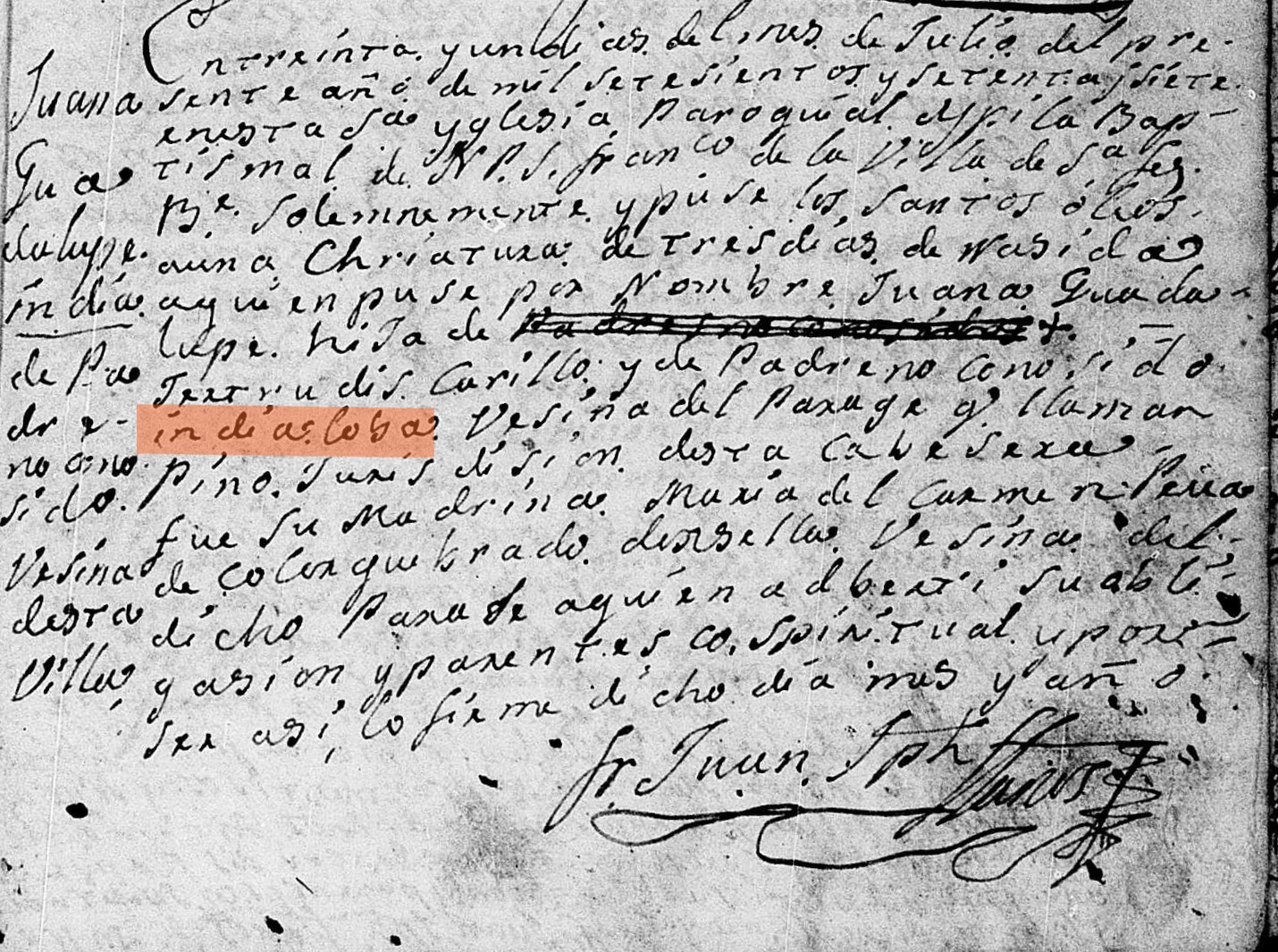
MACEHUALTÍN
The Nahuatl term macehualtín (singular: macehualli) referred to the class of commoners in pre-Hispanic Nahua society. Rooted in the verb macehua (“to deserve” or “to earn through merit”), the term denoted those who labored through their own effort. The macehualtín formed the backbone of Nahua city-states (altepetl), working as agriculturalists, artisans, and warriors. Though positioned beneath the noble pipiltín they held important communal rights through the calpulli—traditional kinship and landholding units—and could gain recognition through military service or exemplary labor.
Following the Spanish conquest, colonial authorities repurposed Nahua social categories for their own administrative and extractive systems. The macehualtín became the principal Indigenous labor force within the encomienda and repartimiento, compelled to provide tribute and seasonal labor in agriculture, construction, and mining. Spanish and Indigenous scribes continued to use the term in tribute rolls, censuses, and legal documents to distinguish commoners from both nobles and enslaved persons (tlacotín).
Despite their subjugation, macehualtín communities demonstrated resilience and adaptability. They engaged Spanish courts to contest tribute burdens, defend communal lands, and maintain aspects of traditional governance. The persistence of the term macehualtín in colonial records reflects not only a structure of exploitation but also the continuity of Indigenous identity and social organization under colonial rule. It stands as a testament to how Indigenous categories were refashioned—yet not erased—by colonial power.
Citations:
- Codex Mendoza, fols. 60–67, in The Codex Mendoza, eds. Frances Berdan and Patricia Rieff Anawalt (University of California Press, 1992).
- Karttunen, Frances. An Analytical Dictionary of Nahuatl. University of Oklahoma Press, 1992.
- Lockhart, James. The Nahuas After the Conquest: A Social and Cultural History of the Indians of Central Mexico, Sixteenth Through Eighteenth Centuries. Stanford University Press, 1992.
MADRINA
The term madrina, derived from madre (“mother”), refers to a godmother in Christian sacramental contexts, including baptism, confirmation, and marriage. In colonial Latin America, madrinas played both spiritual and social roles, formally assuming responsibility for the religious formation of godchildren (ahijados), particularly within a framework of Catholic orthodoxy and Spanish cultural norms.
Baptismal records involving Indigenous or enslaved individuals frequently name madrinas, often as the sole adult listed besides the officiating clergy. Their presence signaled not only a ritual inclusion into Christian society but also a mechanism for embedding marginalized individuals within colonial hierarchies. Godparentage could function as a means of surveillance, discipline, and strategic alliance-building. Many madrinas were drawn from local elites, religious orders, or households connected to systems of labor control, reflecting the deeply stratified nature of colonial religious life.
Although framed as an act of spiritual care, the role of madrina also served to reinforce social hierarchies, particularly along lines of race, class, and gender. The godmother was often expected to guide the moral development of the godchild according to colonial values, and the sacramental tie was used to regulate behavior and obligations. In some cases, the choice of a madrina was imposed, especially in the baptism of enslaved or orphaned children.
Linguistically and culturally, madrina carries connotations of maternal care, but within the colonial world, it also marked the institutional imposition of Catholic identity, entrenching unequal power relationships under the guise of religious mentorship.
Citations:
- Farriss, Nancy. Maya Society under Colonial Rule: The Collective Enterprise of Survival. Princeton University Press, 1984.
- Lavrin, Asunción. Sexuality and Marriage in Colonial Latin America. University of Nebraska Press, 1989.
- Real Academia Española. Diccionario de la lengua española. 22nd ed., 2001. Entry on “madrina.”
MAÎTRE
The French term maître, derived from the Latin magister (“master” or “teacher”), historically signified an individual who held authority, ownership, or specialized status. In colonial contexts, maître functioned as both a legal honorific and a descriptor of social domination, particularly in relation to the enslavement of African and Indigenous peoples in the French Atlantic world.
During the ancien régime and throughout the French colonial empire, maître was commonly used in reference to slaveholders, particularly in official documents, plantation registers, and notarial records. It designated the person who held legal ownership over an enslaved individual—“maître de l’esclave”—and thus carried a connotation of total control over another person’s body, labor, and movement. The title could be applied to men and women, though maîtresse (feminine) appeared less frequently in formal documentation.
Beyond enslavement, maître also indicated a professional or elevated social status: notaries (maître notaire), lawyers (maître avocat), artisans (maître tailleur), or guild members. This dual usage—both professional and proprietorial—reflected how French colonial society naturalized hierarchy and possession, whether over people, labor, or skill.
Importantly, in plantation colonies such as Saint-Domingue, Martinique, and Guadeloupe, enslaved individuals often used maître when referring to their owners, reinforcing the linguistic performance of subordination. This usage persisted in legal petitions and runaway notices, where the maître’s name was cited as proof of ownership. In New France and Louisiana, maître appeared in civil contracts involving enslaved Africans and Indigenous captives, further embedding the term in the legal frameworks of colonial slavery.
While maître today survives as a neutral professional title, its historical usage in colonial settings underscores the intimate connections between language, domination, and law. It exemplifies how European languages codified systems of racialized ownership and reinforced the social legitimacy of enslavement.
Citations:
- Boulle, Pierre H. Race et esclavage dans la France de l’Ancien Régime. Perrin, 2007.
- Peabody, Sue. "There Are No Slaves in France": The Political Culture of Race and Slavery in the Ancien Régime. Oxford University Press, 1996.
- White, Sophie. Voices of the Enslaved: Love, Labor, and Longing in French Louisiana. Omohundro Institute/UNC Press, 2019.
MAMELUCOS
The term mameluco was used in colonial Brazil to refer to individuals of mixed European and Indigenous ancestry, specifically the offspring of a white Portuguese man and an Indigenous woman. The term shares its etymological origin with the Arabic mamlūk (“owned” or “slave”), historically used to describe enslaved soldiers of Turkic or Circassian origin in Islamic empires. While the term underwent a transformation in meaning in the Americas, its association with servitude, conquest, and racialized status persisted.
In Portuguese America, mamelucos were often associated with expansionist expeditions into Indigenous territories, especially in the interior regions of Brazil. Many served as guides, intermediaries, or enforcers in bandeiras—militarized slave raids that sought to capture Indigenous people for forced labor. In this context, mamelucos became both symbols and agents of colonization, simultaneously marginalized and instrumentalized within the settler colonial project.
The term carried ambiguous status. In some contexts, mamelucos were viewed as more “civilized” than Indigenous peoples, due to their partial European ancestry, and could be integrated into settler society through militia service or commerce. In other cases, they remained socially and legally subordinate, especially when associated with Indigenous customs or language. Their identity was thus shaped by geography, behavior, and proximity to whiteness, rather than ancestry alone.
The use of mameluco reflects the Portuguese colonial effort to define, rank, and utilize racial mixture, particularly in relation to Indigenous labor and land dispossession. Unlike the rigid casta systems of Spanish America, Portuguese racial classifications were more fluid and pragmatic, yet no less exploitative. The term also reveals how racialized identities were bound to imperial violence: mamelucos were both products of conquest and participants in its continuation.
Citations:
- Metcalf, Alida C. Go-betweens and the Colonization of Brazil, 1500–1600. University of Texas Press, 2005.
- Schwartz, Stuart B. Slaves, Peasants, and Rebels: Reconsidering Brazilian Slavery. University of Illinois Press, 1996.
- Sweet, David. “A Rich Realm of Nature Destroyed: The Middle Amazon Valley, 1640–1750.” In The Cambridge History of the Native Peoples of the Americas, Volume 3: South America, edited by Frank Salomon and Stuart B. Schwartz, Cambridge University Press, 1999.
MARAJAQI
The term marajaqi referred to an Indigenous person, likely male, compelled into personal service within colonial and early republican Bolivia, particularly in Aymara-speaking regions. It appears in lists of roles associated with Indigenous servitude, including pongo, mitani, and ponguillo, cited by Roberto Choque Canqui as part of a “variedad en prestación de servicios personales.” Although less commonly referenced in surviving administrative texts, the inclusion of marajaqi in an official 1762 complaint by Francisco Miguel Quispe (ANB EC. 1762, No. 130) suggests its formal use in describing coercive labor roles imposed by local Indigenous authorities under the logic of tribute and subordination.
The etymology of marajaqi is rooted in the Aymara language, possibly related to mara (year) and the suffix jaqi (person or being), though this remains speculative. It may imply a person obligated on an annual basis or tied to cyclical service duties, a structure not unlike rotational mita labor. The term does not appear in Spanish colonial dictionaries or mainstream lexicons, highlighting its regional specificity and Indigenous linguistic origins. Like related terms in the service caste, marajaqi exemplifies the euphemisms used to obscure systems of forced Indigenous labor that endured well into the republican period under the guise of custom, community obligation, or domestic economy.
Citations:
- Albó, Xavier. Los señores del poder: los ayllus y la política en el norte de Potosí. CIPCA, 1987.
- Archivo Nacional de Bolivia (ANB), EC. 1762, Nº 130. Francisco Miguel Quispe, indio principal del pueblo de Tiwanaku y capitán enterador de la mita de Potosí.
- Choque Canqui, Roberto. “La servidumbre indígena andina de Bolivia.” Política y economía en los Andes (siglos XVI–XX), editado por Tristan Platt et al., Institut Français d’Études Andines (IFEA), 2006.
MASTER
The English term master, derived from the Latin magister (“chief” or “teacher”), historically denoted a person who held authority, ownership, or command over others. In colonial contexts across the English-speaking Americas, master became a key legal and social designation used to identify the enslaver of African and Indigenous people, as well as a broader figure of dominance in systems of forced labor, apprenticeship, and indenture.
By the 17th century, master was widely used in legal codes, plantation records, and court proceedings to refer to individuals who held chattel property in human beings. Enslaved persons were frequently described as belonging to a master, and the term was used in baptismal registers, wills, sale contracts, and runaway advertisements to signify legal control. Master also appeared in titles such as “master of the plantation” or “slave master,” connoting both ownership and governance.
The authority embedded in the term extended beyond legal possession. Masters were empowered to discipline, punish, extract labor, and determine the lives and deaths of those they enslaved. In some jurisdictions, legal codes such as the Barbados Slave Code (1661) or Virginia Slave Codes codified the master’s power as absolute. In New England and the mid-Atlantic, the term also applied to those who held Indigenous people in bondage, whether through direct enslavement or long-term coerced servitude.
Master was also a title of respect or professional standing—e.g., “master carpenter” or “schoolmaster”—but in the context of slavery, it conferred both social prestige and systemic power. Its use reflected and reinforced a racialized hierarchy, in which whiteness and ownership were linked through language. Enslaved individuals were often required to refer to enslavers as “master” (or “massa,” in creolized forms), a practice that enacted linguistic submission and reinforced the performance of deference.
Although the term has survived in neutral or honorific forms (e.g., “master’s degree”), its historical usage in slavery has rendered it deeply fraught. Contemporary reckonings with slavery in institutions and archives have called for critical reflection on the term’s legacy, especially where “master” continues to appear in metadata, titles, or building names.
Citations:
- Johnson, Walter. Soul by Soul: Life Inside the Antebellum Slave Market. Harvard University Press, 1999.
- Morgan, Jennifer L. Laboring Women: Reproduction and Gender in New World Slavery. University of Pennsylvania Press, 2004.
- Sweet, John Wood. Bodies Politic: Negotiating Race in the American North, 1730–1830. University of Pennsylvania Press, 2003.
MAYORDÓMO/A
Translated: Steward
The term mayordómo, derived from the Latin major domus (“chief of the household”), historically referred to a steward or head servant responsible for managing the economic and domestic affairs of a noble estate, institution, or household. The Diccionario de Autoridades (1734) defines mayordómo as “El Xefe principal del alguna cosa ilustre, a quien estan sujetos y subordinados los demas criados, y a cuya cargo esta el gobierno economico de ella” (“The principal chief of an illustrious thing, to whom the other servants are subject and subordinate, and who is in charge of its economic governance”). This definition highlights the term’s close association with structured hierarchy and delegated authority.
In the Spanish colonial world, mayordómos served as key administrators of labor forces on haciendas, missions, and other agricultural or religious enterprises. They implemented the directives of landowners, religious superiors, or administrators, often managing Indigenous and enslaved laborers through systems of coercion and surveillance. On missions, mayordómos were instrumental in organizing the daily work of Indigenous converts, reinforcing the economic foundations of religious institutions under the pretense of Christian formation.
The role of the mayordómo varied by setting but consistently involved economic oversight, labor discipline, and enforcement of social hierarchies. In many cases, mayordómos were themselves of Indigenous, African, or mixed ancestry, appointed to intermediate between colonial elites and the laboring classes. This dual positioning complicated their role, as they navigated both subordination and delegated power within a rigidly stratified colonial order.
Though the title was also used in religious contexts—such as the stewardship of confraternities or festivals—its application in colonial labor regimes underscores its importance in studies of exploitation, authority, and institutional control. The authority vested in the mayordómo reveals how colonial systems distributed power and maintained coercive structures through everyday administrators.
Citations:
- Diccionario de Autoridades. 1734. Entry on “mayordómo.”
- Lockhart, James. Spanish Peru, 1532–1560: A Colonial Society. University of Wisconsin Press, 1994.
- Real Academia Española. Diccionario de la lengua española. 22nd ed., 2001. Entry on “mayordómo.”
MESTIZO/A
The term mestizo (feminine: mestiza) was a central category in the colonial casta system, referring to individuals of mixed Spanish and Indigenous ancestry. Etymologically, the word derives from the Latin mixticius (“mixed”). In colonial Latin America, mestizos/as occupied a complex and often contradictory position in society. Though they generally ranked above Indigenous and African-descended peoples in the social hierarchy, they were excluded from the privileges afforded to Spaniards and criollos (American-born Spaniards).
Many mestizoss worked as artisans, farmers, or in skilled trades, and some could achieve limited social mobility through education, military service, or economic success. Yet their ambiguous status left them subject to discrimination and restrictions on land ownership, inheritance, and political participation. Over time, the category took on moral and legal weight, often becoming a marker of illegitimacy or impurity.
According to Ben Vinson III, while mixed children were rendered legitimate early in the conquest, “a series of mid-sixteenth century conspiracies and rebellions, launched by creole and mestizo elites, changed this perspective. A new attitude toward racial mixture began to emerge gradually between 1540 and the 1570s. It was at this time that the term mestizo began appearing with more frequency, becoming virtually synonymous with illegitimacy.” Despite this stigma, “Mestizos considered themselves above the rest of the non-españoles (de calidad privilegiada) and lobbied for special privileges, immunities, and exemptions.”
María Elena Martínez further argues that the institutionalization of mestizo identity was inseparable from Spanish anxieties over lineage, religious purity, and sexual control. She notes that colonial authorities used racial nomenclature not only to structure social difference but to enforce broader regimes of power over land, labor, and kinship.
The use of mestizo within the casta system highlights the colonial drive to define, hierarchize, and control racial categories. These classifications reinforced hierarchies and justified systems of exploitation, including tribute, forced labor, and social surveillance. Over time, the growing population of mestizos blurred these boundaries, reflecting the fluid and contested nature of colonial identities. Their racialization reveals colonial ambivalence—mestizos were celebrated as evidence of Spanish “civilizing” efforts yet feared as a threat to colonial stability and racial order.
Citations:
- Martínez, María Elena. Genealogical Fictions: Limpieza de Sangre, Religion, and Gender in Colonial Mexico. Stanford University Press, 2008.
- Real Academia Española. Diccionario de la lengua española, accessed January 2025, https://www.rae.es.
- Vinson III, Ben. Before Mestizaje: The Frontiers of Race and Caste in Colonial Mexico. Cambridge University Press, 2018.
MÉTIS
The term métis originates from the French word métis (“mixed”), and historically referred to individuals of both Indigenous and European ancestry. In the context of New France, it initially described the children of Indigenous women and French traders or settlers. Over time, particularly in the 18th and 19th centuries, the term evolved to designate a distinct Indigenous people whose identity was rooted in the fur trade economy of the northern Plains and subarctic, especially in present-day Manitoba, Saskatchewan, and Alberta.
Métis communities developed cohesive political, cultural, and economic structures that blended Indigenous and European traditions. These included the Michif language, bison-hunting brigades, and forms of governance rooted in kinship and mobility. By the mid-19th century, métis leaders such as Louis Riel spearheaded resistance movements against Canadian state expansion, asserting métis land rights and political autonomy in the Red River and Northwest resistances.
Unlike the broader term mestizo, which often refers generically to racial mixture, métis refers to a specific Indigenous peoplehood with its own collective identity, nationhood, and legal recognition. Today, the métis are recognized as one of the three constitutionally protected Indigenous peoples of Canada under Section 35 of the Constitution Act, 1982. Landmark legal decisions, such as R. v. Powley (2003), have affirmed métis rights and underscored the importance of historical continuity and community-based identity.
While some métis individuals participated in settler colonial economies that involved coercive labor practices, the core of métis history emphasizes resistance to dispossession, cultural resurgence, and the assertion of Indigenous nationhood.
Citations:
- Andersen, Chris. “Métis”: Race, Recognition, and the Struggle for Indigenous Peoplehood. UBC Press, 2014.
- Ens, Gerhard J., and Joe Sawchuk. From New Peoples to New Nations: Aspects of Métis History and Identity from the Eighteenth to the Twenty-First Centuries. University of Toronto Press, 2016.
- Gaudry, Adam. “The Métis-ization of Canada: The Process of Claiming Louis Riel, Métissage, and the Métis People as Canada’s Mythical Origin.” Aboriginal Policy Studies, Vol. 2, no. 2, 2013, pp. 64–87.
- Macdougall, Brenda. One of the Family: Métis Culture in Nineteenth-Century Northwestern Saskatchewan. UBC Press, 2010.
MISSION
The term mission derives from the Latin missio (“sending”) and came to refer to settlements established by Christian missionaries for the conversion and cultural assimilation of Indigenous populations. Missions were central to colonial expansion across Spanish, Portuguese, and French territories, functioning as both religious outposts and instruments of imperial control.
Beginning in the 16th century, missions were strategically located to concentrate Indigenous populations into centralized settlements. These sites enabled the enforcement of European religious practices, agricultural techniques, and labor systems such as the encomienda and repartimiento. Missions also helped solidify colonial sovereignty, placing Indigenous communities under the authority of clergy and royal officials.
Religious orders—particularly Franciscans, Jesuits, and Dominicans—played a key role in founding and managing these settlements. While missionaries often described their efforts as benevolent, missions disrupted Indigenous lifeways, displaced communities from ancestral lands, and eroded traditional governance structures. Mission economies relied on coerced Indigenous labor, making conversion inseparable from economic exploitation.
The term mission thus encapsulates both the religious and colonial dimensions of these institutions. Missions were spaces of profound transformation, where forced assimilation, labor exploitation, and territorial consolidation converged. Colonial and missionary records frequently referenced missions in relation to land disputes, labor quotas, and sacramental administration, underscoring their foundational role in the colonization of the Americas.
Citations:
- Brown, Tracy L. “The Tejano Mission Experience: Historical Memory and the Rescuing of Forgotten Narratives.” In Recovering the Hispanic History of Texas, edited by Monica Perales and Raúl Ramos, 197–217. Houston: Arte Público Press, 2010.
- Castillo, Edward D. A Cross of Thorns: The Enslavement of California’s Indians by the Spanish Missions. Craven Street Books, 2015.
- Jackson, Robert H. Missions and the Frontiers of Spanish America: A Comparative Study of the Impact of Environmental, Economic, Political, and Socio-Cultural Variations on the Missions in the Rio de la Plata Region and on the Northern Frontier of New Spain. Pentacle Press, 2005.
- Real Academia Española. Diccionario de la lengua española. 22nd ed., 2001. Entry on “misión.”
MISTRESS
The English term mistress, derived from the Old French maistresse (feminine of maistre), originally denoted a woman in a position of authority or control. In colonial contexts throughout the English-speaking Americas, mistress referred specifically to a female slaveholder, as well as to women who held legal, domestic, or social power over enslaved or indentured individuals. Though often overshadowed by the term master, the figure of the mistress played a critical role in sustaining and enforcing racialized systems of enslavement.
In legal and domestic records—from wills and probate inventories to runaway advertisements and court cases—mistress denoted a woman who owned enslaved people outright, inherited them through family networks, or exercised daily control over their labor and mobility. While married women were sometimes legally constrained by coverture (their husband’s legal authority), many acted independently as slaveholders, especially as widows, unmarried women, or heads of household. Their roles included assigning labor, meting out discipline, and managing reproduction and caregiving among the enslaved.
The plantation mistress was often responsible for the intimate regulation of enslaved women’s bodies, particularly in the domestic sphere. This included overseeing childbirth, childcare, and sexual policing, sometimes through violence. While framed in historical narratives as morally conflicted or emotionally distant, many mistresses were active participants in the economic and physical control of enslaved people, as shown in surviving letters, diaries, and testimonies.
Importantly, mistress also carried an ambiguous meaning: it could refer to a woman who held romantic or sexual authority, often as the non-married partner of a man. This dual meaning complicates the term’s use in slavery-era documents, especially in cases where enslaved women were referred to as "mistresses" in white male narratives—a euphemism that obscured coercion and sexual violence.
The figure of the mistress reflects how patriarchal and racial hierarchies were mutually reinforcing in slave societies. Even without the formal political power of their male counterparts, white women in slaveholding households exercised significant authority, often within the boundaries of domestic space, and were integral to the perpetuation of slavery as both an economic system and a social order.
Citations:
- Jones-Rogers, Stephanie E. They Were Her Property: White Women as Slave Owners in the American South. Yale University Press, 2019.
- Morgan, Jennifer L. Laboring Women: Reproduction and Gender in New World Slavery. University of Pennsylvania Press, 2004.
- White, Deborah Gray. Ar’n’t I a Woman? Female Slaves in the Plantation South. W. W. Norton, 1985.
MIT'A
The Quechua term mit’a (from mit’ani, “to take a turn” or “to rotate”) referred to a system of rotational labor used in the Inca Empire. Under this structure, adult male members of ayllu (kin-based communities) were required to provide labor as a form of service to the state. These obligations were organized on a cyclical basis and could involve infrastructure construction, agricultural work, military service, or maintenance of state storage facilities (qollqas). While compulsory, the mit’a was rooted in principles of reciprocity: the Inca state provided land access, protection, and redistribution of goods in exchange for labor, and service was distributed equitably across the population.
Spanish colonial administrators later appropriated this system, adapting it into the mita—a fundamentally different institution. Though framed as a continuation of Inca custom, the colonial mita was a coercive labor draft imposed on Indigenous communities, especially in mining regions such as Potosí. The conditions were grueling, compensation minimal, and the death toll devastating. Unlike the Inca model, which rotated service and preserved communal structures, the colonial mita severed workers from their families and support networks, converting a system of shared responsibility into one of extraction.
This transformation exemplifies how Indigenous institutions were reinterpreted and weaponized to serve imperial goals. Scholars such as Karen Spalding and Nathan Wachtel have emphasized that although the term mit’a persisted in colonial records, its meaning—and its consequences—changed profoundly under Spanish rule.
Today, mit’a remains a central concept in Andean historiography, symbolizing both the organizational power of the Inca state and the distortions introduced by colonialism.
Citations:
- González Holguín, Diego. Vocabulario de la lengua general de todo el Perú. 1608.
- Spalding, Karen. Huarochirí: An Andean Society Under Inca and Spanish Rule. Stanford University Press, 1984.
- Wachtel, Nathan. The Vision of the Vanquished: The Spanish Conquest of Peru Through Indian Eyes, 1530–1570. Harper & Row, 1977.
MITANI
The term mitani referred to an Indigenous servant—often female—compelled to perform domestic or semi-domestic labor in colonial and republican Bolivia, especially in Aymara-speaking communities. Commonly grouped with other roles such as pongo, marajaqi, and ponguillo, the mitani represented a form of coercive personal service drawn from tributary Indigenous populations. These roles persisted across the transition from colony to republic and were often imposed by local officials or caciques. Though lacking formal recognition as slavery, the labor was frequently unpaid, humiliating, and enforced by customary or political pressure.
The etymology of mitani likely derives from mita, the rotational labor draft system imposed on Indigenous peoples under colonial rule. The suffix -ni may denote a diminutive or agentive form in Aymara or Quechua, possibly indicating a subordinate or feminized role within the broader mita framework. While mitani does not appear in early Spanish dictionaries such as the Diccionario de Autoridades, it surfaces in archival sources, such as a 1762 complaint filed by Francisco Miguel Quispe in Tiwanaku (ANB EC. 1762, No. 130), who denounced his forced service under this label. As Roberto Choque Canqui notes, the term reflects how Indigenous servitude was maintained through euphemism long after legal abolition.
Citations:
- Archivo Nacional de Bolivia (ANB), EC. 1762, Nº 130. Francisco Miguel Quispe, indio principal del pueblo de Tiwanaku y capitán enterador de la mita de Potosí.
- Choque Canqui, Roberto. “La servidumbre indígena andina de Bolivia.” Política y economía en los Andes (siglos XVI–XX), editado por Tristan Platt et al., Institut Français d’Études Andines (IFEA), 2006.
- Crespo Rodas, Alberto. Esclavos negros en Bolivia. Ediciones ISLA, 1977.
MORENO/A
The term moreno (feminine: morena), meaning “dark-skinned” or “brown” in Spanish, functioned in colonial Spanish America as a phenotypic and racial descriptor that often—but not always—referred to individuals of African ancestry. Derived from the Latin maurus ("Moorish"), the term evolved in early modern Spain to describe persons with darker skin, and by the colonial period it became a widely used but ambiguous label within racialized social systems.
In colonial records, moreno appeared in parish registers, censuses, and notarial documents, sometimes used interchangeably with or in place of formal caste labels like negro, mulato, or pardo. While moreno often signaled African descent, it could also function as a visual descriptor, applied based on appearance rather than genealogy. As a result, it occupied a liminal space—a marker of racialization without strict caste definition.
In her analysis of marriage records from 18th-century Mexico City, Luz María Martínez Montiel notes that moreno frequently appeared as a way to soften or obscure caste status, especially in urban parishes where African descent was widespread but sometimes strategically downplayed. Individuals labeled moreno might be recognized as free, Catholic, and culturally integrated, suggesting that the term could mitigate the legal and social consequences associated with more stigmatized identities like negro.
At the same time, moreno was not a neutral or empowering term. It was used to naturalize difference, signal marginality, and enforce social hierarchies based on skin tone and ancestry. Like other color terms—trigueño, prieto, cobrizo—moreno reflects the colonial fixation on visibility as a marker of value, morality, and belonging. Its flexibility made it useful to both individuals seeking mobility and institutions seeking to sustain racial order.
Citations:
- Martínez Montiel, Luz María. “Marriage Patterns of Persons of African Descent in a Colonial Mexico City Parish, 1750–1792.” The Hispanic American Historical Review, Vol. 51, no. 1, 1971, pp. 79–91.
- Martínez, María Elena. Genealogical Fictions: Limpieza de Sangre, Religion, and Gender in Colonial Mexico. Stanford University Press, 2008.
- Twinam, Ann. Purchasing Whiteness: Pardos, Mulattos, and the Quest for Social Mobility in the Spanish Indies. Stanford University Press, 2015.
- Vinson III, Ben. Before Mestizaje: The Frontiers of Race and Caste in Colonial Mexico. Cambridge University Press, 2018.
MORISCO
The term morisco was used within the territories of the Spanish empire to classify individuals of mixed Spanish and African ancestry—specifically the child of a Spaniard (español) and a mulato. While commonly associated with the casta system, morisco was not solely a racial term. It carried a complex etymology and colonial legacy rooted in Iberian religious history.
In Spain, morisco originally referred to Muslims who converted (voluntarily or under pressure) to Christianity following the Reconquista. These nuevos cristianos ("New Christians") were subject to suspicion and legal discrimination, despite formal conversion. When transposed to the Americas, the term lost its religious connotation and was repurposed as a racial caste designation. As María Elena Martínez and others have noted, this shift from religion to race reflects how colonial societies adapted older Iberian frameworks of purity and otherness to the context of slavery and human mixture.
In colonial caste matrices and casta paintings, morisco often appears as a step closer to whiteness than mulato, yet still marked by African ancestry. This intermediate status could bring relative social and legal advantage, such as access to guilds or lower tribute rates, but moriscos remained excluded from many positions of honor and subject to racial surveillance. In some parish records and legal petitions, morisco identity was strategically negotiated—sometimes softened into mestizo or reclassified through gracias al sacar.
The use of morisco underscores the artificial and contingent nature of the casta system. Like other labels, it linked ancestry to legal capacity, moral character, and occupational potential. Its very ambiguity—marked by a name once denoting religious alterity and later racial mixture—reveals the evolving strategies colonial regimes used to regulate status, labor, and belonging.
Citations:
- Katzew, Ilona. Casta Painting: Images of Race in Eighteenth-Century Mexico. Yale University Press, 2004.
- Martínez, María Elena. Genealogical Fictions: Limpieza de Sangre, Religion, and Gender in Colonial Mexico. Stanford University Press, 2008.
- Twinam, Ann. Purchasing Whiteness: Pardos, Mulattos, and the Quest for Social Mobility in the Spanish Indies. Stanford University Press, 2015.
- Vinson III, Ben. Before Mestizaje: The Frontiers of Race and Caste in Colonial Mexico. Cambridge University Press, 2018.
MOZO
Variations: Mozo de labranza: This refers to a farm laborer or field worker, typically a young man engaged in agricultural tasks.
The term mozo originates from the Latin muttīre ("to mutter" or "murmur"), evolving into Old Spanish as moço ("young person" or "youth"). The earliest recorded definition appears in the 1734 edition of the Diccionario de la lengua castellana, where it is described as lo mismo que joven (“the same as young”). By 1780, the definition had expanded to include labor connotations: el criado que sirve en las casas en los ministerios de trabajo, aunque tenga mucha edad (“the servant who serves in the house in the ministries of work, even if he is very old”). This linguistic shift reflects the term’s transformation from a descriptor of youth to a designation for laborers, particularly in servile positions.
Within the territories of the Spanish empire, mozo was widely used to refer to Indigenous, African-descended, or mixed-race men engaged in agricultural labor, domestic service, and other menial tasks. While the term retained its association with youth, it became a marker of social status, denoting subordination rather than simply age. The term was particularly prevalent on haciendas, estancias, and in urban households, where mozos performed essential labor, often under coercive conditions. It was also used in debt peonage (peonaje por deuda), a system that tied laborers—especially Indigenous men—to estates through perpetual financial obligations.
Although mozo was sometimes applied to Spaniards of lower economic standing, it was more frequently racialized, disproportionately designating Indigenous and Afro-descended workers. The term’s flexibility allowed it to be used both as a neutral occupational title and as a euphemism for forced labor, reinforcing colonial racial hierarchies.
By the 19th century, mozo retained its association with labor but became more generalized in rural Latin America, referring to farmhands and laborers. Its historical usage underscores the intersections of age, race, and class in shaping colonial labor systems and highlights how language was used to naturalize social inequality and coercion.
Citations:
- Gibson, Charles. The Aztecs Under Spanish Rule: A History of the Indians of the Valley of Mexico, 1519-1810. Stanford University Press, 1964.
- Premo, Bianca. Children of the Father King: Youth, Authority, and Legal Minority in Colonial Lima. UNC Press, 2005.
- Real Academia Española. Diccionario de la lengua española. 22nd ed., 2001. Entry on “mozo.”
- Stern, Steve J. Peru's Indian Peoples and the Challenge of Spanish Conquest: Huamanga to 1640. University of Wisconsin Press, 1993.
MULATO/A
The term mulato (feminine: mulata), was a central classification within the Spanish empire, used to describe individuals of mixed African and European ancestry—typically the child of a Spaniard (español) and an African (negra or negro). Its etymology remains debated. Some scholars argue that mulato derives from the Spanish word mula (mule), with its connotation of animal hybridity and sterility, reflecting the dehumanizing logic of racial mixture. Others suggest an Arabic origin from muwallad, meaning someone of mixed ancestry or born of a non-Arab mother. Regardless of its linguistic root, the term became entrenched in imperial discourse as a racial category tied to social regulation.
Across the territories of the Spanish empire, mulato was one of the most frequently recorded casta labels. As Edgar Love’s analysis of eighteenth-century Mexico City parish records shows, the term appeared regularly in marriage registers, where African descent—however partial—was a significant factor in assessing social eligibility, tribute obligations, and occupational roles. While many mulatos were free, their African lineage marked them as inherently inferior in the eyes of colonial authorities. They were subject to discriminatory laws, exclusion from guilds, and restrictions on clothing, arms, and mobility.
Mulatos occupied an ambiguous and often precarious space. Many worked as artisans, servants, muleteers, or day laborers. Some achieved modest wealth or influence and, in rare cases, petitioned for legal whiteness or owned enslaved laborers themselves. These upward moves were exceptions, however, and were shaped by local dynamics, phenotype, and reputation. In practice, the term mulato could encompass a range of skin tones and family histories, reflecting the fluid yet punitive nature of colonial racial categorization.
The use of mulato illustrates the imperial obsession with codifying human variation while maintaining social control through legal and visual surveillance. The category reinforced the idea that African ancestry—regardless of generational distance—was a barrier to honor and privilege. At the same time, it reveals the porous and contested boundaries of caste identity, where race was read through lineage, behavior, speech, and appearance rather than blood alone.
Citations:
- Love, Edgar F. “Marriage Patterns of Persons of African Descent in a Colonial Mexico City Parish.” The Hispanic American Historical Review, Vol. 51, no. 1, 1971, pp. 79–91.
- Martínez, María Elena. Genealogical Fictions: Limpieza de Sangre, Religion, and Gender in Colonial Mexico. Stanford University Press, 2008.
- Twinam, Ann. Purchasing Whiteness: Pardos, Mulattos, and the Quest for Social Mobility in the Spanish Indies. Stanford University Press, 2015.
- Vinson III, Ben. Before Mestizaje: The Frontiers of Race and Caste in Colonial Mexico. Cambridge University Press, 2018.
NA'Ł A
The Western Apache term naʼłá translates as “slave,” referring to individuals held in bondage or servitude. Documented in William de Reuse’s Western Apache-English Dictionary (1998), the term was historically applied to captives who remained in subordinate roles within Apache communities, typically performing labor or subject to exchange.
In Apache societies, captivity followed a range of outcomes. Some individuals—particularly children—were adopted and integrated into kinship networks. Others, especially adults taken during raids, were retained for labor or traded with other groups, including Spanish and Mexican settlers. Those designated as naʼłá occupied a lower social position and were generally not assimilated into the family structure. Their treatment varied, but their status reflected limited autonomy and persistent dependence.
Colonial contact exacerbated these practices. The Spanish and later Mexican regimes institutionalized Indigenous slavery, at times demanding captives from Apache groups or enslaving Apache people themselves. In this context, the meaning of Naʼłá expanded to encompass the commodification of human beings, intersecting with both Indigenous and colonial systems of forced labor and exchange.
The term naʼłá thus captures the fluid and often violent dynamics of captivity in the Southwest—where boundaries between kinship, coercion, and commerce were constantly redrawn under the pressures of empire and survival.
Citations:
- Garrick Bailey and Roberta Glenn Bailey, A History of the Navajos: The Reservation Years. Santa Fe: School of American Research Press, 1986.
- James Brooks, Captives and Cousins: Slavery, Kinship, and Community in the Southwest Borderlands. University of North Carolina Press, 2002.
- Willem J. de Reuse, Western Apache-English Dictionary: A Community-Generated Bilingual Dictionary . München: Lincom Europa, 1998, p. 221.
NAALTÉ
The Diné ("Navajo") term naalté refers to a person held in bondage or servitude—typically translated as “slave.” It derives from the verb naal (“to own” or “to possess”) and marks a relationship in which one individual is regarded as the property of another. The term appears in An Ethnologic Dictionary of the Navaho Language (1910), where it is defined explicitly as “slave,” distinguishing it from other Navajo terms related to captivity or kinship-based incorporation.
Unlike nááʼálkid—a term used for captives who could be adopted into Diné society—naalté denotes a more rigid condition of subjugation, particularly when captives were not integrated into kinship networks but retained as bound laborers. While Diné society emphasized extended familial relationships and incorporation of outsiders, colonial pressures—including the Spanish slave trade and Mexican raiding—introduced and intensified patterns of commodified human captivity. In this context, naalté came to reflect a condition increasingly shaped by external systems of racialized enslavement.
The persistence of naalté in the Navajo lexicon underscores the complex intersections between Indigenous practices of captivity and the expanding colonial economy of forced labor. It serves as a reminder of how Diné language preserved distinctions between captivity as a social process and slavery as commodification—while also bearing witness to the distortions introduced by colonial violence.
Citations:
- Bailey, Garrick and Roberta Glenn Bailey. A History of the Navajos: The Reservation Years. Santa Fe: School of American Research Press, 1986.
- Franciscan Fathers. An Ethnologic Dictionary of the Navaho Language. St. Michaels, AZ: St. Michaels Press, 1910.
- Iverson, Peter. Diné: A History of the Navajos. Albuquerque: University of New Mexico Press, 2002.
NÁÁʼÁLKID
The Diné ("Navajo") term nááʼálkid translates to “captive” or “prisoner,” referring to individuals held during or after conflict, raiding, or forced relocation. Rooted in Navajo verbs related to watching or guarding, the word emphasizes containment and surveillance, distinguishing it from terms associated with permanent ownership or property.
In traditional Diné society, nááʼálkid encompassed a wide range of lived experiences. Captives could be temporarily detained, traded, or made to work, but many—especially women and children—were eventually integrated into the community through adoption, marriage, or kinship incorporation. The category was thus socially flexible, shaped more by the evolving relationships within Diné society than by rigid legal status.
Colonial pressures from Spanish, Mexican, and later U.S. forces transformed this dynamic. Nááʼálkid increasingly became a contested category, as colonial actors forcibly removed captives from Diné households and repurposed them as enslaved laborers in settler society. While the Diné had longstanding systems for managing outsiders, colonial systems imposed new meanings of commodification and dispossession, inflecting the term with deeper forms of violence.
Nááʼálkid remains a powerful linguistic marker of this layered history—situated between kinship, conflict, and colonization.
Citations:
- Franciscan Fathers. An Ethnologic Dictionary of the Navaho Language. St. Michaels, AZ: St. Michaels Press, 1910.
- Garrick Bailey and Roberta Glenn Bailey. A History of the Navajos: The Reservation Years. Santa Fe: School of American Research Press, 1986.
- Robert W. Young and William Morgan Sr. The Navajo Language: A Grammar and Colloquial Dictionary. Albuquerque: University of New Mexico Press, 1980.
NABORÍA
Variations: Laborio (indio laborio; indio naborio); naborías perpetuos
The term naboría originates from the Taíno language, referring to individuals in subordinate roles within their communities. In pre-Columbian Taíno society, naborías were commoners directly and permanently dependent upon the caciques ("chiefs") or nobility, performing essential tasks such as agriculture, hunting, and domestic duties. This social structure was integral to the functioning of Taíno communities, ensuring that the needs of the elite were met through the labor of the naborías.
With the advent of Spanish colonization, the Spaniards appropriated the term naboría to describe Indigenous laborers who left their communities to work for Spanish settlers. These individuals were employed in various capacities, including semi-skilled jobs in colonists' homes, mines, estates, and workshops. Unlike indios encomendados under the encomienda system, naborías were often considered more assimilated and loyal to the Spanish, yet their labor was frequently coerced, reflecting broader systems of exploitation and control. This adaptation of the term underscores the blending of Indigenous and Spanish labor practices, illustrating how colonial powers co-opted existing social structures to serve their economic interests.
The role of naborías evolved over time, especially as Indigenous populations declined due to disease and overwork. In some regions, the term came to be associated with debt peonage, where Indigenous laborers were bound to their employers through indebtedness, further entrenching systems of exploitation. This shift highlights the dynamic nature of colonial labor systems and the ways in which Indigenous peoples were subjected to various forms of coercion and control.
Citations:
- Gibson, Charles. The Aztecs Under Spanish Rule: A History of the Indians of the Valley of Mexico, 1519–1810. Stanford University Press, 1964.
- Lockhart, James. The Nahuas After the Conquest: A Social and Cultural History of the Indians of Central Mexico, Sixteenth Through Eighteenth Centuries. Stanford University Press, 1992.
- "Naboría." Diccionario de la lengua española, 22nd ed., Real Academia Española, 2001.
NEÓFITOS
The Spanish term neófitos, from the Greek neóphytos (“newly planted”), was used within the territories of the Spanish empire to describe Indigenous people recently converted to Christianity, particularly within Franciscan, Dominican, and Jesuit mission systems. These individuals occupied a liminal status, neither fully Indigenous in the traditional sense nor fully integrated into colonial society.
Conversion to Christianity entailed strict supervision within missions, where neófitos were required to labor in agriculture, construction, and domestic service. In California missions, they were confined within mission compounds, with punishments for leaving. Jesuit reducciones in Paraguay and northern Mexico similarly imposed communal labor and religious control. While neófitos were considered spiritually regenerated, they remained socially subordinate, subject to restrictions on language, customs, and marriage.
The mission system blurred the line between religious instruction and economic exploitation. Though neófitos were sometimes exempt from tribute obligations, their labor was vital to mission economies. Franciscan friar Junípero Serra defended this coercion, arguing that work and discipline “improved” Indigenous converts.
The designation of neófitos reveals how religious conversion functioned as a tool of assimilation and control. Rather than securing true freedom, the mission system reinforced economic dependence and cultural subjugation under the guise of Christianization.
Citations:
- Hackel, Steven W. Children of Coyote, Missionaries of Saint Francis: Indian-Spanish Relations in Colonial California, 1769–1850. University of North Carolina Press, 2005.
- Jackson, Robert H. Missions and the Frontiers of Spanish America: A Comparative Study of the Impact of Environmental, Economic, Political, and Socio-Cultural Variations on the Missions in the Rio de la Plata Region and on the Northern Frontier of New Spain. University of Arizona Press, 2005.
- Serra, Junípero. Letters and Writings on Mission Life and Indigenous Conversion, 1770–1784. Translated by Antonine Tibesar, Academy of American Franciscan History, 1955.
NIJORA
Variations: Nijor; Nixora; Nijor; Nixor; Nixora; Nigor; Nigora; Nicora; Nichora; Nifora; and Niforo
The term nijora appears in Spanish colonial records as a designation for Indigenous peoples associated with Yuman-speaking nations near the Colorado River. Spanish missionaries and administrators used this term to classify and control Indigenous populations, often presenting nijora as a distinct “nation.” However, there is no evidence that the people labeled as nijora used this name for themselves, suggesting that it was a colonial construct rather than a self-identified ethnonym.
Spanish authorities frequently used such classifications to justify Indigenous captivity, relocation, and forced labor. Those labeled as nijora were often baptized and absorbed into mission labor systems, where they worked in agriculture, construction, and domestic service under conditions resembling slavery. Colonial officials sometimes classified them as “indios de guerra” ("war Indians") to rationalize their capture and forced assimilation into Spanish settlements and mission communities.
The term nijora reflects the bureaucratic and rhetorical strategies used by the Spanish to erase Indigenous political identities and impose colonial rule. By recording individuals under this designation, colonial administrators obscured the cultural, linguistic, and political diversity of Yuman-speaking peoples, facilitating their subjugation. The frequent appearance of nijora in mission registers and administrative documents highlights how colonial classification systems contributed to the institutionalization of Native bondage in the Southwest.
Citations:
- Bolton, Herbert Eugene. Rim of Christendom: A Biography of Eusebio Francisco Kino, Pacific Coast Pioneer. University of Arizona Press, 1936.
- "Nijoras." Tumacácori National Historical Park, National Park Service.
NIKIȢNAKIHA
Variations: nikiȢinakiha arena
The term nikiȢnakiha originates from the Illinois language, part of the Algonquian language family. In the Gravier-Langillier Illinois-French Dictionary (circa 1690s), it is defined as je le fais esclave, le prend en guerre, luy fait chanter sa chanson de mort, translating to "I make him a slave, I capture him in war. I make him sing his death song." This phrase indicates the forced subjugation of captives, particularly within the context of warfare, a key means by which Indigenous societies acquired and integrated enslaved individuals.
The variant nikiȢinakiha arena (je luy oste son brayet, la traite en esclave, "I lift up his breechcloth, treat him like a slave") suggests a symbolic or ritualized act reinforcing a captive’s new status as a slave, likely marking their transition into servitude through public gestures.
In Illinois society, warfare was one of the primary mechanisms for obtaining captives, who were then subjected to various forms of forced labor, servitude, or ritual incorporation. French colonial authorities, who relied on Indigenous raiding networks to sustain the trade in enslaved people, documented these practices as part of the broader colonial system of forced labor. The presence of nikiȢnakiha in linguistic records underscores the deeply embedded nature of captivity and enslavement within Illinois society and how such terms were used to structure relationships of domination and subjugation.
Citations:
- Gravier-Langillier Illinois Dictionary, c. 1690s. Manuscript held at Watkinson Library, Special Collections, Trinity College, Hartford, Conn.
- Rushforth, Brett. Bonds of Alliance: Indigenous and Atlantic Slaveries in New France. University of North Carolina Press, 2012.
NINESSACANTA
The term ninessacanta originates from the Illinois language, part of the Algonquian language family. In the Gravier-Langillier Illinois-French Dictionary (circa 1690s), it is defined as mon esclave celuy qui jay amené, it[em] que jay tué raro hoc sensu, translating to "my slave, the one whom I brought, also whom I killed rarely in this sense."
Historian Brett Rushforth notes that ninessacanta derives from a root meaning "to beat, batter, bludgeon," occasionally connoting "to beat to death." This term reflects the brutal reality captives faced upon being taken in war. Led along by a leash, captives endured physical and verbal abuse during their forced march to their captors' village. The designation ninessacanta signified both the captive’s status as a slave and the potential for their violent fate.
Within Illinois society, captives taken in warfare were often subjected to public displays of dominance, reinforcing their subjugation. Some captives were eventually adopted into the community, while others remained enslaved or were killed in ritualized acts of vengeance. The presence of ninessacanta in historical dictionaries illustrates how language encoded both the realities of captivity and the power dynamics at play in Indigenous and colonial systems of enslavement.
Citations:
- Gravier-Langillier Illinois Dictionary, c. 1690s. Manuscript held at Watkinson Library, Special Collections, Trinity College, Hartford, Conn.
- Rushforth, Brett. Bonds of Alliance: Indigenous and Atlantic Slaveries in New France. University of North Carolina Press, 2012.
NIÑO DE DOCTRINA
The term niño de doctrina ("child of doctrine"), was used within the territories of the Spanish empire to describe Indigenous children placed under the guardianship of religious institutions for Christian instruction and assimilation. These children were often separated from their families, sometimes through coercion or as a result of colonial policies, and brought into missions or doctrinas—settlements established by religious orders—where they were taught the Catholic faith, the Spanish language, and European cultural norms.
This practice was institutionalized through policies such as the Leyes de Burgos of 1512, which mandated that Indigenous children be educated in the principles of Christianity. Specifically, the laws required that for every fifty Indigenous individuals, one or two children be selected to learn reading, writing, and religious doctrines, with the expectation that they would, in turn, teach these to their communities. While framed as benevolent efforts toward education and salvation, these policies often resulted in the erosion of Indigenous cultures and identities.
In many cases, niños de doctrina were utilized as laborers within missions or Spanish households. Their labor was justified under the guise of religious and cultural education, but in practice, it frequently resembled servitude. These children were deprived of their native cultural heritage and familial connections, subjected to forced labor, and compelled to conform to colonial expectations.
The designation niño de doctrina highlights the intersection of colonial religious and social systems in the subjugation of Indigenous peoples. While presented as a process of education and spiritual upliftment, this practice contributed to the systemic erasure of Indigenous identities and traditions. It underscores the vulnerability of Indigenous children, who were targeted as part of broader colonial strategies of exploitation and assimilation.
Citations:
- Klor de Alva, J. Jorge, et al., eds. The Work of Bernardino de Sahagún: Pioneer Ethnographer of Sixteenth-Century Aztec Mexico. University of Texas Press, 1988.
- Ricard, Robert. The Spiritual Conquest of Mexico: An Essay on the Apostolate and the Evangelizing Methods of the Mendicant Orders in New Spain: 1523-1572. University of California Press, 1966.
NITAÏA
The term nitaïa originates from the Illinois language, part of the Algonquian language family. In the Gravier-Langillier Illinois-French Dictionary (circa 1690), nitaïa is defined as "mon animal domestique, mon chien, mon chat. it[em] mon esclave," translating to "my domestic animal, my dog, my cat; also, my slave."
Linguistic analysis suggests that nitaïa may be composed of the first-person possessive prefix ni- ("my") and taïa, which in some contexts denotes a domestic animal or slave. This structure aligns with other Algonquian linguistic patterns, though further verification is needed to confirm this specific breakdown.
This definition indicates that nitaïa was used to refer to domestic animals such as dogs and cats, and by extension, to enslaved individuals. The inclusion of "slave" alongside domestic animals suggests a conceptual linkage in the language between domesticated beings and individuals subjected to ownership or control. Those referred to as nitaïa occupied a dominated social position, often experiencing dishonor and marginalization within the community. Although Indigenous captivity systems differed from European chattel slavery, the use of nitaïa reflects mechanisms of control, coercion, and violence that shaped these systems.
The presence of nitaïa in historical dictionaries highlights how Indigenous and colonial societies categorized and perceived relationships of dominance and subjugation. The linguistic framework used to define captives within Miami-Illinois society underscores the complexities of enslavement in colonial North America.
Citations:
- Dionne, Fannie. "Nouveaux mots, nouveaux mondes: l’histoire de la Nouvelle-France à partir des documents en langue autochtone." Études canadiennes / Canadian Studies, no. 82, 2017, pp. 67–85.
- Gravier, Jacques, and Jacques Largillier. Dictionnaire Illinois-Français, circa 1690. Manuscript, Watkinson Library Special Collections, Trinity College, Hartford, Connecticut.
- Rushforth, Brett. Bonds of Alliance: Indigenous and Atlantic Slaveries in New France. University of North Carolina Press, 2012.
Examples
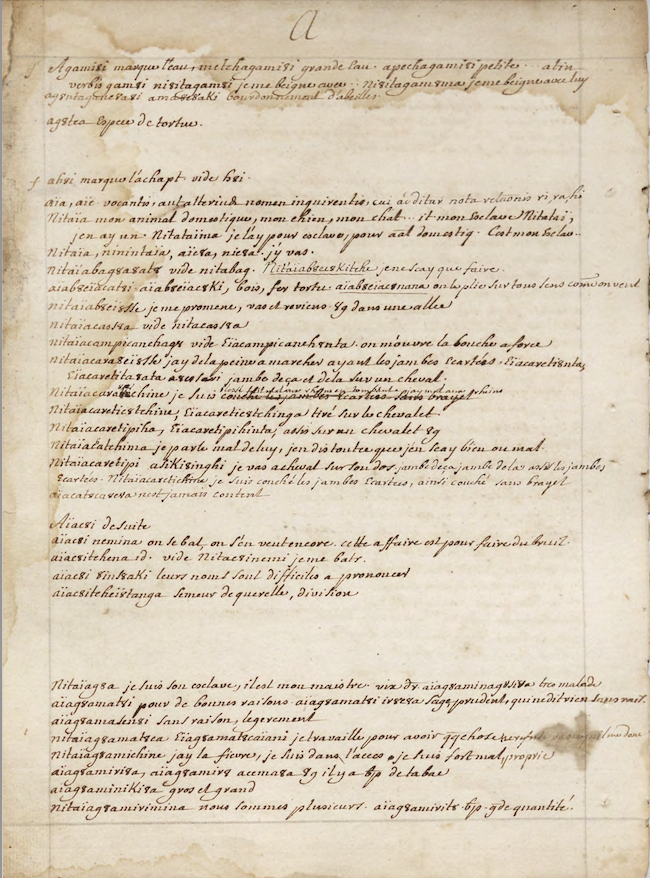
Dictionnaire illinois-français (Dictionary of the Algonquin Illinois Language) attributed to French Jesuit missionary, Father Jacques Gravier, MS, Ca 1690s, MS Page, 17.
NITAÏAGȣA
The rare term nitaïagȣa originates from the Illinois language, part of the Algonquian language family. In the Gravier-Langillier Illinois-French Dictionary (circa 1690), nitaïagȣa is defined as "ils sont mes esclaves" ("they are my slaves").
The use of nitaïagȣa reinforces the conceptual linkage between enslavement and domestication seen in related terms, such as nitaïa ("my slave") and nitataïma ("I have him/her as a slave"). These variations highlight the way Illinois speakers structured language to mark possession, servitude, and social status.
The presence of nitaïagȣa in historical dictionaries provides further evidence of how Indigenous and colonial societies categorized enslaved individuals within their communities. This terminology underscores the systemic nature of captivity and subjugation in Illinois society during the colonial period.
Citations:
- Fletcher, Andrew John. "Using Algonquian Dictionaries as Ethnographic Sources." PhD diss., Université de Sherbrooke, 2023.
- Gravier, Jacques, and Jacques Largillier. Dictionnaire Illinois-Français, circa 1690. Manuscript, Watkinson Library Special Collections, Trinity College, Hartford, Connecticut.
- Rushforth, Brett. Bonds of Alliance: Indigenous and Atlantic Slaveries in New France. University of North Carolina Press, 2012.
NITANESSACANTI AȣIHIA8I
The term nitanessacanti aȣihia8i originates from the Illinois language, part of the Algonquian language family. In the Gravier-Langillier Illinois-French Dictionary (circa 1690), it is defined as "celuy que j'ay fait esclave, que j'ay amené. Je bats toujours," translating to "the one whom I have made a slave, whom I have brought. I always beat."
Linguistically, nitanessacanti aȣihia8i appears to be a complex construction. The prefix ni- denotes first-person possession ("my"), while tanessacanti may relate to the act of enslaving or capturing. The component aȣihia8i could pertain to the action of bringing or leading. This structure suggests a phrase meaning "the one I have enslaved and brought." Further linguistic analysis is required to confirm the precise breakdown of this term.
The definition indicates a relationship where the speaker asserts ownership over an individual they have enslaved and brought into their domain, accompanied by ongoing physical abuse ("I always beat"). This reflects the harsh realities faced by captives, who were subjected to violence and dehumanization. The terminology underscores the mechanisms of control and coercion within the societal structures of the time.
The inclusion of nitanessacanti aȣihia8i in historical dictionaries provides insight into the practices of enslavement and the treatment of captives among the Illinois-speaking peoples. It highlights the linguistic encoding of dominance and subjugation, offering a window into the cultural attitudes toward slavery and the lived experiences of those enslaved.
Citations:
- Gravier, Jacques, and Jacques Largillier. Dictionnaire Illinois-Français, circa 1690. Manuscript, Watkinson Library Special Collections, Trinity College, Hartford, Connecticut.
- Rushforth, Brett. Bonds of Alliance: Indigenous and Atlantic Slaveries in New France. University of North Carolina Press, 2012.
NITATAȣIMȣTARA NICȣISSA
The term nitataȣimȣtara nicȣissa originates from the Illinois language, part of the Algonquian language family. In the Gravier-Langillier Illinois-French Dictionary (circa 1690s), it is defined as je luy confie mon fils pour quelque temps en esclave ("I entrust my son to him for some time as a slave").
The phrase suggests a specific context of entrusting an individual into another’s control, but it does not clarify whether this condition was permanent or if it involved any form of return or release. The use of confie ("entrust") implies a transference of authority over a captive, possibly within kinship or social networks, but further research is needed to determine the precise implications of this phrasing.
Citations:
- Gravier, Jacques, and Jacques Largillier. Dictionnaire Illinois-Français, circa 1690. Manuscript, Watkinson Library Special Collections, Trinity College, Hartford, Connecticut.
- Rushforth, Brett. Bonds of Alliance: Indigenous and Atlantic Slaveries in New France. University of North Carolina Press, 2012.
NITINTAREHIGȣA
Variations: nitintare; tareȣa entarata; nitintaremihagȣa; nitintarerima kikiȣnaȣa; nitintaretaȣa
The term nitintarehigȣa appears in the Gravier-Langillier Illinois Dictionary (c. 1690s), where it is glossed in French as il m'a donné ("he gave him to me"). This phrase was commonly used when captives were distributed within Illinois villages, reflecting the process by which enslaved individuals were allocated among members of the community.
Historian Brett Rushforth notes that nitintarehigȣa could also mean "he made him my property," emphasizing the term’s function in expressing both the transfer and ownership of captives. Related linguistic terms documented in historical sources include nitintare. tareȣa entarata, a phrase meaning "he/she is my slave." The term nitintaremihagȣa translates to "he gave him to me, or he made him my property." Another variation, nitintarerima kikiȣnaȣa, expresses the idea of mastery or control over another individual. Finally, Rushforth writes, "Whether a dog or a slave, to make someone the master of something or someone was nitintaretaȣa.” This highlights the broader conceptualization of mastery within Illinois society, where both human captives and domesticated animals were categorized under similar linguistic structures.
The Illinois, part of the larger Algonquian language family, played a key role in the French colonial slave trade, where terms like nitintarehigȣa expressed the exchange and possession of captives. Its presence in early colonial records highlights how Indigenous captivity and servitude were conceptualized within French-Algonquian interactions.
Citations:
- Gravier-Langillier Illinois Dictionary, c. 1690s. Manuscript held at Watkinson Library, Special Collections, Trinity College, Hartford, Conn.
- Rushforth, Brett. Bonds of Alliance: Indigenous and Atlantic Slaveries in New France. University of North Carolina Press, 2012.
PADRE INCÓGNITO
Variations: Padres Incógnito (plural)
The phrase padre(s) incógnito—or more commonly padre no conocido, padres no conocidos, or no declarado—appears in colonial ecclesiastical and legal records to indicate the absence or omission of one or both parents’ names, most often in baptismal entries. Derived from the Latin incognitus (“unknown”), this designation was applied when a child’s parentage was officially unacknowledged, unstated, or deliberately obscured. It was especially common in records concerning children born to Indigenous women, enslaved persons, or those of marginalized status.
In most cases, the unnamed parent was the father. The omission often reflected broader colonial power dynamics, particularly the asymmetrical relationships between Indigenous or African-descended women and colonial men. These records frequently obscured coercive or exploitative relationships and shielded elite or settler fathers from legal or social responsibility. When both parents were unnamed—particularly in the case of abandoned or enslaved children—the designation padres no conocidos marked the erasure of kinship ties altogether.
Such omissions had serious legal and social consequences. Children recorded with unknown parentage were typically classified as illegitimate, excluding them from inheritance, formal family networks, or social recognition. For Indigenous communities, these practices disrupted traditional systems of kinship and imposed Spanish patriarchal norms through ecclesiastical recordkeeping.
The phrase exemplifies how colonial documentation was used not only to record but also to reproduce inequality. By encoding the absence of parental identity, terms like padre(s) incógnito or padre(s) no conocidos reinforced the social marginalization of children born into structurally vulnerable conditions.
Citations:
- Lavrin, Asunción. “Sexuality in Colonial Spanish America.” The Cambridge History of Latin America, Vol. 2. Cambridge University Press, 1984.
- Premo, Bianca. Children of the Father King: Youth, Authority, and Legal Minority in Colonial Lima. University of North Carolina Press, 2005.
- Twinam, Ann. Public Lives, Secret Secrets: Gender, Honor, Sexuality, and Illegitimacy in Colonial Spanish America. Stanford University Press, 1999.
PADRE NO CONOCIDOS
Variations: Padres no conocidos (plural)
The phrase padres no conocidos (“parents unknown”) appears frequently in colonial baptismal, marriage, and census records to indicate that the identity of one or both of a child’s parents was undocumented, concealed, or deliberately omitted. Though often used formulaically, the phrase carried significant social weight, particularly for children born into vulnerable circumstances, including illegitimacy, poverty, enslavement, or abandonment.
In many cases, padre(s) no conocidos functioned as a marker of illegitimacy or marginality, reinforcing a child’s lower status within the racialized and hierarchical structures of colonial Spanish America. As Bianca Premo has shown in her study of orphanages and ecclesiastical guardianship in colonial Lima, children labeled with unknown parentage often lacked legal protections, inheritance rights, or access to family-based social capital. Their anonymity also made them more vulnerable to institutional control and labor exploitation.
While the designation could apply across racial and social categories, it appears with some frequency among Indigenous, Afro-descended, and mixed-race populations. In certain contexts, it may obscure coercive relationships between Indigenous women and Spanish men, especially when naming the father would carry reputational or legal consequences. However, regional variation is critical: in places like Aguascalientes, Mexico, as noted by local researchers, priests often distinguished clearly between indios sirvientes, mulatos esclavos, and free indios. This suggests that the appearance of padre(s) no conocidos in such records does not, in itself, indicate a status of servitude or captivity, and should be interpreted with caution.
The phrase reflects both the moral order of the Church and the administrative practices of colonial recordkeeping. While not inherently a marker of enslavement or dependency, it contributed to systems of legal erasure and social marginalization, especially when combined with other indicators of subordination.
Citations:
- Johnson, Lyman, and Sonya Lipsett-Rivera, eds. The Faces of Honor: Sex, Shame, and Violence in Colonial Latin America. University of New Mexico Press, 1998.
- Premo, Bianca. Children of the Father King: Youth, Authority, and Legal Minority in Colonial Lima. University of North Carolina Press, 2005.
- Seed, Patricia. To Love, Honor, and Obey in Colonial Mexico: Conflicts over Marriage Choice, 1574–1821. Stanford University Press, 1988.
PADRES PUTATIVOS
The term padres putativos, from the Latin putativus (“supposed” or “reputed”), historically referred to individuals regarded as presumed or socially acknowledged parents, regardless of biological connection. In ecclesiastical and legal contexts across the Americas, the term was used to establish formal relationships of guardianship, legitimacy, or religious responsibility—particularly when biological parentage was unknown, contested, or deliberately omitted.
In colonial records, padres putativos frequently appear in baptismal, confirmation, and legal documents involving Indigenous or enslaved children, where they served to formalize ties between the child and a surrogate figure—often selected or imposed by religious or civil authorities. These designations facilitated the incorporation of marginalized children into colonial Christian society while undermining or replacing traditional kinship systems. The assignment of padres putativos reflected broader colonial strategies of assimilation, often aimed at rendering children legible to imperial institutions.
While the term could signal a bond of care or social legitimacy, it also functioned as an administrative mechanism of control. It allowed clergy and officials to structure families according to Spanish norms, often erasing biological or cultural affiliations that did not align with colonial expectations. In some cases, naming padres putativos enabled access to sacraments or participation in Christian rites, reinforcing the dominance of religious frameworks over Indigenous or African traditions.
Linguistically and culturally, padres putativos exemplifies the way colonial powers redefined family and belonging through legal and ecclesiastical language. The term institutionalized a version of parenthood that was not necessarily chosen but authorized—a reflection of the broader colonial impulse to reorder intimate life in service of governance and conversion.
Citations:
- Lavrin, Asunción. Sexuality and Marriage in Colonial Latin America. University of Nebraska Press, 1989.
- Real Academia Española. Diccionario de la lengua española. 22nd ed., 2001. Entry on “putativo.”
PADRINO/A
Variations: Padrino/as
Translated: Godparents/Godfather/Godmother
The term padrino, derived from padre (“father”), refers to a godfather in Christian sacramental traditions such as baptism, confirmation, and marriage. In colonial Latin America, padrinos held significant religious and social roles, acting as spiritual sponsors and surrogate guardians for their ahijados (godchildren). The godparent relationship was understood to symbolize moral guidance and support, but in practice, it also functioned as a mechanism of social regulation within the colonial order.
In baptismal records involving Indigenous or enslaved individuals, padrinos were often the only formally recognized kin. Their presence helped signal the baptized individual’s inclusion into Christian society, while also reinforcing colonial hierarchies. Godfathers were frequently chosen from among local elites, clergy, or landholding families—making the sacramental bond a means of strategic alliance and cultural assimilation. While the relationship could offer a degree of social protection, it also reinforced racialized systems of control by extending colonial authority into intimate and spiritual domains.
The figure of the padrino served a dual role: as a spiritual guide, but also as an enforcer of colonial norms. Godparenting practices were often used to inculcate Catholic values, assert Spanish-language instruction, and discipline moral behavior. In some cases, padrinos were expected to step in when biological parents were deceased, absent, or enslaved—highlighting how sacramental roles could blur with juridical and social control.
Linguistically and culturally, padrino conveyed care and responsibility, but within the colonial world, it also functioned as a tool of assimilation and social stratification. The pairing of padrinos and madrinas created a gendered framework for embedding colonial ideology within Native and African-descended communities.
Citations:
- Lavrin, Asunción. Sexuality and Marriage in Colonial Latin America. University of Nebraska Press, 1989.
- Real Academia Española. Diccionario de la lengua española. 22nd ed., 2001. Entry on “padrino.”
PANIS/E
Variations: Pani; pany; panisse
The term panis (feminine: panise) was used in French colonial Canada to refer to enslaved Indigenous individuals. Originally, panis denoted the Pawnee people of the Great Plains, who were frequently enslaved and sold in French territories. However, by the 18th century, the term became a generic label for all Indigenous slaves, erasing the distinct identities of various Indigenous nations.
The 1709 Ordinance by Intendant Jacques Raudot legally sanctioned the enslavement of both Black and Indigenous peoples in New France. This law explicitly referred to Indigenous captives as panis, further institutionalizing the practice. While some Indigenous people were taken in warfare and sold by rival nations, others were forcibly removed from their communities by French traders and settlers. The widespread use of panis in legal and commercial documents reveals how French colonial society normalized Indigenous enslavement.
Historians such as Brett Rushforth challenge the conventional understanding of panis as referring only to the Pawnee, emphasizing its broader application to Indigenous peoples across North America. Marcel Trudel estimates that approximately 2,700 Indigenous slaves lived in New France between 1671 and 1831, the majority of whom were classified as panis. These individuals performed domestic, agricultural, and manual labor, yet their status was often ambiguous—some were treated as lifelong slaves, while others were nominally freed but remained economically dependent.
The use of panis in French colonial records reflects the systematic erasure of Indigenous identities and the racialization of enslavement. By categorizing all Indigenous captives under this term, French authorities and settlers justified the commodification and exploitation of Indigenous labor, ensuring that enslaved individuals remained in servile conditions even when legal slavery declined.
Citations:
- "Ordinance by Intendant Raudot on the Subject of Slavery in Canada, 13 April 1709." Canadian Mysteries.
- Rushforth, Brett. Bonds of Alliance: Indigenous and Atlantic Slaveries in New France. University of North Carolina Press, 2012.
- Trudel, Marcel. Canada’s Forgotten Slaves: Two Centuries of Bondage. Independent Publishing Group, 2013.
PARDO/A
The term pardo (feminine: parda) has historically referred to individuals with brown or mixed-race complexions and played a significant role within the Spanish empire as a marker of racial ambiguity. Etymologically, it derives from the Latin pardus (“leopard”), and was initially associated with a tawny or dusky color. By the colonial period, pardo had evolved into a racialized term applied to people of mixed African, Indigenous, and European ancestry, especially when genealogical lineage was unclear or contested. Unlike more rigid casta terms, pardo functioned as a phenotypic descriptor and a social compromise.
The term was commonly recorded in baptismal, marriage, census, and militia documents, where it often denoted individuals whose ancestry included African descent but who may not have been classified as negro or mulato. As Ben Vinson III argues, "pardo may have been a preferred euphemism in the eighteenth century for blackness," partly because of its relative disassociation from slavery and the softer expression of African ancestry it conveyed. In many cases, pardo was used as a strategic or discretionary label—assigned by priests, scribes, or officials based on appearance, behavior, and local reputation rather than documented lineage.
Despite its flexibility, being labeled pardo still carried legal and social limitations. Access to guilds, offices, and honorary titles was often restricted, and pardos were subject to tribute demands or militia service, especially in urban settings. Yet the term could also be leveraged in petitions for whiteness, such as those studied by Ann Twinam, where individuals used the ambiguity of pardo identity to claim improved status through legal appeal.
The use of pardo reveals the instability and contingency of colonial racial systems. As with moreno, trigueño, and cobrizo, it highlights the central role of appearance, context, and power in the racial classification of the period. The term’s elasticity made it both a tool of colonial control and a negotiable label—a reflection of the lived complexities of race, identity, and survival under empire.
Citations:
- Martínez, María Elena. Genealogical Fictions: Limpieza de Sangre, Religion, and Gender in Colonial Mexico. Stanford University Press, 2008.
- O’Hara, Matthew D. A Flock Divided: Race, Religion, and Politics in Mexico, 1749–1857. Duke University Press, 2010.
- Twinam, Ann. Purchasing Whiteness: Pardos, Mulattos, and the Quest for Social Mobility in the Spanish Indies. Stanford University Press, 2015.
- Vinson III, Ben. Before Mestizaje: The Frontiers of Race and Caste in Colonial Mexico. Cambridge University Press, 2018.
PATRÓN
Variations: Possibly "Patrona" but the female gender variation in most cases refers to a patroness as in sponsoring saint
The Spanish term patrón, from the Latin patronus (protector or master), historically referred to an individual who exercised authority or oversight, often framed in terms of benevolence and responsibility. In colonial contexts, patrón had layered meanings—ranging from employer, overseer, or benefactor, to former enslaver or landowner. The Diccionario de Autoridades (1737) notes that the term was synonymous with amo and señor, adding that “enslaved people referred to their owner as patrón, particularly after being granted freedom.” This usage reveals how relationships of subordination persisted long after formal emancipation.
Throughout the Spanish Empire, patrón was used to describe individuals who managed labor, including enslaved, Indigenous, or debt-bound workers. On haciendas, in encomiendas, and within households, patrones enforced productivity and discipline while presenting themselves as protectors of those under their control. This paternalistic rhetoric allowed colonial elites to justify exploitative practices as acts of care, masking asymmetrical power relations behind language that emphasized obligation and loyalty.
For freed individuals, continuing to address a former enslaver as patrón reflected the enduring structures of racial and economic dependency that shaped life after manumission. The term encoded social hierarchy, economic authority, and moral superiority, reinforcing colonial ideologies that framed domination as stewardship.
Linguistically, patrón served as both a title and a justification—a way to naturalize unequal power dynamics and maintain control over marginalized populations. Its widespread use in colonial records, legal disputes, and everyday speech underscores its significance as a vehicle of colonial ideology.
Citations:
- Gutiérrez, Ramón A. When Jesus Came, the Corn Mothers Went Away: Marriage, Sexuality, and Power in New Mexico, 1500–1846. Stanford University Press, 1991.
- Lockhart, James. Spanish Peru, 1532–1560: A Colonial Society. University of Wisconsin Press, 1994.
- Real Academia Española. Diccionario de la lengua española. 22nd ed., 2001. Entry on “patrón.”
PEÇA
The Portuguese term peça (“piece”) was used as a standardized unit of measurement in the transatlantic slave trade to quantify and assign value to enslaved individuals. It became a fiscal and administrative category within the Portuguese Empire, primarily used to measure enslaved Africans, especially adult males considered physically fit for labor. One peça typically referred to a healthy male between the ages of fifteen and thirty. Individuals outside this category, such as women, children, or the elderly, were often valued as fractions of a peça, facilitating their inclusion in cargo counts and sales contracts.
While the term was generally applied to Africans, particularly in Angola, Brazil, and Cape Verde, it is possible that Indigenous individuals were occasionally represented using this metric, especially in frontier regions or in mixed shipments of enslaved people. The term reflects the broader colonial vocabulary used to abstract and dehumanize enslaved individuals, converting lives into units of labor and value.
Peça appears frequently in ship manifests, customs records, and commercial inventories, and was essential to the accounting systems that underpinned the Luso-Atlantic slave trade. Though it did not denote legal status or identity, it functioned as a linguistic mechanism for commodifying people, especially within plantation economies. In this way, peça parallels the Spanish pieza de Indias, though the Portuguese term was most closely associated with the African slave trade and rarely applied to Indigenous captives in systematic fashion.
The term exemplifies the bureaucratic violence of enslavement, in which racialized bodies were rendered calculable, exchangeable, and divisible. Its presence in commercial records reveals the deeply embedded logic of economic abstraction that helped sustain slavery in Brazil and across the Portuguese colonial world.
Citations:
- Conrad, Robert Edgar, ed. Children of God’s Fire: A Documentary History of Black Slavery in Brazil. Penn State University Press, 1994.
- Florentino, Manolo. Em costas negras: Uma história do tráfico de escravos entre a África e o Rio de Janeiro. São Paulo: Companhia das Letras, 1993.
- Karasch, Mary C. Slave Life in Rio de Janeiro, 1808–1850. Princeton University Press, 1987.
- Miller, Joseph C. Way of Death: Merchant Capitalism and the Angolan Slave Trade, 1730–1830. University of Wisconsin Press, 1988.
PEÓN
The Spanish term peón originates from the Latin pedō (“foot soldier” or “walker”). In medieval Spain, peones were landless laborers working on noble estates. This concept was transplanted to the Americas during colonization, where peón came to refer to Indigenous and mixed-race laborers bound to agricultural or domestic work under coercive conditions.
In colonial Latin America, peonage functioned as a system of debt servitude. While peons were not legally enslaved, their obligations to haciendas, missions, and estates kept them economically dependent and socially subordinate. Many Indigenous laborers incurred debts they could not repay, which legally bound them to the estates where they worked. Although Spanish law nominally provided protections, landowners manipulated legal loopholes to retain Indigenous and mixed-race peons in conditions resembling slavery.
The Leyes de Indias ("Laws of the Indies") regulated Indigenous labor obligations, distinguishing peonage from other systems such as encomienda and repartimiento. However, in practice, peonage often operated alongside these systems, reinforcing colonial hierarchies and perpetuating Indigenous exploitation.
By the 19th century, peonage extended into Mexico and the southwestern United States, where the term peón entered the English language to describe unskilled laborers in subordinate roles. The Peonage Abolition Act of 1867 formally outlawed the practice in the U.S., but coercive labor systems persisted. In Mexico, debt peonage remained widespread until agrarian reforms following the Mexican Revolution (1910–1917).
The term peón reflects both economic exploitation and the enduring legacy of Spanish colonial labor structures. It has persisted into modern usage to describe day laborers or rural workers, often stripped of its historical weight.
For a related term referring to housed laborers tied to haciendas, see peón acasillado.
Citations:
- Kiser, William S. Borderlands of Slavery: The Struggle over Captivity and Peonage in the American Southwest. University of Pennsylvania Press, 2017.
- Rael-Gálvez, Estevan. Identifying Captivity and Capturing Identity: Narratives of American Indian Slavery, Colorado and New Mexico, 1776–1934. Ph.D. dissertation, University of Michigan, 2002.
- Van Young, Eric. Hacienda and Market in Eighteenth-Century Mexico: The Rural Economy of the Guadalajara Region, 1675–1820. University of California Press, 1981.
PEÓN ACASILLADOS
The term peón acasillado refers to a class of resident laborers bound to haciendas or large estates in colonial and postcolonial Latin America, especially in Mexico. The phrase joins peón ("common laborer") and acasillado ("lodged" or "housed"), signifying a laborer who lived on the estate in employer-provided housing. Though not legally enslaved, peones acasillados were subject to systems of dependency and coercion that often made leaving the estate impossible.
Rooted in the Spanish word casilla ("small house" or "dwelling"), acasillado connoted more than residence—it denoted a labor status defined by proximity, surveillance, and economic entrapment. Workers accepted lodging as part of their compensation, but were frequently paid in kind, or in wages offset by debts for food, clothing, or tools supplied by the hacienda. These debts, often informal, created long-term obligations resembling serfdom. The Diccionario de Autoridades (1732) described acasillados as “those who, in exchange for housing, are obliged to serve an estate without freedom to relocate.”
As María Eugenia Ponce Alcocer documents in her study of Aguascalientes, peones acasillados formed the base of a hierarchical labor system that included meseros ("monthly-paid skilled workers"), semaneros ("weekly wage earners from nearby towns"), and arrendatarios ("tenants who rented estate lands"). Peones acasillados were the largest and least mobile group, reinforcing the landowner’s power not only economically but culturally, through systems of patronage and daily domination.
Although the system was rooted in colonial structures, it persisted into the 19th century and beyond. Following Mexican independence, debt peonage flourished in rural economies and would not be seriously curtailed until agrarian reforms during the Mexican Revolution (1910–1917). The peón acasillado thus represents a central figure in the transformation of Indigenous and mixed-race labor into coerced agrarian servitude under the guise of wage labor and tenancy.
Both components of the phrase—peón and acasillado—may appear independently in historical records, but together they signify a legally ambiguous yet socially entrenched form of coerced labor.
Citations:
- Bauer, Arnold J. Goods, Power, History: Latin America’s Material Culture. Cambridge University Press, 2001.
- Diccionario de Autoridades. Real Academia Española, 1732.
- Ponce Alcocer, María Eugenia. “El habitus del hacendado: cultura y poder en Aguascalientes, siglos XVIII y XIX.” Estudios de Historia Moderna y Contemporánea de México, no. 40 (2010).
- Van Young, Eric. Hacienda and Market in Eighteenth-Century Mexico: The Rural Economy of the Guadalajara Region, 1675–1820. University of California Press, 1981.
PERTENECIENDO A
Variations: "de la pertenecia de"
The Spanish phrase perteneciendo a (“belonging to”) frequently appeared in colonial records, including baptismal, legal, and property documents. It was used to denote ownership, affiliation, or subjugation, particularly in contexts involving Indigenous and enslaved individuals. The phrase reinforced the hierarchical social structures of the colonial world, often marking individuals as bound to a specific household, institution, or person.
In baptismal records, perteneciendo a commonly identified enslaved Indigenous or African-descended individuals in relation to their owners, encomenderos, or institutional authorities. For example, a record might state, “Fulano, perteneciendo a Don X”, indicating legal dependency or servitude. Similarly, in census records and legal documents, the phrase was used to formalize the status of individuals as part of estates, missions, or colonial households.
The use of perteneciendo a in official documentation reflects the ways colonial language codified human commodification. By framing individuals in terms of possession or belonging, the phrase normalized systems of labor exploitation, forced servitude, and Indigenous displacement. The widespread documentation of people under this phrasing illustrates the bureaucratic mechanisms through which colonial authorities maintained control over subjugated populations.
Citations:
- Premo, Bianca. Children of the Father King: Youth, Authority, and Legal Minority in Colonial Lima. University of North Carolina Press, 2005.
- Real Academia Española. Diccionario de la lengua española. 22nd ed., 2001. Entry on “pertenecer.”.
- Seed, Patricia. To Love, Honor, and Obey in Colonial Mexico: Conflicts Over Marriage Choice, 1574–1821. Stanford University Press, 1988.
PIEZA
Variations: Piezas (plural); titulo de piezas; pieças; piezas de Indias
The Spanish term piezas (“pieces” or “units”) originates from the Latin pensa (“weight” or “measure”). Within the territories of the Spanish empire, piezas became a standardized metric in the transatlantic slave trade, quantifying enslaved individuals as economic units. This practice facilitated the commodification of human lives by assigning them monetary value based on their labor potential.
The concept of pieza de Indias (“piece of the Indies”) was developed as a method of valuation, particularly for enslaved Africans and, in earlier contexts, Indigenous captives. A prime adult male between 15 and 25 years old was typically valued as one full pieza. Those outside this category—such as women, children, and individuals deemed less physically capable—were often appraised as fractions of a pieza, with multiple individuals collectively equating to a single unit. This system allowed colonial authorities and investors to calculate tariffs, profits, and quotas for the trade and forced labor of enslaved people.
The terminology was deeply entrenched in the legal, administrative, and economic structures of the Spanish Empire, appearing frequently in slave contracts, sale records, and official reports. For instance, in an investigation into Gaspar Castaño de Sosa’s unauthorized expedition to New Mexico in 1590–1591, a colonial document recorded: "en lo tocante a las dichas pressas como a la dicha entrada del Nuebo Mexico y que pieças de yndios e yndias an ffecho sclabos y sacadolos de sunaturaleza..." (“...concerning the said captures as well as the said entry into New Mexico and that pieces of Indian men and women have been made slaves and taken from their homeland…”). This usage illustrates how piezas functioned as both a unit of measurement and a linguistic tool to normalize the reduction of people to tradeable property.
The use of piezas highlights the dehumanizing nature of the colonial slave trade, where individuals were transformed into economic assets. This linguistic and bureaucratic practice facilitated systemic exploitation, allowing colonial enterprises to regulate and profit from enslaved labor while obscuring the violence and coercion inherent in these systems.
Citations:
- Gómez, Pablo F. "Pieza de Indias: Slave Trade and the Quantification of Human Bodies." In New World Objects of Knowledge: A Cabinet of Curiosities, edited by Mark Thurner and Juan Pimentel, 47–50. London: University of London Press, 2021.
- Palmer, Colin. Human Cargoes: The British Slave Trade to Spanish America, 1700–1739. University of Illinois Press, 1981.
PONGO
The term pongo was used in colonial and republican-era Peru and Bolivia to describe Indigenous men compelled into personal domestic service—often unpaid and performed under coercion. Though not legally classified as slaves, pongos were drawn from tributary communities and rotated into the households of Spanish or Creole officials, clergy, or landowners. Roberto Choque Canqui describes the institution as a form of servidumbre extrema, where pongos endured forced labor, violence, and symbolic degradation. Their tasks included cleaning latrines, carrying water, and sleeping on dirt floors—conditions that mirrored enslavement in all but name.
The etymology of pongo remains debated. It is possibly derived from the Quechua puncu (door), evoking the figure of a doorkeeper or one stationed at the domestic threshold. Others argue that it may originate from the Spanish verb poner (to place), suggesting one who is placed or assigned, reinforcing the notion of disposability.
In terms of lexicographic usage, pongo appears in colonial-era administrative records and is defined in mid-20th-century sources like Espinosa’s Diccionario de la administración colonial del Perú as a “servidor indígena doméstico forzado.” While the term does not appear in early pan-Hispanic dictionaries such as the Diccionario de Autoridades, it was widely used in regional colonial archives. The institution continued after independence under euphemisms like obligación personal, showing how servitude persisted despite formal abolition.
Citations:
- Choque Canqui, Roberto. “La servidumbre indígena andina de Bolivia.” Política y economía en los Andes (siglos XVI–XX), editado por Tristan Platt et al., Institut Français d’Études Andines (IFEA), 2006.
- Espinosa, Aurelio. Diccionario de la administración colonial del Perú: tiempos del virreinato. Instituto Panamericano de Geografía e Historia, 1943.
- Larson, Brooke. Trials of Nation Making: Liberalism, Race, and Ethnicity in the Andes, 1810–1910. Cambridge University Press, 2004.
PONGUILLO
The term ponguillo referred to an Indigenous servant within colonial and republican Bolivia, functioning as a variation or diminutive of pongo. Both terms described coerced domestic service imposed on Indigenous men, often drawn from tribute-paying communities. The suffix -illo in Spanish denotes a diminutive form, suggesting that the ponguillo may have been a younger, lower-ranking, or more junior domestic laborer. While similar in function to a pongo, the ponguillo may have performed shorter-term or less physically demanding tasks, though always within the same framework of unpaid and forced service.
Roberto Choque Canqui includes ponguillo in a list of roles comprising Indigenous servidumbre indígena (personal servitude), as documented in a 1762 complaint by Francisco Miguel Quispe (ANB EC. 1762, No. 130). There, the term appears alongside mitani and marajaqi, indicating its official use and its embeddedness in systems of tribute and obligation enforced by local authorities. While ponguillo does not appear in Spanish colonial dictionaries, its derivation from pongo and usage in archival records reveals how euphemistic or diminutive terms were used to obscure enduring systems of Indigenous labor exploitation. The existence of both terms underscores the hierarchical and racialized gradations imposed on coerced Indigenous workers.
Citations:
- Archivo Nacional de Bolivia (ANB), EC. 1762, Nº 130. Francisco Miguel Quispe, indio principal del pueblo de Tiwanaku y capitán enterador de la mita de Potosí.
- Choque Canqui, Roberto. “La servidumbre indígena andina de Bolivia.” Política y economía en los Andes (siglos XVI–XX), editado por Tristan Platt et al., Institut Français d’Études Andines (IFEA), 2006.
- Klein, Herbert S. Haciendas and Ayllus: Rural Society in the Bolivian Andes in the Eighteenth and Nineteenth Centuries. Stanford University Press, 1993.
POR PROCURA DE
The Spanish phrase por procura de (“by proxy of” or “on behalf of”) appears in colonial sacramental and legal records to indicate that one person acted in place of another. Rooted in the Latin procurare (“to take care of” or “to manage”), the term reflects a formalized delegation of authority, often associated with legal or ecclesiastical representation. Within the territories of the Spanish empire, it can be found in baptismal, marriage, and notarial documents when the principal party—such as a godparent, spouse, or legal guardian—was absent, unwilling, or unable to attend.
In baptismal records, por procura de sometimes marked the presence of a stand-in godparent acting on behalf of someone of higher social status or living at a distance. In marriage dispensations and property transactions, it reflected legal arrangements where representation by proxy was necessary or imposed. For Indigenous and enslaved individuals, this practice could reveal restrictions on movement, voice, or legal standing. Proxies were often chosen by clergy or colonial officials, reinforcing social hierarchies and institutional control.
The use of por procura de illustrates how colonial systems administered presence, consent, and personhood. It reflects both the flexibility of legal forms and the structural inequalities that shaped who could act, speak, or be seen in official contexts.
Citations:
- Lavrin, Asunción. Sexuality and Marriage in Colonial Latin America. University of Nebraska Press, 1989.
- Premo, Bianca. The Enlightenment on Trial: Ordinary Litigants and Colonialism in the Spanish Empire. Oxford University Press, 2017.
- Real Academia Española. Diccionario de la lengua española. 22nd ed., 2001. Entry on “procura.”
POSTILLONAJE
The term postillonaje referred to a system of coerced Indigenous labor in colonial and republican Bolivia, wherein men from tributary communities were required to serve as postillones—muleteers, porters, or couriers responsible for transporting people, goods, or official correspondence across often hazardous and mountainous terrain. This service was imposed under the authority of local officials, church administrators, or traveling elites, forming part of a broader set of personal service obligations known as servidumbre indígena (personal servitude). While the term appears in Spanish dictionaries as a neutral descriptor of mail relay systems, in the Andean context, it masked the realities of racialized, unpaid labor demanded from Indigenous men.
The word derives from the Spanish postillón ("post rider"), which in turn is rooted in posta ("relay station or stop"). In practice, postillonaje in regions such as Tiwanaku involved long journeys under extreme conditions, often without rest, compensation, or adequate provisions. Men compelled into this role were frequently diverted from community agricultural work, disrupting local economies and kin obligations. Roberto Choque Canqui includes postillonaje among the rotating labor burdens protested in 18th-century archival records, placing it alongside roles such as pongo, mitani, and marajaqi. Despite not being classified as slavery, postillonaje exemplified how the colonial state used infrastructural needs to normalize coerced Indigenous service within legal and bureaucratic frameworks.
Citations:
- Choque Canqui, Roberto. “La servidumbre indígena andina de Bolivia.” Política y economía en los Andes (siglos XVI–XX), editado por Tristan Platt et al., Institut Français d’Études Andines (IFEA), 2006.
- Diccionario de la lengua española. Real Academia Española, 1726–1739 (Diccionario de Autoridades), s.v. “postillón.”
- Tandeter, Enrique. Coacción y mercado: la minería de la plata en el siglo XVIII. Sudamericana, 1992.
QUILOMBO
The term quilombo refers to autonomous settlements founded by fugitive slaves and Afro-descendant peoples in colonial Brazil and other parts of the Portuguese empire. Derived from the Kimbundu word kilombo, meaning “war camp” or “encampment,” the term evolved in the Americas to describe communities of resistance that often included Indigenous allies, Afro-Indigenous descendants, and others escaping servitude, captivity, or colonial control.
Quilombos emerged as early as the 17th century in the Brazilian hinterlands, particularly in areas such as Alagoas, Bahia, and Minas Gerais. The most well-known was Quilombo dos Palmares, a multiethnic confederation of fugitive communities that resisted Portuguese and Dutch incursions for nearly a century. These settlements asserted territorial autonomy, sustained agriculture, and engaged in armed defense, trade, and diplomacy.
While often associated primarily with African resistance, many quilombos were deeply entangled with Indigenous populations—either as hosts, kin, or co-resisters. In frontier regions, quilombos became sites of cultural fusion, kinship alliances, and mutual survival, complicating rigid colonial racial taxonomies. Portuguese authorities often labeled quilombos as subversive and launched violent campaigns to suppress them, reinforcing their symbolic power as alternatives to slavery and colonial rule.
Colonial and imperial records describe quilombos not only as havens for the enslaved but also as spaces of contested sovereignty, often criminalized under evolving legal categories tied to insurrection and “maroonage.” Today, quilombo also carries political and cultural resonance in Brazil, particularly among Afro-Brazilian communities asserting land rights and historical recognition.
Citations:
- Flávio Gomes. Histórias de Quilombolas: Mocambos e Comunidades de Senzalas no Brasil. Editora Claro Enigma, 2015.
- João José Reis. Slave Rebellion in Brazil: The Muslim Uprising of 1835 in Bahia. Johns Hopkins University Press, 1993.
- Richard Price. Maroon Societies: Rebel Slave Communities in the Americas. Johns Hopkins University Press, 1996.
- Stuart B. Schwartz, ed. Slaves, Peasants, and Rebels: Reconsidering Brazilian Slavery. University of Illinois Press, 1992.
RANCHERIA
The term ranchería derives from the Spanish rancho (a small rural settlement), itself from ranchear—to camp or cluster. In colonial and postcolonial contexts, ranchería came to describe small Indigenous settlements that existed outside centralized towns, missions, or formally recognized pueblos. Although the term might appear neutral, its use often reflected colonial and later U.S. efforts to classify, reduce, or control Indigenous habitation.
In Spanish colonial records, rancherías were used to describe decentralized Indigenous settlements, particularly in northern New Spain and along the California frontier. These communities, often labeled as informal or migratory by officials, resisted incorporation into mission or pueblo systems and reflected ongoing Indigenous autonomy. Archaeologist Kent G. Lightfoot has shown that such settlements—frequently established near or between missions—embodied Native strategies of persistence, adaptation, and spatial mobility in the face of colonial disruption.
Following the secularization of California missions in the 1830s and the U.S. annexation of the region, many former mission-affiliated Indigenous groups resettled in or remained at sites that came to be called rancherías. Historian Albert Hurtado documents how these settlements became vital spaces of cultural and communal survival, even as state and federal policies—especially land dispossession and labor exploitation—threatened their continuity. In the 20th century, the U.S. government institutionalized the term through the creation of federally recognized Rancheria reservations, many of which were later terminated and subsequently restored.
The term ranchería, then, reflects not only spatial designation but also layered histories of settler control, Native endurance, and legal contestation.
Citations:
- Hurtado, Albert L. Indian Survival on the California Frontier. Yale University Press, 1988.
- Lightfoot, Kent G. Indians, Missionaries, and Merchants: The Legacy of Colonial Encounters on the California Frontiers. University of California Press, 2005.
- Real Academia Española. Diccionario de la lengua española. 22nd ed., 2001. Entry on “ranchería.”
RECLUTA
The Spanish term recluta, derived from the verb reclutar (“to recruit”), traditionally refers to a military recruit or individual enlisted—voluntarily or by conscription—into service. In colonial and postcolonial contexts, however, recluta acquired a bureaucratically euphemistic function, often used to obscure the forced capture, transfer, or enslavement of Indigenous people, particularly in the 19th-century Caribbean.
In the aftermath of the Caste War of Yucatán (1847–1901), recluta appeared in Cuban and Yucatecan documents to describe Maya captives transferred to Cuba under the guise of legal migration or labor contracts. Labeled as reclutas, these individuals were presented as voluntary recruits—typically for colonization, agricultural work, or military service—despite the fact that many had been captured during raids, purchased in local markets, or subjected to coerced removal from their communities.
As historian Julio David Rojas Rodríguez has noted, the term was part of a broader repertoire of rhetorical strategies (alongside colono, rescatado, and sirviente) used to mask the illegal trafficking of Indigenous peoples into Cuba. This linguistic obfuscation enabled Cuban authorities and enslaving families to continue acquiring Indigenous labor under the appearance of legitimacy, even as slavery was being challenged by international abolitionist pressure.
The term recluta reveals how language was mobilized to frame captivity as civic duty or opportunity, rebranding acts of coercion as recruitment. Like other euphemisms in slave societies, it served both an administrative and ideological purpose: to sanitize forced labor practices and protect those involved from legal or moral scrutiny.
Though rarely recognized today as a term linked to enslavement, recluta exemplifies the semantic laundering that underpinned systems of Indigenous servitude well into the 19th century.
Citations:
- Gabbert, Wolfgang. Violence and the Caste War of Yucatán. Cambridge University Press, 2019.
- Rojas Rodríguez, Julio David. La diplomacia abolicionista inglesa contra el tráfico maya (1848–1861). Forthcoming.
- Yaremko, Jason M. Indigenous Passages to Cuba, 1515–1900. University Press of Florida, 2016.
REDIMIDO/A
Variations: redención; redimida; redimido
The term redimido (feminine: redimida) (“redeemed”) originates from the Latin redimere (“to buy back” or “to ransom”). In both Roman and medieval Iberian contexts, it referred to the act of securing someone’s freedom through payment or exchange, particularly in cases of debt slavery or captivity. This concept carried over into colonial Spanish America, where redimido appeared in legal, notarial, and ecclesiastical records to describe individuals—often Indigenous or African-descended—who had been freed through redemption.
Redemption could be facilitated by the individual, their family, a patron, or a religious institution. Yet even when framed as charity or spiritual salvation, the act of redemption rarely translated into full autonomy. Redimidos often remained in dependent relationships with their redeemers—living in missions, working in agricultural labor, or serving in private households. These arrangements, while avoiding the legal status of slavery, frequently replicated its conditions.
In ecclesiastical contexts, redimido also carried sacramental connotations, particularly for baptized captives. However, the language of redemption functioned as a euphemism: it concealed the coercive systems that continued to structure the lives of those “liberated.” As such, redimido reveals how colonial authorities used religious and legal vocabularies to cloak structural unfreedom in the language of mercy.
Citations:
- Bennett, Herman L. Colonial Blackness: A History of Afro-Mexico. Indiana University Press, 2009.
- McKinley, Michelle. Fractional Freedoms: Slavery, Intimacy, and Legal Mobilization in Colonial Lima. Cambridge University Press, 2016.
- Real Academia Española. Diccionario de la lengua española. 22nd ed., 2001. Entry on “redimir.”
REDUCCIÓN
The term reducción derives from the Spanish verb reducir (“to bring back” or “to gather”) and was used in the colonial period to describe the forced relocation of Indigenous populations into centralized settlements. As a cornerstone of Spanish colonial policy, the reducción was designed to dismantle traditional spatial and social structures, concentrating Indigenous communities in planned towns to facilitate control, conversion, and labor extraction.
Introduced in the early 16th century, reducciones mirrored the layout of Spanish towns, with a central plaza, church, and grid-like housing. These settlements served multiple colonial objectives: they made populations easier to govern, enabled systematic tribute collection, and allowed authorities to implement coercive labor systems, including the distribution of indigenous laborers (repartimiento). Religious orders—especially Jesuits and Franciscans—were instrumental in promoting reducciones as part of a broader civilizing mission, portraying them as protective and orderly while suppressing Indigenous autonomy. However, in practice, they often led to severe conditions including malnutrition, disease due to unsanitary and overcrowded living, harsh physical punishments, and a significant decline in indigenous population , effectively suppressing Indigenous autonomy by forcing them from their traditional ways and subjecting them to rigid discipline.
In practice, reducciones severed communities from ancestral lands, imposed rigid religious and social discipline, and often collapsed longstanding systems of governance and reciprocity. They also served as tools of territorial reorganization, reclassifying land and population under imperial rule. Barbara Ganson’s work on the Guaraní and Karen Spalding’s study of Huarochirí show how reducciones were met with varying degrees of resistance, adaptation, and survival across regions.
The term reducción thus encapsulates a deeper colonial logic: it was not merely about physical resettlement, but about restructuring Indigenous societies to align with imperial frameworks of labor, belief, and space.
Citations:
- Ganson, Barbara. The Guaraní Under Spanish Rule in the Río de la Plata. Stanford University Press, 2003.
- Real Academia Española. Diccionario de la lengua española. 22nd ed., 2001. Entry on “reducción.”
- Spalding, Karen. Huarochirí: An Andean Society Under Inca and Spanish Rule. Stanford University Press, 1984.
- Velázquez, María del Carmen. Notas sobre sirvientes de las Californias y proyecto de obraje en Nuevo México. Jornadas 105. El Colegio de México, 1984.
REDUCIDO (INDIO)
Variations: Reducidos (indios) (plural)
The term indio reducido ("reduced Indian") was used within the territories of the Spanish empire to describe Indigenous people forcibly relocated to reducciones, settlements established by colonial authorities and religious orders to concentrate, convert, and control Indigenous populations. Derived from the Spanish verb reducir ("to reduce" or "to bring under control"), the term reflected the colonial effort to dismantle Indigenous sociopolitical structures while imposing European cultural, religious, and economic norms.
The process of reducción involved the displacement of Indigenous peoples from their ancestral lands and the reorganization of their communities under Spanish oversight. While framed as a protective and civilizing measure, reducciones functioned as instruments of forced labor, Christianization, and taxation. Indigenous inhabitants were compelled to work in agriculture, mining, and construction under Spanish supervision. The policies surrounding reducciones facilitated land dispossession and the erosion of Indigenous autonomy, often resulting in widespread resistance, flight, or uprisings.
Although reducciones were implemented across Spanish America, the most extensive programs occurred in Peru, where Viceroy Francisco de Toledo (1570–1575) oversaw the forced resettlement of approximately 1.4 million Indigenous people into 840 settlements. In Paraguay and the Río de la Plata, Jesuit missions sought to convert and govern Indigenous groups, particularly the Guaraní, while also shielding them from direct Spanish exploitation. Despite these efforts, reducciones ultimately contributed to the long-term displacement and subjugation of Indigenous communities, embedding colonial hierarchies into social and economic structures.
Citations:
- Ganson, Barbara. The Guaraní Under Spanish Rule in the Río de la Plata. Stanford University Press, 2003.
- Mumford, Jeremy Ravi. Vertical Empire: The General Resettlement of Indians in the Colonial Andes. Duke University Press, 2012.
- Wightman, Ann M. Indigenous Migration and Social Change: The Forasteros of Cuzco, 1570-1720. Duke University Press, 1990.
RESCATADO/A
The term rescatado (feminine: rescatada) derived from the Spanish verb rescatar (“to rescue” or “to ransom”), historically referred to an individual who had been redeemed—often through payment or exchange. In colonial Spanish America, the term was frequently applied to Indigenous captives “rescued” from Indigenous enslavers by Spanish settlers, soldiers, or missionaries. Though framed as a humanitarian or spiritual act, rescate ("rescue") often led to the forced integration of these individuals into colonial households or missions as coerced laborers, perpetuating systems of exploitation.
The status of rescatado appears in baptismal, legal, and administrative records, formalizing the transition from Indigenous captivity to Spanish control. Individuals labeled as indios de rescate—Indigenous people acquired through payment or barter—were often categorized as rescatados in these documents, institutionalizing their entry into Spanish households or missions. Ostensibly liberated for their welfare, many were subjected to new forms of dependency and servitude under the guise of Christianization. While the term was occasionally used for Spaniards or mestizos ransomed from Indigenous captivity, such cases were rarer and carried different social meanings.
The cultural and legal function of rescatado reveals the ideological double bind of colonial rule. While the term connoted salvation, it also legitimized captivity and commodification, often exempting the enslaver from accusations of unlawful trafficking. By institutionalizing rescate as a civilizing practice, colonial authorities reinforced the hierarchical structures that sustained Indigenous subjugation.
Baptismal registers, legal decrees, and notarial records document the widespread use of rescatado to classify and control individuals within colonial labor systems.
Citations:
- Lockhart, James. Spanish Peru, 1532–1560: A Colonial Society. University of Wisconsin Press, 1994.
- Real Academia Española. Diccionario de la lengua española. 22nd ed., 2001. Entry on “rescatado.”
- Seed, Patricia. Ceremonies of Possession in Europe’s Conquest of the New World, 1492–1640. Cambridge University Press, 1995.
- Yaremko, Jason M. Indigenous Passages to Cuba, 1515–1900. University Press of Florida, 2016.
RETAINER
The term "retainer" originates from Middle English and Old French, derived from the Latin retinere ("to hold back" or "keep"). Historically, "retainer" described a servant or attendant bound to a noble household, performing various duties in exchange for protection or sustenance. By the early modern period, it was widely used in European feudal and aristocratic structures, denoting individuals who served under a patron’s authority.
In 14th- and 15th-century English legal texts, "retainer" referred to those offering service and loyalty to a lord in exchange for financial or material support. However, its usage in colonial American labor systems is limited. While European indentured laborers and enslaved individuals were sometimes categorized as "servants" or "bonded laborers," the term "retainer" does not frequently appear in legal or economic records concerning Indigenous or African-descended individuals in English-speaking colonies. Instead, terms such as "servant," "indentured," and criado were more commonly used to describe coerced labor relationships in colonial settings.
Though "retainer" may have occasionally been used in elite colonial households that mirrored European social structures, it does not appear as a standard designation for forced laborers or captives. Its inclusion in the terminology contextualizing colonial labor and servitude in the Americas helps clarify how European aristocratic traditions influenced labor relations but also highlights the distinctions between feudal servitude and colonial systems of forced labor.
Citations:
- Bush, Michael L. Servitude in Modern Times. Polity Press, 2000.
- Johnson, Samuel. A Dictionary of the English Language. London, 1755.
- Kupperman, Karen Ordahl. Indentured Servitude in Early America: Essays on Contract Labor. Cambridge University Press, 1986.
- Oxford English Dictionary. Entry on "Retainer."
SAVAGE
The term "savage," derived from the Latin silvaticus (“of the forest”), entered European languages through Old French (sauvage) and became a cornerstone of colonial ideology. Across English, Spanish (salvaje), French (sauvage), and Portuguese (selvagem) empires, the term was used to characterize Indigenous peoples as uncivilized, wild, and morally deficient. This rhetorical construction served to rationalize conquest, dispossession, forced labor, and cultural erasure.
In colonial North America, "savage" was frequently invoked in political and legal documents to portray Native peoples as existential threats to European settlement and order. The term appears prominently in the Declaration of Independence (1776), where the phrase “merciless Indian Savages” is listed among the colonists’ grievances against King George III. Its inclusion in such a foundational document reveals how deeply embedded this language was in the early political imagination of the United States, portraying Native peoples as threats to national order and expansion. In Spanish America, salvaje often appeared in missionary and administrative texts to describe unbaptized or unconquered Indigenous groups living beyond the reach of colonial authority, reinforcing the idea that such populations required spiritual discipline and civilizing intervention.
The term also intersected with legal and economic systems, particularly in justifying the enslavement or forced labor of Indigenous peoples. Those labeled "savages" were often deemed incapable of self-rule or property ownership, legitimizing their inclusion in systems such as the encomienda or repartimiento. In theological discourse, their perceived lack of reason or faith further underpinned arguments for coercive conversion and subjugation.
"Savage" functioned not merely as a descriptor but as a powerful legal and ideological tool. It created a binary between civilization and barbarity, casting Indigenous peoples outside the boundaries of political and moral personhood. Its legacy persists in modern stereotypes and legal frameworks, underscoring how language has structured—and continues to shape—systems of exclusion and domination.
Citations:
- Arneil, Barbara. John Locke and America: The Defence of English Colonialism. Oxford University Press, 1996.
- Berkhofer Jr., Robert F. The White Man’s Indian: Images of the American Indian from Columbus to the Present. Vintage, 1979.
- Pagden, Anthony. The Fall of Natural Man: The American Indian and the Origins of Comparative Ethnology. Cambridge University Press, 1982.
- Seed, Patricia. Ceremonies of Possession in Europe's Conquest of the New World, 1492–1640. Cambridge University Press, 1995.
- United States. Declaration of Independence, 1776.
SEMANERO
The term semanero, derived from the Spanish word semana ("week"), referred to agricultural laborers who worked on haciendas and estates but lived outside the property, typically in nearby villages or pueblos. These workers were hired on a weekly basis and commuted to the hacienda to perform seasonal or routine labor. While they retained a degree of geographic mobility and familial independence not afforded to resident laborers such as peones acasillados, semaneros remained economically dependent on the estate and were often subject to fluctuating wages and insecure employment.
In her study of Aguascalientes, Mexico, María Eugenia Ponce Alcocer situates semaneros within a broader hacienda labor hierarchy that also included meseros ("monthly-paid skilled workers"), peones acasillados ("resident laborers"), and arrendatarios ("tenant cultivators"). Semaneros were the labor force most closely tied to the surrounding Indigenous and mestizo rural communities. Estate administrators often relied on this group for tasks that required flexibility, such as harvesting, land clearing, or temporary construction, especially when additional manpower was needed during periods of peak agricultural activity.
Although semaneros were technically “free” in terms of legal status and residential arrangement, their dependence on the hacienda economy placed them in precarious positions. Employers could terminate them at will, reduce their pay without recourse, or pressure them into more permanent dependency. In some cases, semaneros eventually became peones acasillados or arrendatarios, drawn further into the hacienda’s orbit through debt, land leasing, or familial ties.
The presence of semaneros underscores the porous boundaries between free and coerced labor in colonial and postcolonial Mexico. Their role complicates simplistic divisions between enslaved and free persons, revealing how estates created and managed multiple layers of economic control. Although semanero has largely fallen out of modern usage, the labor category remains critical for understanding the adaptive strategies of rural workers and the enduring structures of inequality that shaped the agrarian world of New Spain and independent Mexico.
Citations:
- Brading, D. A. Haciendas and Ranchos in the Mexican Bajío: León, 1700–1860. Cambridge University Press, 1978.
- Ponce Alcocer, María Eugenia. “El habitus del hacendado: cultura y poder en Aguascalientes, siglos XVIII y XIX.” Estudios de Historia Moderna y Contemporánea de México, no. 40, 2010.
- Van Young, Eric. Hacienda and Market in Eighteenth-Century Mexico: The Rural Economy of the Guadalajara Region, 1675–1820. University of California Press, 1981.
SEÑOR/A
Translated: In the Latin American colonial context of servitude all of the following terms are synonymous: Dueño, Amo, Patrón and Señor
The Spanish term señor, derived from the Latin senior (“elder” or “leader”), historically denoted a person of authority, ownership, or elevated social status. In medieval Iberia, it referred to feudal lords and nobles who exercised dominion over land and vassals. By the colonial period, señor had expanded into both a title and a form of address used for landowners, encomenderos, hacendados, and other figures who exercised legal and social control—particularly over Indigenous and African-descended populations.
In colonial societies across the Americas, señor operated as a linguistic marker of subordination and hierarchy. Enslaved individuals and coerced laborers used the term to address their owners or overseers, a usage that reinforced systems of dominance through deferential speech. At the same time, Señor appeared in religious contexts as a title for God or Christ, reinforcing the divine sanction of social order and legitimizing secular authority through spiritual metaphor.
While often framed in paternalistic terms—as protector, provider, or head of household—those addressed as señor frequently maintained power through coercion, economic control, and legal structures of inequality. Legal petitions, censuses, and sacramental records routinely employed señor to signal authority, embedding it in the bureaucratic and moral language of empire. Even in cases where the relationship was informal or extra-legal, the term conferred status and command, blurring the line between title and social performance.
Linguistically and culturally, señor played a central role in naturalizing asymmetrical relationships across colonial society. It functioned not only as a respectful address but as a tool of deference and submission, shaping how individuals navigated colonial power structures—whether voluntarily or under duress.
Citations:
- Lockhart, James. Spanish Peru, 1532–1560: A Colonial Society. University of Wisconsin Press, 1994.
- Owensby, Brian Philip. Empire of Law and Indian Justice in Colonial Mexico. Stanford University Press, 2008.
- Real Academia Española. Diccionario de la lengua española. 22nd ed., 2001. Entry on “señor.”
SERVANT
The term "servant" historically encompassed a wide range of dependent labor relationships, from voluntary service to coerced or bonded labor. In English colonial contexts, "servant" was frequently used to describe European indentured laborers, enslaved Africans, and Indigenous peoples, though it obscured key distinctions between these groups. The deliberate use of this term in legal, religious, and economic records helped normalize systems of unfree labor and erase the reality of slavery, particularly for Indigenous and African-descended individuals.
During the 17th and 18th centuries in North America, indentured servitude became a dominant labor system, particularly in Virginia, Maryland, and the Caribbean colonies. Indentured servants—primarily European—agreed to labor for a set number of years in exchange for passage, sustenance, and land or wages upon completion of their service. However, the same term was applied to enslaved individuals in legal and religious contexts, downplaying their lack of autonomy. Enslaved people were generally held for life, and their children inherited their enslaved status under the legal doctrine of partus sequitur ventrem.
English colonial laws frequently manipulated the term "servant" to conceal forms of enslavement. The 1641 Massachusetts Body of Liberties, for example, prohibited enslaving Christians but permitted the forced labor of Indigenous captives, calling them "servants". Similarly, in Spanish and Portuguese colonies, legal terms such as criado (Spanish), siervo (Spanish), serviteur (French), and servo (Portuguese) were used to mask coercive labor relationships.
The broad application of servant in colonial legal records, censuses, and wills reflected a deliberate linguistic strategy to obscure forced labor. By framing coerced labor as voluntary service or Christian stewardship, colonial authorities and settlers justified the exploitation of marginalized groups while preserving the illusion of social order and contractual fairness.
Citations:
- Oxford Research Encyclopedia of American History. "Indentured Servitude in Colonial America."
- Rushforth, Brett. Bonds of Alliance: Indigenous and Atlantic Slaveries in New France. University of North Carolina Press, 2012.
- Tomlins, Christopher. Freedom Bound: Law, Labor, and Civic Identity in Colonizing English America, 1580–1865. Cambridge University Press, 2010.
SERVIDUMBRE
The term servidumbre—derived from the Latin servitudo (“state of service or bondage”)--was used within the territories of the Spanish empire to describe conditions of coerced labor that, while formally distinct from slavery (esclavitud), often replicated its core dynamics. It applied broadly to systems in which Indigenous peoples and other marginalized groups were compelled to labor under the guise of obligation, moral duty, or spiritual redemption.
In colonial legal and ecclesiastical discourse, servidumbre encompassed a range of exploitative labor practices, particularly those associated with the encomienda, repartimiento, and later, debt peonage. These systems relied on the fiction of reciprocal obligation—offering “protection” or religious instruction in exchange for service—while enabling extractive labor and severe social control. Though not always codified as a legal status, servidumbre described a lived reality of subjugation and dispossession.
The term also reflected the colonial state’s ideological project. Indigenous laborers were framed as inherently subordinate within a divine and civilizing mission, reinforcing racial and cultural hierarchies. By linking service to spiritual salvation, the Church and Crown legitimized unpaid labor as redemptive, masking its coercive foundations.
Servidumbre thus reveals the linguistic strategies of colonial rule: euphemisms that sustained forced labor while claiming moral and religious justification. Its endurance across centuries underscores the deep entanglement of empire, economy, and belief in shaping unfreedom in the Americas.
Citations:
- Mangan, Jane E. Trading Roles: Gender, Ethnicity, and the Culture of the Cusco Market. Duke University Press, 2005.
- Real Academia Española. Diccionario de la lengua española. 22nd ed., 2001. Entry on “servidumbre.”
- Zavala, Silvio. El servicio personal de los indios en la Nueva España. El Colegio Nacional, 1935.
SETTLEMENT INDIANS
The phrase "Settlement Indians" was used in colonial North America, particularly in English-controlled regions such as New England and the Southeast, to refer to Indigenous peoples who lived in or were relocated to colonial settlements. These included praying towns, mission villages, and later reservations—spaces designed to concentrate Native populations under the supervision of colonial or missionary authorities. While ostensibly established for protection or Christianization, these settlements served as mechanisms of surveillance, labor extraction, and cultural transformation.
The designation "Settlement Indians" was used to distinguish those who had been brought under colonial influence from so-called “wild” or “unsettled” groups who remained autonomous or resistant. This dichotomy reinforced colonial hierarchies by casting settlement as a sign of civility and submission, while justifying military or legal action against those who resisted. In practice, settled Indigenous peoples were often subject to tribute payments, forced labor, and religious discipline. Their communities faced the erosion of traditional kinship networks, language, governance structures, and spiritual practices.
In New England, the creation of “praying towns” such as Natick and Hassanamesit marked a concerted effort to refashion Indigenous identity around Christian and English norms. Similar strategies were pursued in the Southeast, where trade and alliance systems increasingly forced Indigenous communities into semi-sedentary patterns. The phrase "Settlement Indians" thus reflects a broader colonial ideology that linked spatial reordering with political and cultural subjugation.
Citations:
- Axtell, James. The Invasion Within: The Contest of Cultures in Colonial North America. Oxford University Press, 1985.
- O’Brien, Jean M. Dispossession by Degrees: Indian Land and Identity in Natick, Massachusetts, 1650–1790. Cambridge University Press, 1997.
- Saunt, Claudio. A New Order of Things: Property, Power, and the Transformation of the Creek Indians, 1733–1816. Cambridge University Press, 1999.
SIERVO/A
Variations: Ciervo/a
The term siervo (feminine: sierva) originates from the Latin servus ("servant" or "slave"). While it initially referred to a broad category of dependents in medieval Spain, its meaning evolved in colonial Spanish America to describe individuals bound by obligations of labor and subjugation. It first appeared in Antonio de Nebrija’s Gramática (1495), where it was defined in Latin as feruus mancipium, meaning "zealous slave." By the 1739 Spanish dictionary, it was equated with esclavo ("slave"), though in legal and social practice, siervo could refer to a broader spectrum of coerced laborers who were not always classified as chattel slaves.
In colonial contexts, siervo was frequently used to describe Indigenous or African-descended individuals who were subjected to forced labor under encomiendas, haciendas, or mission systems. The term functioned as a euphemism for servitude, particularly within religious institutions. In missionary settlements, Indigenous neophytes were often referred to as siervos de Dios ("servants of God"), reinforcing their submission to both the Church and colonial authorities. This religious framing blurred the distinction between spiritual and economic subjugation, legitimizing coercive labor practices under the guise of Christian conversion.
While siervo was sometimes distinct from outright slavery in legal terms, it was often used interchangeably with terms that denoted subjugation and forced dependency. The application of siervo within colonial hierarchies justified racial and social distinctions, framing Indigenous labor as both an economic necessity and a divinely sanctioned duty. Despite its coercive implications, Indigenous people frequently resisted this status, whether by negotiating labor conditions, escaping settlements, or maintaining cultural autonomy within mission structures.
Citations:
- Mumford, Jeremy Ravi. Vertical Empire: The General Resettlement of Indians in the Colonial Andes. Duke University Press, 2012.
- Real Academia Española. Diccionario de la lengua española. 22nd ed., 2001. Entry on “siervo.”
- Schwaller, Robert C. Géneros de Gente: Racial Ideology and Cultural Adaptation in Colonial Mexico. University of Oklahoma Press, 2016.
SIRVIENTE
Variations: Sirbiente; Sirviente en los carros de; sirv(te); cirviente
The Spanish term sirviente, derived from the Latin servientem (“one who serves”), historically referred to an attendant or domestic worker. Within the territories of the Spanish empire, sirviente was often used interchangeably with criado, both terms describing individuals engaged in household and agricultural labor. While appearing to denote voluntary service, these terms frequently functioned as euphemisms for coerced labor, particularly when applied to Indigenous and African-descended laborers.
The earliest known appearance of sirviente is found in Sir Richard Percivale’s 1591 dictionary, where it is simply translated as "servant." By 1739, the Diccionario de Autoridades equated sirviente with criado, emphasizing servitude and dependence. A Spanish proverb included in the same dictionary illustrates this: “Quien sirve no es libre. Que enseña la precisión, con que el criado debe estar a la voluntad de su amo.” (“He who serves is not free. This teaches the precision with which the servant must be at the will of his master.”)
Colonial authorities framed labor as voluntary servitude, obscuring the reality of forced labor imposed on Indigenous peoples. Spanish records document sirvientes on haciendas, plantations, and domestic estates, where they performed intensive agricultural and domestic work under conditions that often mirrored slavery. In French and English colonies, the equivalent terms serviteurs and “servants” similarly disguised systems of labor coercion. French colonial decrees from 1695 refer to serviteurs indigènes in Saint-Domingue plantations, while English colonial accounts labeled Indigenous laborers as "servants" despite their restricted autonomy.
The use of sirviente within colonial economies reflects a broader linguistic strategy of minimizing forced labor. By framing coerced work as household service, colonial powers sought to normalize subjugation while maintaining social and racial hierarchies.
Citations:
- Real Academia Española. Diccionario de Autoridades. Vol. VI. Madrid: Imprenta de la Real Academia Española, 1739.
- Seed, Patricia. To Love, Honor, and Obey in Colonial Mexico: Conflicts over Marriage Choice, 1574–1821. Stanford: Stanford University Press, 1988.
- Twinam, Ann. Purchasing Whiteness: Pardos, Mulattos, and the Quest for Social Mobility in the Spanish Indies. Stanford: Stanford University Press, 2015.
SLAVE
Variations: Esclave; escravo; esclavo; Slavin
The term "slave" refers to a person legally regarded as property, deprived of personal freedom, and subjected to forced labor. It derives from the medieval Latin sclavus, originally used to describe Slavic captives in Europe, and entered the English language by the thirteenth century. Cognate terms evolved across colonial languages: esclavo (Spanish), escravo (Portuguese), and esclave (French), each used in imperial legal and commercial records to define individuals held in chattel bondage. These terms shared a common purpose: to fix human beings within structures of hereditary, commodified subjugation.
In colonial contexts, slave and its equivalents referred primarily to African and Indigenous individuals who were forcibly uprooted, sold, and compelled to labor under perpetual ownership. In Spanish America, esclavo appears frequently in baptismal records, notarial transactions, censuses, and last wills—often paired with caste labels or ethnic descriptors. In Portuguese America, escravo served as the core legal designation in trade manifests, judicial proceedings, and plantation inventories, sometimes supplemented by euphemistic terms such as peça ("unit of sale") or cautivo ("captive"). In French colonies, esclave was codified in documents like the Code Noir, and used to define a racialized condition marked by Catholic conversion, labor regulation, and surveillance.
In English-language records, "slave" appears in legal codes, bills of sale, probate inventories, and maritime registers. While it is most often associated with the transatlantic African slave trade, the term also applied to Indigenous peoples captured in warfare, seized through raiding networks, or sentenced to lifelong servitude under vague or evolving legal justifications. In some colonies—particularly New England, the Carolinas, and Louisiana—terms like "servant," "slave," "negro," and "Indian" overlapped ambiguously, creating legal space for covert or racialized enslavement without clear acknowledgment.
Modern scholarship increasingly favors the term "enslaved person" to emphasize the humanity of those subjected to bondage and to resist the dehumanizing grammar of slavery’s bureaucratic language. This shift reflects broader efforts to confront the ideological foundations of slavery and to center the experiences, resistance, and survival of those whose lives were marked by captivity.
Citations:
- Karasch, Mary C. Slave Life in Rio de Janeiro, 1808–1850. Princeton University Press, 1987.
- Morgan, Jennifer L. Laboring Women: Reproduction and Gender in New World Slavery. University of Pennsylvania Press, 2004.
- Newell, Margaret Ellen. Brethren by Nature: New England Indians, Colonists, and the Origins of American Slavery. Cornell University Press, 2015.
- Rushforth, Brett. Bonds of Alliance: Indigenous and Atlantic Slaveries in New France. University of North Carolina Press, 2012.
SÚBDITO
The term súbdito, derived from the Latin subditus (“subjected” or “submissive”), was widely used in Spanish colonial governance to denote individuals under the authority of the Spanish Crown. Unlike esclavo ("slave") or siervo ("servant"), which explicitly described labor roles, súbdito functioned as a political designation that emphasized subordination within the empire.
In colonial Latin America, Indigenous peoples were frequently categorized as súbditos naturales (“natural subjects”), a legal status that theoretically granted them protection under the Crown while also reinforcing their subjugation. This classification was rooted in Spanish legal traditions that framed monarchical rule as divinely ordained and subjects as bound by duty to obey the king. In practice, the súbdito natural status justified tribute obligations, forced labor, and land dispossession, positioning Indigenous communities as dependent on colonial oversight.
Súbdito also played a key role in erasing Indigenous sovereignty. By reclassifying Indigenous polities as subject communities, colonial authorities stripped them of political autonomy and redefined their social and economic roles to fit the needs of the empire. This reclassification legitimized land dispossession, forced labor, and cultural assimilation. The use of súbdito highlights how colonial language functioned as a tool of governance, reinforcing social hierarchies and legitimizing exploitation.
Citations:
- Benton, Lauren. A Search for Sovereignty: Law and Geography in European Empires, 1400–1900. Cambridge University Press, 2009.
- Real Academia Española. Diccionario de la lengua española. 22nd ed., 2001. Entry on “súbdito.”
- Seed, Patricia. Ceremonies of Possession in Europe’s Conquest of the New World, 1492–1640. Cambridge University Press, 1995.
TAMAMES
Variations: tlamama (Nahuatl)
The term tamames is a Hispanicized plural derived from the Nahuatl word tlamama, meaning “one who carries” or “porter.” In Nahuatl, the verb mama refers to carrying something on one’s back, and tlamama designated those who performed this labor. During the colonial period, Spanish authorities adopted and adapted the term—often rendered as tameme (singular) and tamames or tamemes (plural)—to describe Indigenous porters compelled to transport goods across New Spain.
Tamames became essential to the functioning of the colonial economy. In mountainous terrain or regions lacking roads, they served as the primary means of transport for food, textiles, tools, and silver. These men, drawn from Indigenous communities through the repartimiento draft labor system, were legally considered free. In practice, however, they endured extreme exploitation. Burdened with loads exceeding their physical limits, often barefoot and underfed, tamames labored under brutal conditions that resulted in high rates of injury, exhaustion, and premature death.
Though not enslaved in law, the position of the tamame exposes the porous boundaries between free and unfree labor in colonial systems. Their suffering is documented in administrative complaints, visual representations, and missionary accounts that describe them as the embodiment of physical subjugation. The persistence of the term tamames in colonial Spanish underscores how Indigenous labor categories were appropriated, renamed, and weaponized in the service of imperial extraction.
Citations:
- Bernardino de Sahagún, General History of the Things of New Spain [Florentine Codex], Book 10 (trans. Dibble and Anderson, University of Utah Press).
- Frances Karttunen, An Analytical Dictionary of Nahuatl (University of Oklahoma Press, 1992).
- Gibson, Charles. The Aztecs Under Spanish Rule: A History of the Indians of the Valley of Mexico, 1519–1810. Stanford University Press, 1964.
TAPYYIPE
Variations: Tapyyipera
The Tupi-Guaraní term tapyyipe appears in Antonio Ruiz de Montoya’s 1639 Tesoro de la lengua guaraní and denotes an enslaved person—specifically, a person who has been purchased. The word derives from tapy, referring to something acquired or bought, combined with a nominal suffix that indicates personhood. A gendered variant, tapyyipera, referred to a female enslaved person, while tapyiyhu specified an enslaved African, combining tapy with yhu (“black”).
These terms reflect the linguistic adaptation of Guaraní speakers to colonial structures of bondage. Under Spanish rule and Jesuit missions, Guaraní communities encountered new hierarchies of captivity, including the commodification of both Indigenous and African individuals. By developing a vocabulary that incorporated purchase and racial descriptors, Guaraní speakers both absorbed and resisted the colonial logic of enslavement.
The term tapyyipe underscores how colonial power reshaped Indigenous conceptualizations of captivity. Though Indigenous societies had pre-existing practices of incorporating captives, the European system of commodified, permanent enslavement—especially in relation to the Atlantic slave trade—marked a profound rupture. In this context, tapyyipe became a linguistic vehicle for expressing and navigating those new realities of subjugation.
Citations:
- Antonio Ruiz de Montoya, Tesoro de la lengua guaraní . Madrid, 1639.
- Barbara Ganson, The Guaraní Under Spanish Rule in the Río de la Plata , Stanford University Press, 2003.
- Branislava Susnik, Etnohistoria de los Guaraníes: Época colonial . Universidad Católica Nuestra Señora de la Asunción, 1981.
TECUHTLI
In Nahuatl-speaking societies, tecuhtli (plural: tēuctin) referred to a hereditary noble or lord who held political, economic, and military authority over an altepetl (city-state) or its subordinate communities. As a social rank, the tecuhtli class formed the top of the Indigenous hierarchy, commanding tribute, land, and labor from commoners and other dependent populations.
Before the Spanish invasion, tecuhtin controlled various classes of workers, including macehualtin (commoners), mayeque (tenant laborers), and tlacotin (bonded servants or slaves). Their dominion over labor—acquired through warfare, tribute, or birthright—positioned them as key figures in the redistribution of resources and the enforcement of coercive obligations.
With the onset of colonization, many tecuhtin retained privileged positions as intermediaries in the Spanish system of indirect rule. Some became caciques, tribute collectors, or local governors, helping to facilitate encomienda-like systems of labor extraction. In this colonial context, their role as lords often converged with that of enslaver, particularly when they benefited from coerced labor and asserted authority over both Indigenous and African dependents.
While tecuhtli was not a term for an enslaver per se, it represents a social category that frequently overlapped with practices of enslavement, forced labor, and hierarchical domination in both pre-Hispanic and colonial systems.
Citations:
- Frances Karttunen, An Analytical Dictionary of Nahuatl (University of Oklahoma Press, 1992).
- James Lockhart, The Nahuas After the Conquest: A Social and Cultural History of the Indians of Central Mexico, Sixteenth Through Eighteenth Centuries (Stanford University Press, 1992).
- Susan Kellogg, Law and the Transformation of Aztec Culture, 1500–1700 (University of Oklahoma Press, 1995).
TEMBIGUAI
The Guaraní term tembiguai refers to a person who is made to work or compelled to labor, combining tembi (“work”) with the passive/agentive suffix -guai, which denotes being subject to an action. The term can be translated as “one who is subjected to labor” and was historically used to refer to individuals in positions of dependency, captivity, or forced service.
While not equivalent to chattel slavery, tembiguai described a state of coerced labor or social subordination. It could apply to captives, debt-bound individuals, or those absorbed into a household or community under conditions of limited autonomy. In Jesuit-Guaraní missions, the term was used to classify those assigned to agricultural or domestic labor under the authority of religious or local leaders, reflecting a hybrid system of colonial control and Indigenous social categories.
Tembiguai illustrates how Guaraní societies understood and articulated coercion—not through the lens of property ownership, but through relational hierarchies and labor obligations. Under colonial rule, the term’s meaning expanded as systems of forced labor intensified, revealing both the flexibility of Indigenous vocabulary and the colonial appropriation of native categories to mask exploitation.
Citations:
- Bartomeu Melià, El Guaraní Conquistado y Reducido. Asunción: CEADUC, 1986.
- Branislava Susnik, Etnohistoria de los Guaraníes: Época colonial. Universidad Católica Nuestra Señora de la Asunción, 1981.
- Ganson, Barbara. The Guaraní Under Spanish Rule in the Río de la Plata. Stanford University Press, 2003.
TEQUITL
The Nahuatl term tequitl refers to labor, tribute, or service owed by individuals to their community, ruler, or deity. Derived from the verb tequi (“to work” or “to labor”), tequitl functioned as a foundational concept in the political and economic organization of Nahua city-states (altepetl) prior to Spanish colonization. It encompassed agricultural labor, construction of temples and irrigation systems, military campaigns, and the delivery of goods or services to lords or communal authorities.
In this pre-Hispanic context, tequitl was not merely work but a social and religious obligation, performed within a highly stratified society governed by reciprocal duties. The codification of tribute and service—such as in the Codex Mendoza—demonstrates how tequitl was systematically collected and recorded at local and regional levels.
During the colonial period, Spanish authorities appropriated the term tequitl to describe labor obligations imposed on Indigenous communities through systems like the encomienda, repartimiento, and church-led building campaigns. Although the Nahua terminology persisted in tribute registers and petitions, the labor became increasingly coercive, often stripped of its former communal or sacred dimensions. Indigenous peoples were conscripted for the construction of churches, roads, and agricultural estates under conditions that diverged sharply from traditional patterns of service.
While tequitl retained symbolic value as a marker of collective responsibility in some postcolonial Indigenous narratives, its meaning—and practice—was fundamentally altered by colonial demands. The term reveals the continuity, adaptation, and distortion of Indigenous labor systems under Spanish rule.
Citations:
- Karttunen, Frances. An Analytical Dictionary of Nahuatl. University of Oklahoma Press, 1992.
- Lockhart, James. The Nahuas After the Conquest: A Social and Cultural History of the Indians of Central Mexico, Sixteenth Through Eighteenth Centuries. Stanford University Press, 1992.
- Terraciano, Kevin. The Mixtecs of Colonial Oaxaca: Ñudzahui History, Sixteenth Through Eighteenth Centuries. Stanford University Press, 2001.
- Townsend, Camilla. Fifth Sun: A New History of the Aztecs. Oxford University Press, 2019.
TIENDA WARMI
The phrase tienda warmi referred to an Indigenous woman assigned to operate or labor in a household shop, typically under conditions of coercion or unpaid service, in colonial and republican Bolivia. Used in Aymara-speaking regions, the term combines the Spanish tienda ("shop" or "store") with the Aymara word warmi ("woman" or "wife"), reflecting both the gendered nature of the role and its embeddedness in a bilingual colonial environment. Though seemingly innocuous, the role of tienda warmi often masked systems of unpaid Indigenous servitude framed as domestic or commercial assistance.
Roberto Choque Canqui includes tienda warmi among several categories of servidumbre indígena in an 18th-century complaint from Tiwanaku (ANB EC. 1762, No. 130), grouping it alongside pongo, coci, and mitani. Women labeled tienda warmi may have been required to tend to domestic shops for religious orders, officials, or wealthy Creoles, preparing goods, handling small sales, or serving behind counters—all without compensation and outside formal wage systems. The term does not appear in early Spanish dictionaries, reflecting its localized and oral nature. It offers insight into how Indigenous women’s labor was commodified in hybrid household–commercial spaces, yet rendered invisible in colonial legal discourse. Tienda warmi thus illustrates the gendered dimensions of Indigenous servitude, particularly in the domestic-commercial economy of the highland Andes.
Citations:
- Archivo Nacional de Bolivia (ANB), EC. 1762, Nº 130. Francisco Miguel Quispe, indio principal del pueblo de Tiwanaku y capitán enterador de la mita de Potosí.
- Choque Canqui, Roberto. “La servidumbre indígena andina de Bolivia.” Política y economía en los Andes (siglos XVI–XX), editado por Tristan Platt et al., Institut Français d’Études Andines (IFEA), 2006.
- Fernández Juárez, Gerardo. Género, parentesco y trabajo en los Andes. CSIC, 2002.
TLACOYOTL
Variations: Tlacoiotl
The Nahuatl term tlacoyotl derives from tlacatl ("person" or "man") and the abstract suffix -yotl, forming a noun that can be understood as “the state or condition of personhood.” In colonial Nahuatl, however, tlacoyotl took on a more specialized meaning: it referred to a condition of dependency, subordination, or social inferiority, often tied to labor or service obligations. Though not codified as a legal status in pre-Hispanic Mexica society, the term came to express the relationships of power and labor that structured both Indigenous and colonial hierarchies.
In colonial legal documents written in Nahuatl, tlacoyotl was used to describe individuals in dependent relationships—those who owed labor, allegiance, or tribute to another person or institution. These relationships could emerge from indebtedness, lineage hierarchies, or coerced arrangements. Although not equivalent to slavery (tlacotin) or hereditary servitude (mayeque), tlacoyotl reflected a form of structural subjection that blurred the lines between free and unfree labor.
Under Spanish colonialism, administrators and Indigenous elites alike appropriated the term to help legitimize systems like the encomienda and repartimiento. By invoking tlacoyotl, they framed forced labor as an extension of Indigenous custom, masking the brutality of exploitation with a veneer of cultural continuity. The term’s persistence in legal Nahuatl reveals how colonial actors manipulated native categories to naturalize colonial domination.
Citations:
- Bernardino de Sahagún, General History of the Things of New Spain: Florentine Codex, trans. Charles E. Dibble and Arthur J.O. Anderson. University of Utah Press, 1950–1982.
- Frances Karttunen, An Analytical Dictionary of Nahuatl. University of Oklahoma Press, 1992. [For tlacatl and -yotl morphology.]
- James Lockhart, The Nahuas After the Conquest: A Social and Cultural History of the Indians of Central Mexico, Sixteenth Through Eighteenth Centuries. Stanford University Press, 1992.
TLATOANI
In Nahuatl, tlatoani means “speaker” and was the title given to the supreme ruler of an altepetl (city-state) in central Mexican societies. The tlatoani held ultimate political, military, and ritual authority, overseeing military campaigns, land distribution, and tribute systems. Although the term itself does not mean “enslaver,” the tlatoani wielded power that included the taking of captives, the assignment of tribute labor, and the redistribution of human and material resources.
As commander of military expeditions, the tlatoani orchestrated the capture of war prisoners—many of whom were subjected to labor, ritual preparation, or sacrifice. These captives, known as tlacotin or mayeque, were not only symbols of political dominance but also functioned as sources of labor and status. In this sense, the tlatoani stood at the apex of systems that incorporated forms of servitude and coercion.
With the Spanish conquest, the title of tlatoani was gradually replaced by that of cacique, as the colonial regime restructured Indigenous governance. Yet the legacy of the tlatoani persisted, and the figure remains emblematic of centralized Indigenous authority—one that was deeply intertwined with hierarchies of labor, war, and subordination.
Citations:
- Camilla Townsend, Fifth Sun: A New History of the Aztecs (Oxford University Press, 2019).
- James Lockhart, The Nahuas After the Conquest: A Social and Cultural History of the Indians of Central Mexico, Sixteenth Through Eighteenth Centuries (Stanford University Press, 1992).
- Susan Kellogg, Law and the Transformation of Aztec Culture, 1500–1700 (University of Oklahoma Press, 1995).
TRIBUTARIOS (INDIOS)
The term indios tributarios refers to Indigenous individuals or communities in the Spanish colonial system required to pay tribute to the Spanish Crown. Derived from the Latin tributum ("tax" or "tribute"), the term emphasized the compulsory nature of these obligations, which could take the form of labor, agricultural produce, textiles, metals, or currency. The tribute system was central to the colonial economy, reinforcing Spanish control over Indigenous populations while funding administrative and military expenditures.
Established under the Leyes de Indias, the tribute system replaced earlier encomienda obligations, shifting tribute collection directly to the Crown. Indigenous groups subjected to tribute were typically organized into pueblos de indios, which served as economic and administrative units. Tribute requirements varied by region, time period, and status—for example, forasteros ("migrants" or "outsiders") were sometimes exempt or paid at reduced rates.
Spanish authorities justified the tribute system as a means of civilizing and protecting Indigenous peoples, but in practice, it often led to economic burdens, forced labor, and displacement. Tribute assessments were sometimes per capita, while in other cases, obligations were imposed collectively on entire villages. The system functioned as both economic extraction and a mechanism of control, reinforcing colonial racial hierarchies.
In tribute records, indios tributarios were distinguished from indios de guerra (those who resisted Spanish rule) and indios ladinos or criollos (those assimilated into Spanish culture). Over time, increasing evasion and fiscal reform led to the decline of direct tribute payments, replaced by other forms of forced labor such as the mita and repartimiento.
Citations:
- Bakewell, Peter. Silver and Entrepreneurship in Seventeenth-Century Potosí: The Life and Times of Antonio López de Quiroga. University of New Mexico Press, 1988.
- Monteiro, John Manuel. Negros da Terra: Índios e bandeirantes nas origens de São Paulo. Companhia das Letras, 1994.
- Spanish Colonial Tribute Legislation from the Sixteenth to Eighteenth Centuries. Brill, 2023.
TRAIDO de ...
The phrase traído de... (“brought from...”) frequently appeared in colonial records to describe individuals forcibly relocated from one region to another. These individuals were often captives taken during conflicts between Indigenous groups, or they were enslaved or displaced persons moved by Spanish authorities or allied Indigenous communities. The phrase typically indicated the origin of the individual, emphasizing their status as an outsider within their new community.
In some cases, individuals labeled as traído de... had been previously enslaved by Indigenous groups before being captured and relocated to Spanish or Pueblo settlements. They might continue as servants, laborers, or dependents, often under coerced or highly restricted conditions. While some were eventually “freed” and allowed to reintegrate into their original communities, these freedoms were constrained by colonial governance, which maintained control over Indigenous mobility and labor.
The use of traído de... reveals the fluid yet coercive movement of populations in colonial societies, where displacement was both a consequence of warfare and an administrative tool for managing labor and social hierarchies. By tracking relocated individuals, colonial authorities and Indigenous elites reinforced systems of dependency and assimilation, ensuring that captives or displaced persons remained under their control. The term underscores how forced mobility operated as a mechanism of power, subjugation, and integration across colonial and Indigenous-controlled regions.
Citation:
- Real Academia Española. Diccionario de la lengua española. 22nd ed., 2001. Entry on “traído.”
TRESALBO/A
Variations: Tresalvo, Trezalbo
Tresalbo (feminine: tresalba) was a rarely used caste label in colonial Spanish America, found in ecclesiastical records and occasionally in judicial or inquisitorial documents. The term appears to have been regionally specific, surfacing most clearly in late eighteenth-century sacramental records from frontier regions such as Nuevo León and the Presidio de San Fernando, in present-day Texas. It was used to identify individuals of mixed ancestry, generally associated with those presumed to be predominantly Indigenous.
According to the Diccionario de la lengua española, the word tresalbo originally referred to a horse or mare with three white legs. A historical variant in the same dictionary defined it in human terms as the child of a mestizo and an india, or of an indio and a mestiza, suggesting a classification of someone considered to be three-quarters Indigenous. The term thus aligns conceptually with other fractional casta labels such as coyote, although it may have functioned with different connotations depending on local context.
Ben Vinson III has documented an early use of the term as both a surname and caste label in 1605 in the Michoacán town of Cacapo. In this case, the category was applied to “hybridized mestizos” whose ancestry did not necessarily align with the dictionary definition. One woman, Úrsula de Povares, was referred to as both mestiza and tresalba, though it remains unclear whether the term was in local vernacular use or imposed by officials. Such cases illustrate how caste terms could be inconsistently applied, improvised, or invented by colonial authorities to suit local political and religious interests.
Citations:
- Ben Vinson III. Before Mestizaje: The Frontiers of Race and Caste in Colonial Mexico. Cambridge University Press, 2018.
- “Lista de castes.” Artes de México, vol. 8 (1990): 79.
- Real Academia Española. Diccionario de la lengua española, 23.ª ed., voz “tresalbo, ba”
TRIGUEÑO/A
The Spanish term trigueño (feminine: trigueña) was used throughout the colonial period to describe individuals with a wheat-colored, light brown, or olive complexion. Derived from trigo (“wheat”), the word emphasized skin tone rather than ancestry. Unlike formal casta classifications such as mestizo or mulato, trigueño was a phenotypic descriptor, often used informally in parish records, social commentary, and everyday speech to suggest a person’s physical appearance without explicitly naming their lineage. Within this context, trigueño was one of many flexible and situational color terms—alongside labels like moreno, prieto, cobrizo, and pardo—used to navigate the colonial obsession with appearance, allowing scribes, priests, and officials to interpret and encode perceived difference in ways that were often inconsistent, strategic, or deeply subjective.
Although not a legal caste in itself, being described as trigueño could have material consequences. Skin tone influenced marriage eligibility, military or guild service, tribute obligations, and access to honor. As María Elena Martínez has shown, the colonial emphasis on limpieza de sangre ("purity of blood") was visually policed, and terms like trigueño helped reinforce moral and social hierarchies by mapping appearance onto assumptions about character, loyalty, and civility.
As Ann Twinam has documented, trigueño was sometimes used as a strategic softening term, substituting for categories associated with African ancestry in efforts to claim legal whiteness through gracias al sacar. This reflects the broader phenomenon in which colonial officials exercised discretion in racial naming, relying on visual assessment as much as genealogical documentation.
The use of trigueño reveals the colonial fixation with visual cues of difference, and the blurry boundaries between racial identity, complexion, and status. While it could sometimes obscure or mitigate harsher caste designations, it remained embedded in a system of racialized governance that subordinated Indigenous and African peoples and privileged proximity to whiteness.
Citations:
- Martínez, María Elena. Genealogical Fictions: Limpieza de Sangre, Religion, and Gender in Colonial Mexico. Stanford University Press, 2008.
- O’Hara, Matthew D. A Flock Divided: Race, Religion, and Politics in Mexico, 1749–1857. Duke University Press, 2010.
- Twinam, Ann. Purchasing Whiteness: Pardos, Mulattos, and the Quest for Social Mobility in the Spanish Indies. Stanford University Press, 2015.
- Vinson III, Ben. Before Mestizaje: The Frontiers of Race and Caste in Colonial Mexico. Cambridge University Press, 2018.
VALES
The term vales (plural of vale, meaning “voucher” or “note”) refers to documents used in colonial Spanish America as substitutes for coinage. These handwritten or printed slips were issued as promissory notes, often redeemable only within a closed economic system such as an estate, mine, or company-owned store. Their use emerged in response to coin shortages and logistical constraints, particularly in remote or cash-poor regions like Zacatecas and Potosí.
In practice, vales became a tool of economic coercion. Employers issued them to Indigenous workers, debt peons, and sometimes enslaved laborers in lieu of wages. Redemption was typically limited to purchasing goods from the issuer’s store or agent, binding workers into cycles of dependency and restricting mobility. Estate ledgers and mining records frequently document vales as part of daily labor transactions.
Some archival references suggest vales were also used as legal instruments authorizing the custody or guardianship of Indigenous children, particularly orphans. While framed as mechanisms of care, these arrangements often facilitated the unpaid or underpaid labor of children in Spanish households or institutions. Further research is needed to fully trace the scope of this practice across regions.
The use of vales illustrates how colonial authorities and elites manipulated local economies to control labor. By divorcing labor from fair compensation and restricting the circulation of value, vales sustained systems of exploitation and inequality central to the colonial order.
Citations:
- Bakewell, Peter. Silver Mining and Society in Colonial Mexico: Zacatecas, 1546–1700. Cambridge University Press, 1971.
- Burns, Kathryn. Colonial Habits: Convents and the Spiritual Economy of Cuzco, Peru. Duke University Press, 1999.
- Cole, Jeffrey A. The Potosí Mita, 1573–1700: Compulsory Indian Labor in the Andes. Stanford University Press, 1985.
- Spalding, Karen. Huarochirí: An Andean Society Under Inca and Spanish Rule. Stanford University Press, 1984.
VASSALLO
The Spanish term vassallo refers to a person in a subordinate position to another, typically within a framework of loyalty, service, and protection. Derived from the Latin vassallus (“servant" or "domestic of a prince”), the term was foundational to medieval feudal structures and appears in early Castilian literature, including the Poema de Mio Cid, to denote a reciprocal bond of allegiance between lord and retainer.
Early lexicographical sources preserve this emphasis on loyalty and domestic service. The 1739 Diccionario de Autoridades defines vassallo as “Criado u Domestico del Príncipe,” while the 1791 edition of the Academy dictionary broadens the term to mean “Súbdito, o sujecto a algun Príncipe o Señor.” This semantic shift reflects the extension of the concept from feudal relationships to subjects under monarchical rule.
In the Spanish colonial world, vassallo was frequently applied to Indigenous peoples following their incorporation into the Spanish Crown’s dominion. By designating Indigenous communities as vassals, colonial authorities reframed systems of forced tribute and labor as duties owed by loyal subjects. The term thus functioned as a legitimating device: it cloaked the exploitative realities of the encomienda, repartimiento, and missionary control in the language of hierarchical obligation and reciprocal duty. As a result, vassallo became a euphemism that disguised coercion as allegiance, supporting the broader imperial ideology that cast colonization as governance over willing subjects rather than domination.
Citations:
- Real Academia Española. Diccionario de Autoridades, 1739.
- Real Academia Española. Diccionario de la lengua española, 1791.
- Pagden, Anthony. Lords of All the World: Ideologies of Empire in Spain, Britain and France c. 1500–c.1800. Yale University Press, 1995.
YANA
The Quechua term yana translates roughly to “servant,” and in some contexts, “slave,” though the role it denoted in the Inca Empire did not equate to chattel slavery in the European legal tradition. Within Inca society, yana referred to individuals assigned to labor for the state, nobility, or temples—often separated from their ayllu (kin group) but still integrated into a structured social hierarchy. Their service might include domestic work, agricultural labor, artisanal production, or ritual support.
Diego González Holguín’s Vocabulario de la lengua general de todo el Perú (1608) defines yana as “criado moço de servicio”—a servant or youth in service—capturing the term’s meaning as a position of subordination within Inca society. Unlike yanacona, which later denoted individuals permanently displaced from their communities and incorporated into colonial labor systems, yana encompassed a broader pre-Hispanic category of dependent labor.
Spanish colonization transformed the meaning and function of the term. In colonial documents, yana was used to describe Indigenous laborers compelled into service under systems like the encomienda and mita. Colonial authorities appropriated the term to legitimize coercive labor practices, while obscuring the reciprocal structure of Inca service roles. Over time, yana came to mark Indigenous individuals performing menial, often unpaid work for Spanish households, religious institutions, and landed estates.
The persistence of the term in Quechua-speaking communities underscores both the resilience and adaptation of Andean cultural categories. As a linguistic artifact, yana reflects the layered histories of labor, subordination, and resistance across the transition from Inca sovereignty to Spanish colonial rule.
Citations:
- González Holguín, Diego. Vocabulario de la lengua general de todo el Perú. 1608.
- Spalding, Karen. Huarochirí: An Andean Society Under Inca and Spanish Rule. Stanford University Press, 1984.
- Wachtel, Nathan. The Vision of the Vanquished: The Spanish Conquest of Peru Through Indian Eyes, 1530–1570. Harper & Row, 1977.
YANACONA
The term yanacona is a colonial adaptation of the Quechua word yana, traditionally used in the Inca Empire to describe individuals who performed personal service for the state or nobility, often outside the kin-based structure of the ayllu. While yanas were subordinated, their labor relationships were embedded within a system of reciprocal obligations and state support. They were not considered enslaved in the European legal sense.
With Spanish colonization, yanacona took on a broader and more coercive meaning. It came to refer to Indigenous individuals separated from their ancestral communities and absorbed into colonial labor systems, often in conditions approximating bondage. These individuals—frequently porters, domestic servants, or military auxiliaries—were denied land, kinship protections, and communal rights. Antonio de Herrera, writing in the early 17th century, described yanaconas as “men by lineage obligated to perpetual servitude and captivity,” visually and socially distinguished from the free population by their dress and treatment.
The term appeared in colonial dictionaries that reveal its evolving usage. John Stevens (1706) defined yanacona as “the name by which they call Indians that bear burdens in Perú,” while Esteban Terreros y Pando (1788) described them as Indigenous people in military or service roles. In practice, yanaconas were often generationally bound to Spanish households, missions, or estates—transformed from community-based retainers into a caste-like laboring class.
While most closely associated with the Andean region, the term circulated across the broader Spanish empire, including the Río de la Plata. A 1598 legal case from Asunción refers to an enslaved Indigenous woman as a yanacona, illustrating the reach and flexibility of the term across legal and geographic boundaries. In all its forms, yanacona marked Indigenous people removed—physically, culturally, and politically—from their home communities, reclassified by the colonial state as permanent dependents.
Citations:
- Burga, Manuel. Nación y comunidad: ensayos de historia social andina. Instituto de Estudios Peruanos, 2005.
- Herrera y Tordesillas, Antonio de. Historia general de los hechos de los castellanos en las islas y tierra firme del mar océano. Madrid, 1601–1615.
- Spalding, Karen. Huarochirí: An Andean Society Under Inca and Spanish Rule. Stanford University Press, 1984.
- Stevens, John. A New Spanish and English Dictionary. London, 1706.
- Terreros y Pando, Esteban de. Diccionario castellano con las voces de ciencias y artes. Madrid, 1788.
ZAMBO/A
The term zamboa (feminine: zamba) was used within the Spanish empire to refer to individuals of mixed African and Indigenous ancestry, typically the child of a negro and an india (or vice versa). It was one of the most stigmatized classifications in the casta system, associated with both racial mixing outside sanctioned norms and geographic marginality. The term likely derives from African linguistic roots—possibly from Kimbundu or Kikongo—where nzambu referred to a monkey or tailed animal, reflecting the profound racial dehumanization embedded in the term’s colonial usage.
In casta paintings and administrative records, zambos were consistently depicted as belonging to the lowest social strata, often associated with manual labor, servitude, or service in coastal and frontier militias. In some contexts, they were also labeled lobo, cafuzo, or chino, depending on regional linguistic conventions. The term appeared in baptismal, marriage, and tribute registers, but was especially prominent in military and colonial census records (e.g., padrón de castas), where racial classification was tightly linked to tribute obligations, forced labor, and settlement controls.
As Ben Vinson III and María Elena Martínez have both shown, the category of zambo was treated with particular disdain by colonial authorities. It implied cultural intractability—a resistance to both Christianization and Hispanicization—and was often used to justify surveillance, exclusion, or punitive labor assignments. In many regions, especially in frontier zones like the Caribbean coast, Venezuela, and northern New Spain, zambos were associated with rebel groups, fugitive settlements, or semiautonomous communities, and thus seen as both socially and politically suspect.
The use of zambo illustrates how colonial racial thinking fused lineage, phenotype, and perceived civility into a rigid but unstable hierarchy. While formal casta categories aimed to fix identities, lived realities were often far more fluid. The enduring marginalization of zambos reveals the intensity of colonial efforts to suppress and discipline identities that challenged the racial and social order.
Citations:
- Martínez, María Elena. Genealogical Fictions: Limpieza de Sangre, Religion, and Gender in Colonial Mexico. Stanford University Press, 2008.
- Schwartz, Stuart B. Slaves, Peasants, and Rebels: Reconsidering Brazilian Slavery. University of Illinois Press, 1996.
- Twinam, Ann. Purchasing Whiteness: Pardos, Mulattos, and the Quest for Social Mobility in the Spanish Indies. Stanford University Press, 2015.
- Vinson III, Ben. Before Mestizaje: The Frontiers of Race and Caste in Colonial Mexico. Cambridge University Press, 2018.